
The Indian Catastrophe
India’s elections show that right-wing Hindu nationalism has achieved total hegemony over Indian society.
India’s elections show that right-wing Hindu nationalism has achieved total hegemony over Indian society.

Narendra Modi’s hard-right agenda is rolling on, unimpeded by significant opposition in India. His latest attack: on 1.9 million undocumented people, with the intention of displacing Bengali Muslims from northeastern India.

In his recent James Connolly lecture, Labour’s John McDonnell praised the Irish revolutionary as a formative influence on his politics. Connolly’s republicanism isn’t just of historical interest — it tells socialists how to think about democratizing society today.

When President Trump scuttled talks for a peace deal in Afghanistan, liberal media heaved a sigh of relief. But despite the risks, an end to the US occupation is a precondition for peace in the country.

The conventional wisdom about the Hong Kong protests is wrong. The threat to Hong Kong's already-weak democracy comes not only from China’s authoritarian state capitalism but the West’s neoliberalism.

For all the Democratic Party’s warnings about Trump’s far-right friends, it’s home to an alarming number of supporters of India’s quasi-fascist prime minister Narenda Modi. One of them is a top staffer to Joe Biden. That’s a big problem.

The British Labour Party botched its response to false allegations of rampant antisemitism among the party membership. Left-wing movements in other countries can’t make the same mistake.

After we put out a call for remembrances of Michael Brooks, we received deeply emotional emails from his viewers and listeners all around the world about how he changed their politics — and often their lives.

Michael Brooks’s ability to understand and analyze the similarities among authoritarians across the globe meant that he had little time for narratives that sought to portray non-Western culture as the source of barbarism and authoritarian rule.

Critics say Marxism can’t account for the popular appeal of nationalism. But the Marxist tradition contains some vital insights into the origins and future of national communities.

Last year, farmers in India blocked Prime Minister Narendra Modi’s neoliberal agricultural reforms through a wave of protests. But the economic woes that fueled the unrest continue to hammer farmers, leading to sky-high suicide rates.

Labour held on in Batley and Spen in spite of Keir Starmer's unpopular leadership, not because of it. An effective local campaign kept him as far away as possible. In thrall to focus groups and media groupthink, Starmer is still guiding Labour onto the rocks.

Governments around the world have partnered with tech companies to battle the COVID-19 pandemic. But their high-tech solutions haven’t saved lives — they’ve simply lined the pockets of Big Tech.

After a yearlong battle, Indian farmers have forced Narendra Modi to repeal his neoliberal farm laws. The movement that took on Modi and won is a powerful blow against India’s ruling Hindu nationalists.

A heroic struggle has stopped Narendra Modi's government from ramming through regressive farm laws. Modi is still deeply entrenched in power, but the farmers have shown that mass mobilization can pose a bigger challenge to his rule than parliamentary games.

Palestinian writer Mohammed el-Kurd spoke to Jacobin about Israel’s vicious war on Gaza and the daily humiliations and frequent killing that Israel has long inflicted on Palestinians. “We are told time and time again that our death is business as usual.”

Russia’s invasion of Ukraine has revealed the new reality of great-power conflict, underwritten by nuclear weapons. Our task is to reject aligning with one of the great powers and to instead push for across-the-board nuclear disarmament.

With his original war aims in shambles, a desperate Vladimir Putin is openly threatening nuclear warfare in Ukraine. The rhetoric of nuclear retaliation and escalation is a risk to the entire world, and, yes, you should be alarmed.
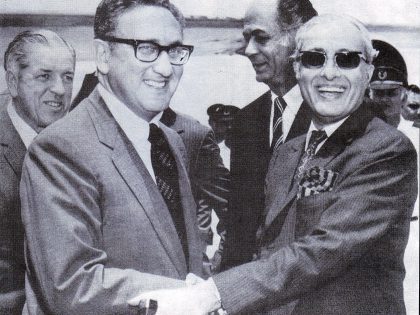
When war erupted in South Asia in 1971, Henry Kissinger called Indians “bastards,” and Richard Nixon said they needed “a mass famine.” For both men, US interests were worth killing hundreds of thousands of Bangladeshis and displacing millions more.

The UN is being urged to adopt a misleading, partisan redefinition of antisemitism that is intended to protect Israel from critical scrutiny. We should oppose this cynical attempt to silence advocacy on behalf of the Palestinians in the name of anti-racism.