The Donald Trump of Central America
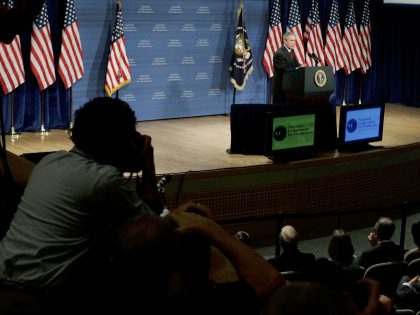
President Nayib Bukele is El Salvador’s Donald Trump. His hard-right bluster and media-centric populism threaten to deal a devastating blow to the country’s once-mighty left.

President Nayib Bukele is El Salvador’s Donald Trump. His hard-right bluster and media-centric populism threaten to deal a devastating blow to the country’s once-mighty left.

Tory Brexiteers’ talk of a “global Britain” is a mere fantasy of returning to the glory days of empire. But even left-wing Remainers are pushing the case to maintain British military supremacy — and using it as a stick to beat Jeremy Corbyn.

The US-backed coup in Honduras ten years ago spawned a maelstrom of violence that terrorized ordinary Hondurans and forced caravans of migrants to flee the country. It was just another instance of US imperialism wreaking havoc on the world.

Socialism is moving from the margins to the center of American politics. After the Democratic Socialists of America’s convention in Atlanta last weekend, DSA is better positioned than ever to lead the socialist charge.

Far-right forces will converge on Portland tomorrow, incited by the right-wing provocateur Andy Ngo. Though he poses as a journalist, the purpose of his platform is to sow harassment and violence against his targets on the Left — and the mainstream media have fallen for it.

With Central America in flames, Henry Kissinger’s challenge was to portray local revolutionary movements as foreign conspiracies more alien than the United States’ own violent interventions. Where democracy failed, capitalism flourished.

Spain's Socialist premier Pedro Sánchez has refused to grant top cabinet jobs to the radical left party Podemos. And as Spain faces another general election, Podemos faces a tough battle against division and marginalization.

Pundits analyzing the “populist threat” often assume an audience that wants to defend the status quo. Presenting all political “outsiders” as merely dangerous, anti-populist literature tells us more about the role of public intellectuals than the movements it is meant to describe.

Jean-Luc Mélenchon’s breakthrough in the 2017 presidential election brought France Insoumise to the heart of French public life. Yet today, as its base shrinks to a traditional far-left electorate, the movement’s very survival is in doubt.

The ongoing popular upheaval in Chile is the product of thirty years of neoliberal oligarchy and half-hearted democratization. To uproot the existing power structure, the country needs a new constitution.

Decades of free market fundamentalism are the root cause of the ongoing crisis in Chile. Addressing the staggering levels of inequality will require a break with neoliberal dogma — an inconceivable move for the country’s billionaire president.

In an exclusive interview, Ecuador’s former president Rafael Correa spoke to Jacobin about the coup against his ally Evo Morales in Bolivia and the mass resistance to his rightward moving successor Lenín Moreno in Ecuador.

The Bolivian military forced President Evo Morales to step down — the classic definition of a coup. Now, the country is caught in a spiral of horrors as the far-right regime of terror consolidates its rule.

The legendary nonviolence theorist Gene Sharp wasn’t just a lonely scholar studying how political change happens. He was a Cold War defense intellectual whose ideas left a profound imprint on the way America wields power in the world.

In Colombia, a mass movement has emerged to challenge the government’s neoliberal policies and failure to honor its historic peace agreement with the FARC. It offers the possibility of a just future for the country.

Argentina’s Mauricio Macri officially steps down as president today, having overseen four years of neoliberal mismanagement, inflation, and a new IMF bailout program. The election of the Peronist Alberto Fernández is good news for the Left, but it faces an uphill battle in stabilizing a deeply indebted economy.

It’s been a year since Andrés Manuel López Obrador took power in Mexico. Against the odds, his administration has won a host of important progressive victories. But it’ll need to do more to withstanding pressure from Washington and the more conservative parts of the MORENA coalition.

In November, the Bolivian military forced Evo Morales to step down: the classic definition of a coup. Despite the evidence, some commentators — even on the Left — have failed to identify it for what it was: an elite plot to oust a progressive president whose program of reforms had transformed the lives of many of the country’s most excluded people.

The PSOE-Podemos coalition promises to roll back recent attacks on labor rights and provide a negotiated solution to the Catalan crisis. But the new government’s moderate tone hasn’t placated the business and institutional establishment — and they’re already working to thwart its plans.

Peruvians vote today in crucial parliamentary elections. But the future of the country relies not just on fighting corruption, but taking on the powerful corporate interests that dominate the country.