Spain’s “Progressive Government” Is Already Under Siege
- Todd Chretien
The PSOE-Podemos coalition promises to roll back recent attacks on labor rights and provide a negotiated solution to the Catalan crisis. But the new government’s moderate tone hasn’t placated the business and institutional establishment — and they’re already working to thwart its plans.
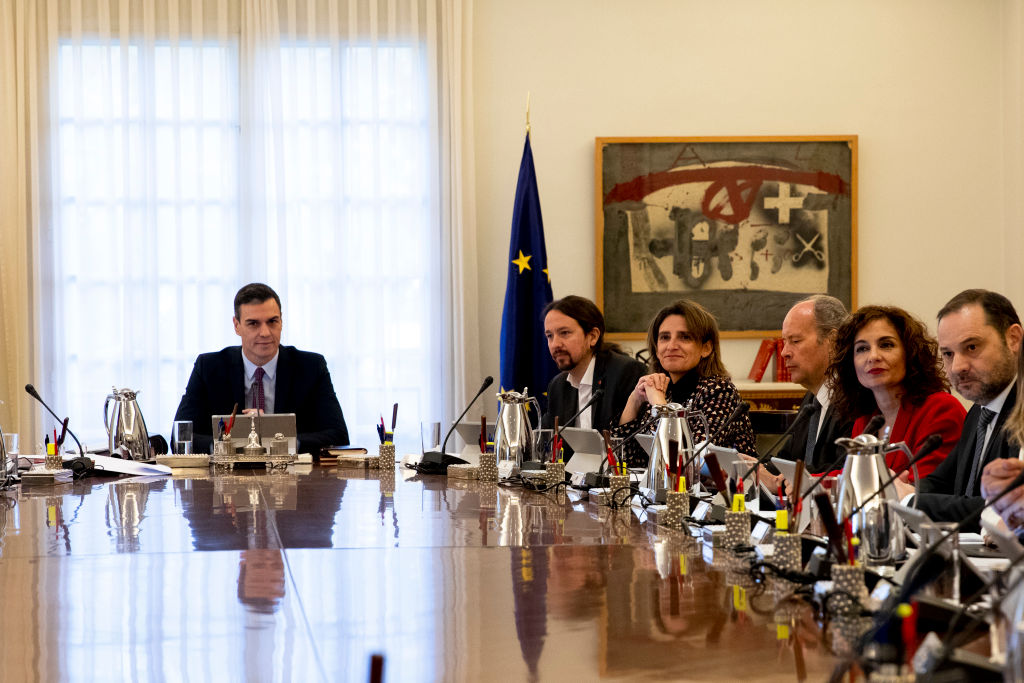
Spanish prime minister Pedro Sanchez (L), Spain’s Deputy Prime Minister for Social Rights and Spain’s 2030 Agenda Pablo Iglesias, and other ministers attend the first council meeting at Moncloa Palace on January 14, 2020 in Madrid, Spain.Pablo Blazquez Dominguez / Getty
Amid rising tensions in a fragmented parliament, last week the Socialist Party (PSOE) leader Pedro Sánchez won a tight vote of confidence to be confirmed as the Spanish prime minister. Governing together with Pablo Iglesias’s Unidas Podemos (UP), Sánchez is to lead the first coalition government in Spain’s post-Franco democracy, which has until now rotated between the two dominant parties.
In what is undoubtedly a historic moment, the new PSOE-UP government comes to power in the context of a crisis in the Spanish regime, unfolding along multiple fronts. On the socioeconomic front, the turn to austerity initiated by previous PSOE prime minister José Luis Rodríguez Zapatero in May 2010 has brought about one of the most unequal and precarious societies in the European Union. It also provoked the emergence, in May 2011, of the movement of mass occupations of public squares — predating even the Occupy movement in the United States.
There is also a crisis on the institutional front. The judiciary has acted as a “government of the judges,” there is a crisis of political representation, and more and more people are questioning the role of the monarchy. And on the national-territorial front, the Catalan movement has challenged the central government’s rule, while simultaneously shedding light on a depopulation crisis known as España vaciada (“empty Spain”).