The Meaning of Chile’s Explosion
The ongoing popular upheaval in Chile is the product of thirty years of neoliberal oligarchy and half-hearted democratization. To uproot the existing power structure, the country needs a new constitution.
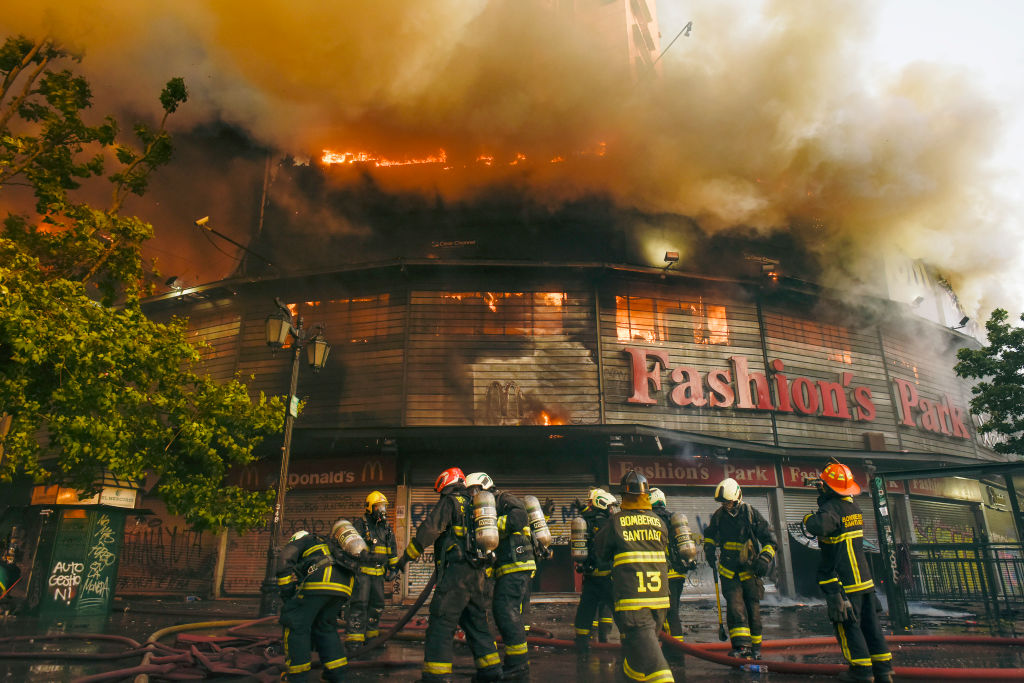
Firemen work to contain a building fire after massive protests against Sebastian Piñera’s policies at Palacio de La Moneda on October 28, 2019 in Santiago, Chile.Claudio Santana / Getty
Chile, Latin America’s “oasis” of stability, has been in flames for a week, fueled by an underlying current of socioeconomic oppression. The rapacity of the “Latin American tiger” that accomplished the neoliberal “miracle” of high economic growth from the ashes of socialism, has been revealed in street clashes in which protestors threatening the neoliberal order have become enemies of the state — stripped of their rights in a de facto, and therefore illegal, state of siege. The aggressive, zero-tolerance response of the police to peaceful civil disobedience, and the government’s resort to the use of the military to quell political dissent, is partly the result of three decades of denial vis-à-vis Chile’s growing oligarchization of power. The oppressive conditions facing the working class and the precarious position of an indebted middle class in a system in which all basic necessities have been privatized to make a profit, have been ignored, justified, and normalized during the last three decades of democratic governance in which left- and right-wing governments have alternated power.
Chile is neoliberalism’s ground zero, a testing ground for neoliberal economic policies as well as neoliberal forms of legality. The Constitution of 1980, which has been amended almost forty times and is still in place, was mostly designed by Jaime Guzmán, an ultraconservative jurist and member of the fundamentalist Catholic Opus Dei, with the intention of stabilizing and protecting the newly implemented neoliberal economic model — together with a patriarchal social framework — against popular pushback. Article 8 — repealed in 1989 just few months before the return to democracy — outlawed any doctrines based on “class struggle” or aimed at “attacking the family.” The brutal costs of the “neoliberal adjustment” came shortly after, and the population was forced to endure economic hardship and domination at gunpoint.
During the seventeen years of dictatorship under Pinochet, poverty increased from 20 percent to 44 percent while GDP was distributed more unequally: the share of wages in national income fell from more than half to one-third, while the share of corporate profits rose from 31.4 percent to 42.4 percent. The neoliberal model of accumulation by dispossession created massive wealth on the backs of the working classes and through the savage plundering of public property as well as the Earth. The legal scaffolding of the neoliberal state allowed the oligarchy to disproportionately appropriate this socially created wealth while shielding political elites from popular pressures through procedural arrangements aimed at insulating public officials from electoral accountability. Chile’s particular institutional arrangement has made for a rapid oligarchization of the economy in which oligopolies have given rise to collusion scandals, from the toilet paper industry to pharmacies, and a political system in which elected representatives receive the highest compensation packages in Latin America while consistently endorsing laws and policies favoring the wealthy and further entrenching monopolies, or neglecting to adopt measures to counteract oligarchic outcomes, passively letting the wealthy keep enriching themselves.