President Correa to Jacobin: “Clearly What Happened in Bolivia Was a Coup”
- Todd Chretien
In an exclusive interview, Ecuador’s former president Rafael Correa spoke to Jacobin about the coup against his ally Evo Morales in Bolivia and the mass resistance to his rightward moving successor Lenín Moreno in Ecuador.
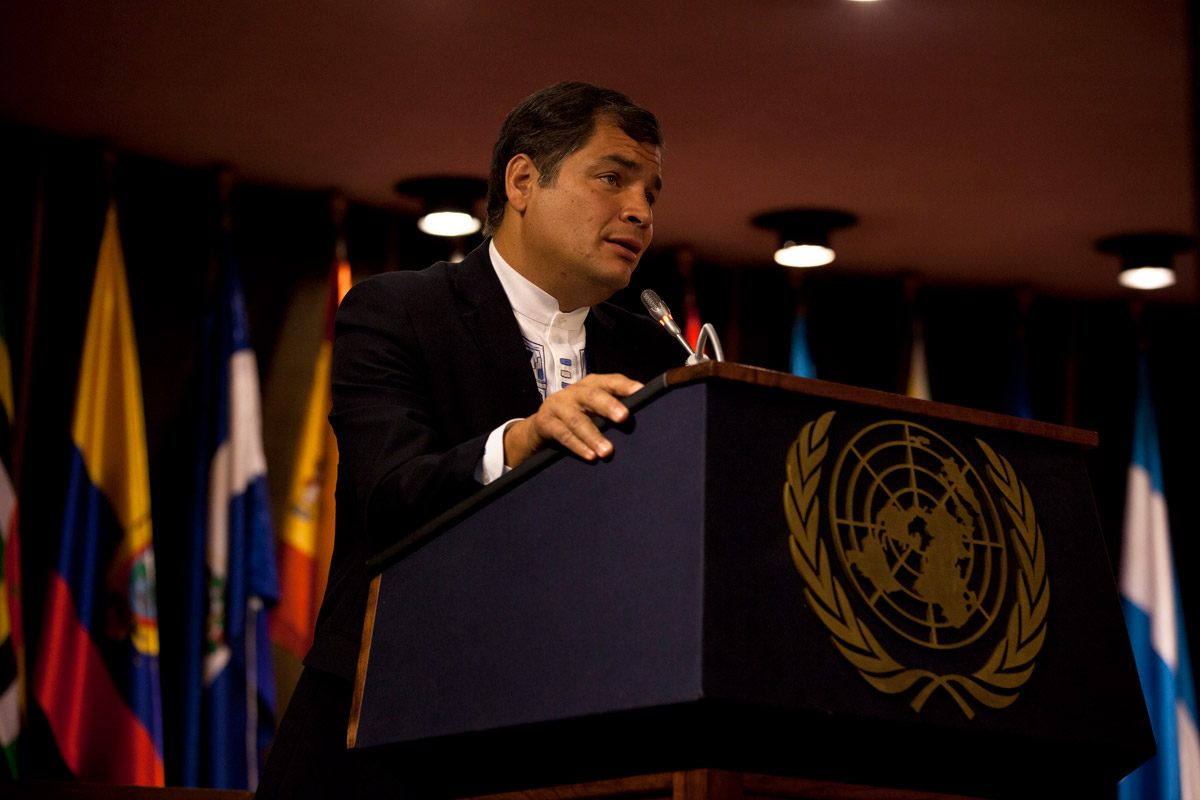
Former president of Ecuador, Rafael Correa, speaks at a conference on October 26, 2012. (Fernanda LeMarie / Flickr)
Rafael Correa, president of Ecuador from 2007 to 2017, ranks among the Pink Tide’s greatest leaders. Coming to power in a land ravaged by poverty and crippled by austerity and privatization programs, Correa oversaw a transformation of Ecuador. In his decade-long tenure, Ecuador’s minimum wage more than doubled, billions were invested in health care, and poverty was cut in half.
His story is not unlike that of the recently ousted Evo Morales. Morales was not just Bolivia’s first indigenous president, but its most successful. Since his first election in 2005, the lifelong trade unionist presided over the most consistently high economic growth in Latin America, while also slashing poverty and illiteracy. Yet this did not win him the support of all Bolivians. After three weeks of armed demonstrations fanning out from the country’s eastern provinces, last weekend the army high command told Morales to go.
The coup’s organizers hail from traditionally reactionary sections of Bolivian society: the key coup leader Luis Fernando Camacho, a businessman from the Santa Cruz province, arrived in La Paz last weekend promising to “bring God back into the presidential palace.” Like Brazil’s far-right president Jair Bolsonaro, Camacho combines Christian rhetoric with open racism toward indigenous people and intense anticommunism. Such themes are the cutting edge of a bid to criminalize the social movements and progressive leaders who have come to prominence in Latin America in recent years.