Bolivia Is Descending Into a Full-Blown Far-Right Military Dictatorship
The Bolivian military forced President Evo Morales to step down — the classic definition of a coup. Now, the country is caught in a spiral of horrors as the far-right regime of terror consolidates its rule.
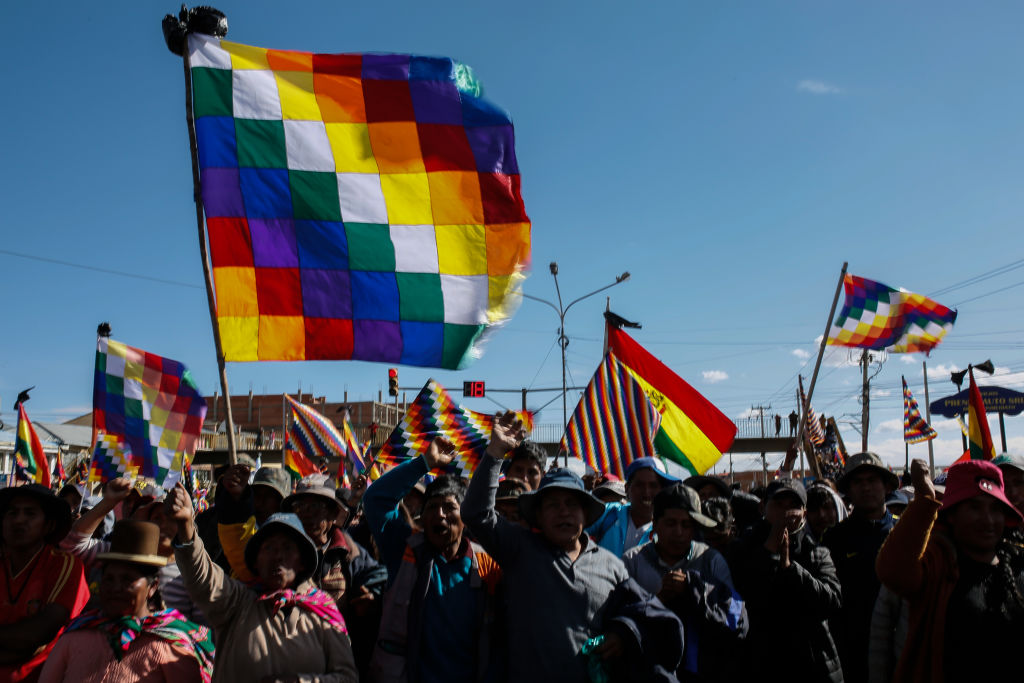
Supporters of former president Evo Morales block a road to a Yacimientos Petroliferos Fiscales Bolivianos (YPFB) oil refinery as part of a protest against Jeanine Áñez on November 17, 2019 in El Alto, La Paz, Bolivia. (Gaston Brito Miserocchi / Getty Images)
If there was any doubt before, the horrifying events of the past week in Bolivia should have laid those doubts to rest: it was a coup. But there should have been no doubt to begin with. While it is true that the events preceding Morales’s ouster were complex and multifaceted, there is no disputing that the military demanded Morales step down. The fact that the military head used the word “suggest” is irrelevant. When the military “suggests” a president step down, and he or she does immediately after, that is a coup. As Bernie Sanders said when asked about this issue, “At the end of the day, it was the military who intervened . . . and asked [Morales] to leave. When the military intervenes . . . that’s called a ‘coup.’”
Lead-Up to Morales’s Ouster
The most immediately relevant time period to understand events preceding Morales’s resignation is from 2016 to the present. Focusing on this period helps with understanding the virulent opposition Morales faced in the weeks before he was forced out. Urban middle classes initially led these protests, with far-right upper-class forces subsequently seizing control and directing them. This opposition focused on two charges. The first is that Morales should not have run in the 2019 election, because Bolivia’s constitution permits reelection only once, and because Morales — narrowly — lost a 2016 referendum on indefinite presidential election. It is worth pointing out — as NACLA did at the time — that the run-up to this referendum involved what Morales supporters felt to be a “dirty war” against him, with some justification. In the weeks before the referendum, conservative media played up a scandal involving a “love child” of Morales, with subsequent reporting suggesting the child died shortly after birth or never existed. It is likely that this campaign had some effect on the referendum result, which Morales lost by only a few percentage points.
A 2017 electoral court decision overturned the referendum result, which allowed Morales to run this year but also generated widespread dissent, particularly from urban middle classes. This combined with the second charge — that Morales stole the October 20 election — and resulted in large protests against Morales in the weeks after the election. The Organization of American States (OAS) led the charge of fraud. After weeks of questioning the official results that gave Morales a first-round victory, on November 10, the OAS issued a report stating that it could not certify the results of the vote as accurate. A report by the Center for Economic and Policy Research (CEPR) makes a convincing case that the OAS acted in a biased manner and failed to present evidence of actual fraud. This means that Evo Morales won the October 20 election in the first round. Irrespective of any valid criticisms one can make of MAS (Movement Toward Socialism) or Morales, this fact is crucial to remember.