Inside Venezuela’s Response to Donald Trump’s Attack
A former Venezuelan diplomat speaks to Jacobin about how the state, military, and popular forces are responding to US military aggression — and what comes next.

A former Venezuelan diplomat speaks to Jacobin about how the state, military, and popular forces are responding to US military aggression — and what comes next.

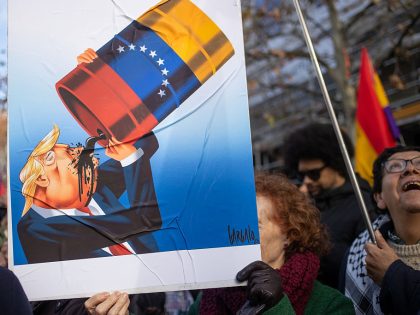
Venezuela is a "national security threat" only because it refuses to be controlled by the US.

The Venezuelan opposition has repeatedly failed to depose Nicolás Maduro. So now they’re launching a last-ditch effort to get Donald Trump to intervene — by tying Maduro to Iran and Hezbollah.

Unions and international labor federations argue that it’s the same billionaires that want to run Venezuela who keep us working longer hours for less pay, without health care, job security, or stable housing.

Venezuela’s colectivos are a myth created by the country’s elites to discredit the struggle for socialism and grassroots democracy.

When a road bridge in Genoa collapsed in August 2018, killing 43 people, reports soon exposed the negligence of its private managers. Today, the government is part-renationalizing the road maintenance firm in question — a tiny step away from neoliberalism that has sparked wild claims of a “Venezuela-style” attack on business.

The Bolivarian Revolution hasn't been perfect, but it's improved the lives of millions in the face of violent opposition.

Critical historians like William Appleman Williams played a key role in highlighting the US’s imperial record in Latin America. Now Donald Trump has cut out the middleman, bluntly stating the US’s imperialist agenda.

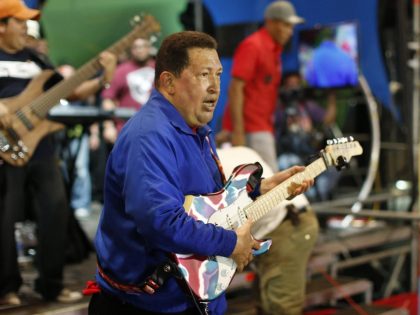
Recently obtained documents show that in 2011, the US funded rock bands in Venezuela — through a group sympathetic to right-wing forces that later attempted a coup. Giving money to young musicians seems innocuous, but it’s part of a long history of US meddling in the democratic processes of countries to advance American interests.

Twenty-one members of Congress last week called for lifting US sanctions on Cuba and Venezuela, including most of the Squad. The pushback is needed: sanctions are a cruel economic weapon that hurts average people — and has spurred a surge of economic refugees.

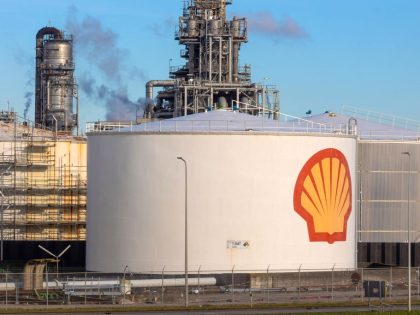
Venezuela’s heavy crude is expensive to extract, it will take years of sustained investment to meaningfully lift output, and it may not even be profitable at current prices. The current aggression is more about power than economics.

Western journalists can't admit that Venezuela's opposition is neither democratic nor peaceful.

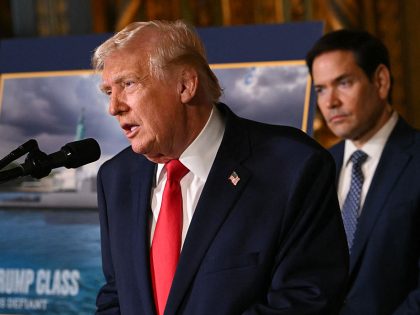
The seizure of two tankers carrying Venezuelan oil is a further escalation of Donald Trump’s war policy. While British prime minister Keir Starmer denied involvement in the earlier attack on Caracas, this time Britain actively joined the operation.

If the Biden administration wants to stop the mass displacement that is leading enormous numbers of Cuban and Venezuelan migrants to the US-Mexico border, it should end the sanctions that have made life in those countries all but impossible for average people.

Outrage over alleged Russian intervention in US elections has been widespread. But documents obtained by Jacobin reveal that the US has intervened in Venezuelan elections by training opposition forces to use Facebook against President Nicolás Maduro’s party.

US policy towards Venezuela is not motivated by a concern for democracy or human rights. And its arrogant intervention is making the country's humanitarian crisis even worse.

Only the Venezuelan sans culottes can save the Bolivarian Revolution.

The United States's sanctions against Venezuela continue to punish ordinary Venezuelans while deepening the country's political crisis. They need to end.

US intervention in Venezuela wouldn't just be a catastrophe for that country — it would be a disaster for neighboring Colombia too.

For Venezuela, the worst-case scenario of a US military intervention remains a potent threat. A long-time advisor to Hugo Chavez offers his thoughts on the country's crisis.