Venezuela and the Long Shadow of the Monroe Doctrine
Critical historians like William Appleman Williams played a key role in highlighting the US’s imperial record in Latin America. Now Donald Trump has cut out the middleman, bluntly stating the US’s imperialist agenda.
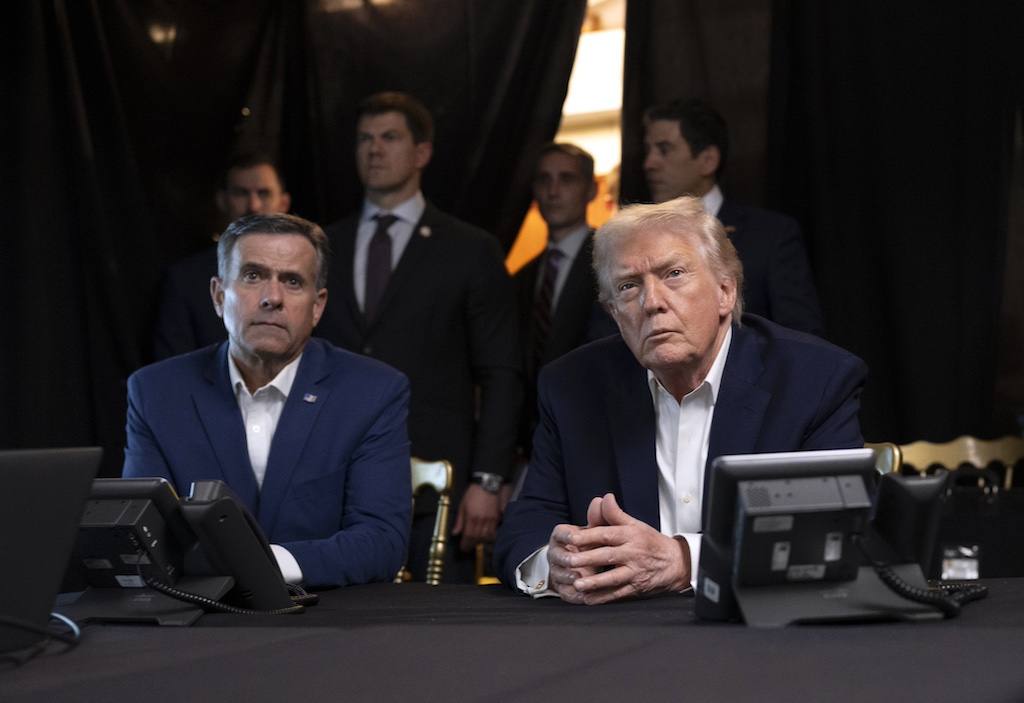
President Donald Trump’s statements about the attack on Venezuela fall short of the moralizing standard that the peoples south of the border have come to expect from the US. (Molly Riley / official White House photo via Getty Images)
On December 17, Donald Trump spoke to reporters with refreshing candor, for a US president, about the motives behind his bellicose policy in Venezuela. Referring to the ousting of US oil companies dating from 1976, he bluntly declared, “[We wanted] all of the oil, land, and other assets that they previously stole from us.” Venezuela’s resources had not belonged to its people at all but to the United States. Trump was now simply taking back what had rightfully belonged to us. This was the policy that fueled his bombing attacks across Venezuela — and this weekend’s kidnapping of President Nicolás Maduro.
As rationales for US foreign policy in Latin America go, President Trump’s statement about Venezuela fell well short of the moralizing standard that the peoples south of the border have come to expect from us. Washington’s goals in Latin America have usually come packaged in propaganda about our intentions to be a good neighbor or a partner in hemispheric prosperity. These traditional marketing strategies, however, generally have not produced the desired results on public opinion in Latin America. The problem all along with the US language of philanthropic uplift has been the Monroe Doctrine.
Hiram Bingham III, a pioneering professor of Latin American history at Yale University credited with drawing international attention to the Incan city of Machu Picchu, succinctly explained our Monroe Doctrine problem. His illuminating article, “The Monroe Doctrine: An Obsolete Shibboleth,” appeared in the June 1913 issue of the Atlantic Monthly.
He described this document as the country’s most universally accepted foreign policy — and conceded that it was conceived with at least some good intentions in 1823 by US leaders seeking to protect the hemisphere from the further encroachments of European imperialism. And yet even then, people in Latin America saw the document as “a display of insolence and conceit on our part.”
Two turning points irreversibly blackened the reputation of the Monroe Doctrine in Latin America: the Mexican War of 1846–48 — when, in a spirit of ever-resurgent manifest destiny, we helped ourselves uninvited to California and the American Southwest — and the Spanish-American War of 1898 — which involved more land-grabbing on an epic scale in the Caribbean and Pacific. Bingham had been living in Buenos Aires at the time of the Spanish-American War. He remembered the caustic criticism by the people there of America’s professed motives in going to war with Spain. They ridiculed President William McKinley’s declarations about freedom for Cuba, Puerto Rico, Guam, and the Philippines as hypocritical nonsense — and a pretext for conquest.
Imperial Prerogative
Bingham observed that over the next fifteen years, the United States claimed the right to interfere with the independence of many Latin American countries. With the Roosevelt Corollary to the Monroe Doctrine in 1904, arising from developments over a financial crisis in Venezuela the previous year, the United States conferred upon itself the right to intervene in Latin America if countries could not pay their international debts. To prevent European intervention, Washington thus became the enforcer for the capitalist system in Latin America.
At the time, Bingham warned that along such a path lay dangers that would involve the United States in endless wars and occupations. It would be better to abandon the Monroe Doctrine entirely and to stop thinking of ourselves as a bullying preceptor for our neighbors: “Is there not a tendency in our country to believe so far in our own rectitude that we may be excused from any restrictions . . . ?”
The poet William Carlos Williams filled in the deep historical background of the Monroe Doctrine and put it in a wider historical context. Family ties to Latin America attracted him to Hispanic themes, which, in In the American Grain (1925), come to the fore. The essay “The Destruction of Tenochtitlan” depicts the conquest of Mexico by the sixteenth-century Spanish imperialist Hernán Cortés. It was an annihilation: “The whole world of its unique associations sank back into the ground to be rekindled, never.” Cortés is said to have gone to mass every day before ordering the slaughters and pillaging that ended in slavery for survivors. Williams thought that the fate of all Latin America had been bound up with the demise of the Aztecs in Mexico. As seen in the book’s essay on Juan Ponce de León, the modern history of native peoples in the New World began “with murder and enslavement, not with discovery.”
Major General Smedley Darlington Butler, another American writing in the interwar period, magnified the fine print in the Monroe Doctrine. In sensational magazine articles and in his book War Is a Racket (1935), he depicted scenes from his long career as a Marine Corps officer. His orders had taken him to Mexico, Haiti, Nicaragua, the Dominican Republic, and other exotic ports of call furthering the interests of the oil companies, the sugar monopolies, and the banks.
He had spent most of his time in the military as “a high-class muscle-man for Big Business, for Wall Street, and the bankers. In short, [he] was a racketeer, a gangster for capitalism.” Butler could give a few tips to Al Capone: “The best he could do was to operate his racket in three city districts. We Marines operated on three continents.” All of their operations came under the official heading of national “defense,” which meant, “of course, vast schemes for foreign invasion and offensive war.” War Department propaganda constituted the mainstream US news about Latin America.
Updating such critiques as those of Williams and Butler, The Open Veins of Latin America (1971) by Eduardo Galeano illustrated how native cultures first became acquainted with European Christianity. Latin America — the Uruguayan journalist, novelist, and historian wrote — “has specialized in losing ever since those remote times when Renaissance Europeans ventured across the ocean and buried their teeth in the throats of the Indian civilizations.”
Spain’s conquest of the New World began an imperialist process that other Western countries would perpetuate. Rightly understood, the Monroe Doctrine had taken its place in the context of previous manifestoes of empire, early on in the form of papal bulls distributing newly discovered native lands to European Christian princes.
In the contemporary form of Latin American imperialism, Galeano contended, the United States exercised hegemonic control through the mechanisms devised at the 1944 Bretton Woods international financial conference. He described modern Latin American history as a further development “in a long story of infamies,” albeit with upbeat language about democracy and human rights unique to US statecraft. To him, the International Monetary Fund and the World Bank functioned as essential institutions in the current structure of plunder integrated around US corporations. The Monroe Doctrine was, in this view, the preamble for present-day crimes in Latin America.
When Venezuelan president Hugo Chávez met Barack Obama in 2009, he presented Galeano’s book to the then–US president, encouraging him to read it as the best way to understand the basic realities of the region. At the left-wing World Social Forum in Caracas three years earlier, he had given a speech anchored in Galeano’s ideas about US empire and its leaders since the time of the Monroe Doctrine.
Chávez denounced President George W. Bush as “Mr Danger” and averred, “This is a cynical empire. At least the Roman Empire admitted that it was an empire, but Mr Danger’s empire talks about democracy and human rights.” Such talk, he contended, distracted attention from US foreign policy’s true imperialist aims in Latin America.
The Trump administration has not talked much about democracy and human rights in Venezuela. It has confronted that country primarily with overwhelming force and firepower, from blowing small Venezuelan boats out of the water and murdering the people on board to invading the country and toppling Maduro.
We now have the Trump Corollary to the Monroe Doctrine, as described this past November in the “National Security Strategy of the United States.” This means a commitment to “no competing powers physically dominant in our Hemisphere, borders at no risk of military invasion.” The United States would work with regional champions “broadly aligned with our principles and strategy.” Now under the auspices of the Trump Corollary, we must anticipate further attempts to cleanse Latin America of governments deemed by Washington to be lacking in US-championing potential.
Cut Out the Middleman
In the hours following Saturday’s attack on Venezuela, Trump declared that the United States would now be running the country and its oil industry. He dispensed with the standard euphemisms for operations involving the defense or augmentation of US capitalism in Latin America. In so doing, he has robbed US historians of what should be one of their chief functions in analyzing our foreign policy: peering behind the verbal draperies decked out by Washington as camouflage for the economic forces at work.
In the second half of the twentieth century, William Appleman Williams held forth as the leading US historian for such intellectual sleuthing. In his most famous books — The Tragedy of American Diplomacy (1959), The Contours of American History (1961), and Empire as a Way of Life (1980) — Williams argued that our foreign policy concerned fundamentally the perpetuation of the “American present,” which he described as the regime of the banks, financial houses, and corporations. Washington sought to undermine any alternative to the US-dominated status quo — that is, its control of the rules-based order initiated at Bretton Woods — through CIA-engineered regime-change operations or, as in the 1961 Bay of Pigs attack in Cuba, outright military invasion. Williams thought that all US wars since 1945 were nothing but displays of power projection, for the enhancement of the oligarchy that ruled the country.
In The Contours of American History, Williams linked current US policies in Latin America to the Monroe Doctrine, which he described “clearly as the manifesto of the American empire.” American leaders had conceived the doctrine as an “expansionist statement of American supremacy in the hemisphere.” Through the United States’ comparative economic advantages, we would be controlling the newly emerging nations of Latin America. Writing about the Cuban missile crisis of 1962, Williams cited the Monroe Doctrine as the primordial expression of Washington’s intentions to rule Latin America and the point of origin for this “horrible, monstrous conflict.”
Williams was a self-described Marxist, but no book influenced him more in his thinking about history-writing than In the American Grain. He discovered it early in his career and became a lifelong missionary for its special insights. In his book, the radical but non-Marxist poet William Carlos Williams (no relation) had included essays about South and North America. In the essay “The Virtue of History: Aaron Burr,” he explained why virtuous historical writing seldom appeared in the United States: “But how small is the sum of good writing against the mass of poisonous stuff that finds its way into the history books; for the dead can be stifled like the living.”
With the United States’ regime-change operations against the Maduro government, Trump has cut out the middlemen, directly offering the insights once provided by critical historians. We will not have to buy any expensive scholarly books to get at the heart of the matter in Venezuela. It’s about the oil, as an on-site application of America’s declared aim in the “National Security Strategy of the United States” to bring the Monroe Doctrine to full fruition by running the region to our own satisfaction. Perhaps Chávez would have been impressed by the Roman-style frankness with which Trump stated his commitment to the satrapy-subjugation business.