Inside Venezuela’s Response to Donald Trump’s Attack

Carlos Ron

A former Venezuelan diplomat speaks to Jacobin about how the state, military, and popular forces are responding to US military aggression — and what comes next.
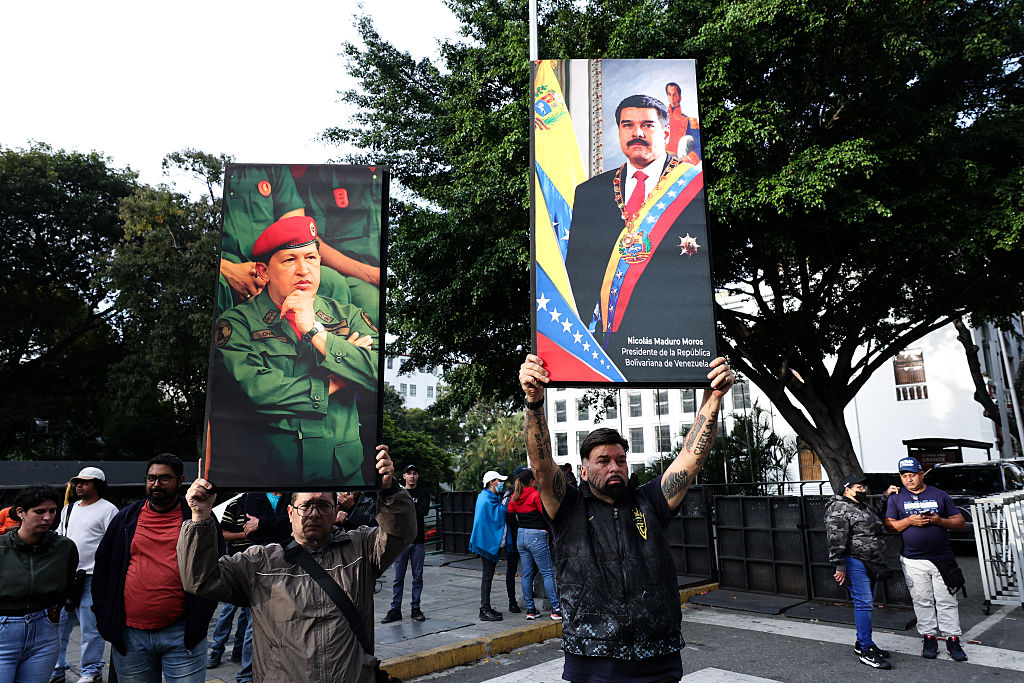
Supporters of Nicolás Maduro and the late Hugo Chávez hold posters with their images after explosions and low-flying aircraft were heard on January 3, 2026, in Caracas, Venezuela. (Jesus Vargas / Getty Images)

Interview by
Bhaskar Sunkara

Yesterday the United States carried out a direct military attack on Venezuela, abducting President Nicolás Maduro and conducting strikes around Caracas — a grave violation of international law that risks plunging the region into wider conflict.

To understand how Venezuelan officials and supporters of the Bolivarian project are interpreting these events — and what they believe comes next — Jacobin founding editor Bhaskar Sunkara spoke last night with Carlos Ron, a former Venezuelan diplomat who served as one of the government’s principal interlocutors with the United States during years of sanctions and diplomatic confrontation.


Bhaskar Sunkara

Carlos, can you introduce yourself to readers?

Carlos Ron

Today I’m an independent geopolitical researcher and analyst, but previously I served in the Venezuelan foreign service. I represented Venezuela in Brazil and in the United States, and I served from May 2018 to January 2025 as vice minister of foreign affairs to North America.

Bhaskar Sunkara

Prior to that, you spent significant time living and studying in the United States. How did you come to identify and become involved with the Bolivarian Revolution under Hugo Chávez, and what did it represent to you?

Carlos Ron

Migrant life in the United States helps you build class consciousness, understand inequality, and aspire to social justice. The United States has a rich story of social struggles and processes that can be very inspiring and shape progressive political ideology. The Bolivarian Revolution erupted as I was studying these political ideas, so it felt very logical that a project that called for the drafting of a new constitution and the radicalization of democracy was a call for me to be part of it and join the collective efforts to transform society.

My grandfather stood up against the US-backed fascist dictatorship of Marcos Pérez Jiménez. Chávez’s call resonated with my own personal history, and it also resonated with the radical US tradition — the ideas of Martin Luther King Jr and Malcolm X, and the idea that the suffering of the poor must be overcome, whether in Appalachia, the South Bronx, or Venezuela’s Barlovento.

Bhaskar Sunkara

What can you confirm about the current status of Venezuela’s executive authority, and how are decisions being made in the midst of imperialist military pressure?

Carlos Ron

On the evening of January 3, 2026, the Constitutional Court of Venezuela’s Supreme Tribunal found that in light of the abduction of President Nicolás Maduro by US military forces, Vice President Delcy Rodríguez must be sworn in temporarily as president in order to guarantee administrative continuity and the defense of the nation. All members of the cabinet, all commanders of the Armed Forces, and all state government leadership remains in place. Venezuela has a constitutional president, Nicolás Maduro, who has been abducted, but no regime change has taken place.

Bhaskar Sunkara

What is functioning normally right now inside Venezuela, and what has clearly been disrupted — communications, energy, transport, or governance?

Carlos Ron

Most of the country is functioning normally — communications are still up, and public, private, and community media are functioning normally. In zones impacted by the attacks, there have been reports of energy outages. Airports in La Carlota and Charallave suffered attacks. Commercial flights in the country’s main airports are set to resume. I would say that, the presidential abduction aside, governance remains mostly in place and unaffected.

Bhaskar Sunkara

How is the Venezuelan military positioned politically at this moment?

Carlos Ron

As expressed by the minister of defense during the night of the attack, the Venezuelan Armed Forces have mobilized in defense of the nation, in opposition to the US military aggression and the president’s abduction. The military has shown remarkable unity and cohesion in the face of external aggression. The nation is generally in a state of calm and normalcy.

Bhaskar Sunkara

Critics say that the Bolivarian project rests more on coercion today than popular sovereignty. What can you point to to show real support for the government?

Carlos Ron

This narrative has been promoted by those who have not been able to obtain popular support for their neoliberal and conservative political project over the years. This is due to the huge impact the Bolivarian Revolution had in overcoming poverty, political exclusion, and disenfranchisement. If we could make a comparison, the Bolivarian project for the Venezuelan excluded masses had the same impact that the New Deal and the civil rights movement had on the US disenfranchised population in the twentieth century.

The extremist opposition has often tried to hide its political failures with accusations of coercion, but in reality, the Bolivarian process continues to be widely popular among the majority sectors because of its direct and participatory characteristics. People feel they have a direct space to express their will, prioritize public policies that affect them, and impact decision-making. [Meanwhile] the opposition has repeatedly shown its lack of mobilization capabilities. It is very telling that, at a moment when the president has been abducted, they still have no strength to convene any significant mobilization. Rather, the streets of Venezuela today were filled with government supporters and people rejecting foreign intervention.

Bhaskar Sunkara

How do you respond to those, including Venezuelans, who oppose US intervention but are also critical of the government’s democratic record and economic management?

Carlos Ron

I applaud their patriotism for opposing US interventionism. No one can love their country and ask for a foreign intervention; it’s a fundamental contradiction. Other differences we may have on economic policy or on other political issues must be solved peacefully and internally among Venezuelans, not by foreign actors.

Bhaskar Sunkara

Let’s talk about the economic situation in the country. Is it improving despite US pressure? And in the long sweep of the past decade plus, do you entirely attribute it to the prolonged period of sanctions and economic siege, or do you think there were real economic mistakes also made by the government?

Carlos Ron

Venezuela’s greatest economic problem has been US sanctions since 2015, particularly those pertaining to the oil industry. At one point, the amount of losses faced by the industry was huge: income in 2020 was 90 percent lower that it had been in 2014, for example. However, President Maduro’s government had put in place recovery measures that by the end of 2025 showed an economic growth of 9 percent, according to the United Nations Economic Commission for Latin America and the Caribbean (ECLAC). This means that the Venezuelan economy has registered growth during the past twenty consecutive quarters.

Venezuela achieved this by creating fourteen productive engines or sectors, which have developed quickly out of necessity because of the sanctions regime. Food production, for example, which historically was highly dependent on imports, has expanded to the point that Venezuela now produces over 80 percent of its food needs. 

Bhaskar Sunkara

Where did the Bolivarian process succeed in building durable popular power — and where has it fallen short?

Carlos Ron

I think the communes, with their direct democratic participation in specific territorial spaces, has been the greatest and most durable success of the revolution. This, I believe, is the greatest achievement. However, not all of the national territory has had the conditions to develop communal processes equally. Geographical, cultural, and productive conditions have made it difficult to build successful communal projects in certain parts of the country. I think those conditions can still be built; however, it is a matter of time for them to develop.

Bhaskar Sunkara

If this crisis forces a renewal of the project rather than its defeat, what could be the sources of renewal within Venezuela?

Carlos Ron

I think this crisis will help show the necessity to deepen the communal process and to guarantee that we are, as a nation, capable of defending ourselves against foreign aggression and against foreign dependence. I think that the communal process was steadily succeeding in overcoming bureaucratism and in guaranteeing its interconnectivity. This would surely gain a new boost as a result of this crisis. The more consolidated the communal process is, the better we can guarantee its irreversibility.

Bhaskar Sunkara

Looking across Latin America, do you see this attack as a signal that US tolerance for left sovereignty in the region has ended? What are the consequences for social democratic governments in Brazil as well as the Cuban Revolution?

Carlos Ron

I see a project of the United States reasserting dominance over what it has historically considered its sphere of influence. MAGA’s Project 2025 considered “re-hemisphering” as a necessity to guarantee US supply chains and economic dominance. The recently released National Security Strategy also considered a rebranding of the Monroe Doctrine to guarantee US control over the region’s strategic resources. Under this scenario, it seems Washington will attempt to crush independent projects not aligned with its purposes. We have seen interventionism in elections such as the ones in Argentina or Honduras. We have seen threats and coercion even against nonradical, progressive projects such as in Colombia, Brazil, or Mexico. More revolutionary projects like Venezuela and Cuba are direct targets of aggression.

Bhaskar Sunkara

What are the mechanisms of regional coordination between Latin American left parties, unions, and social movements?

Carlos Ron

I think social and popular organizations in the region need to have a wide conversation about what a minimum collective agenda looks like. In Venezuela, there was an initiative called the World Social Alternative in 2023 and 2024, which was an attempt to build such an agenda. There have been others. Part of this conversation needs to overcome sectarian divisions and must include practical solutions to everyday problems for our peoples; it must stand in solidarity and defense of the transformative and revolutionary projects in Cuba, Nicaragua, and Venezuela; and it must build the foundations for a common cultural identity on the Left.

Bhaskar Sunkara

What should antiwar forces in the United States be doing right now?

Carlos Ron

I think the US antiwar movement has done much to denounce aggression against Venezuela. Perhaps the movement needs to improve the building of bridges across political organizations and improve its show of strength.

Bhaskar Sunkara

Five years from now, what would renewal look like for the Bolivarian Revolution — and what would defeat look like?

Carlos Ron

In five years, renewal would be stronger communes, a better interaction between popular organizations and state institutions, and a more sovereign and independent country. Defeat would be returning to neoliberalism and US influence.

Bhaskar Sunkara

At a time like this, what keeps you politically committed, and even hopeful?

Carlos Ron

I am hopeful this moment will drive the Latin American left into greater cohesion and articulation. It is not an easy moment — many on the Left are frustrated with the rise of the extreme right, but I trust necessity will be a strong driving force.

I think revolutionaries must exercise political coherence. If you fight injustice when the conditions are easy, you must also be ready to fight it when they’re extremely hard.

I am a believer in diplomacy; I think that speaking with frankness and respect can achieve unimaginable success, and that’s why I will always opt for diplomacy before any type of confrontation. I am committed to the revolution because I know that a better world is possible. I have seen it happen in Chávez’s Venezuela, and I saw it come under attack after Maduro was elected.

Socialism is not utopia for me; it was something real — difficult to build, but real. I have been living under the struggle to build socialism, and I want to see it succeed. The greatest threat in the world to that socialist horizon is US imperialism, particularly now in a more desperate and dangerous phase. The only possibility that we can save the planet and build social justice is to defeat empire.