
We Can’t Fight the Climate Crisis Without Fighting the Military-Industrial Complex
If we’re serious about stopping impending climate disaster, we have no choice but to radically rein in one of the world’s worst polluters: the US military.
If we’re serious about stopping impending climate disaster, we have no choice but to radically rein in one of the world’s worst polluters: the US military.

Argentina’s public health response to COVID-19 was far better than Jair Bolsonaro’s disastrous mismanagement in Brazil. Yet as the two countries seek to rebuild, both are enfeebled by their subordinate place in the global financial system, a subordination that is threatening to turn today’s shock into a protracted crisis.

Central to the justification for the “war on terror” by right-wing and liberal administrations was the simple idea that the United States has the right to impose its will on the rest of the world. The results, unsurprisingly, were disastrous.

Canada’s leading right-wing news organization has launched a bizarre series that celebrates capitalism. The articles, a collection of misunderstandings and clichés, are proof that our economic system’s defenders are completely out of ideas.

Moscow’s invasion of Ukraine has prompted a fierce debate over realism as an approach to thinking about foreign policy. Historian Daniel Bessner tells Jacobin what socialists can learn from realism and what they should reject.

In the 1930s and ’40s, Langston Hughes wrote poetic tributes to the working class and socialist leaders worldwide. Some critics allege he abandoned his principles later in life, but they ignore the role of McCarthyist oppression — and Hughes’s creative resistance to it.
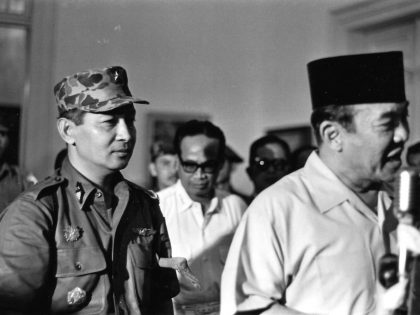
The US-backed Indonesian dictator Suharto was responsible for some of the twentieth century’s worst crimes. More than two decades after Suharto’s death, his regime’s brutal legacy is still holding back democracy in Indonesia.

The Japanese Communist Party turns 100 today. Its activists challenged the authoritarian emperor system of prewar Japan, and it remains an important countervailing force in a deeply conservative and conformist political culture.

Last week, Intel’s CEO said that the semiconductor industry needs a $52 billion subsidy package to invest resources in the US. But there’s nothing in the subsidy bill that would guarantee benefits to American workers rather than Intel shareholders.

Throughout the Cold War, Moscow-backed bodies like the Afro-Asian Writers' Association and the Tashkent Film Festival brought writers and filmmakers from across the Third World to the USSR. Their exchanges with their Eastern Bloc counterparts reflected the ambitions and limits of Soviet internationalism.

After weeks on the sidelines, Bernie Sanders and other progressives are taking a forceful stand on the Ukraine crisis. They’re navigating a dangerous climate created by mainstream media — including liberal outlet MSNBC — that casts antiwar opinion as disloyalty.

The global oversupply of oil and gas before the pandemic, plus the massive slump in demand as a result of lockdown, has put the profitability of the sector in extreme crisis. The case for nationalizing energy production has never been stronger.

The Pentagon claims it’s serious about reducing American military emissions, which eclipse those of some developed nations. But the US military has helped perpetuate the climate crisis and continues to obscure its contribution to climate change.

During the Vietnam War, the city of Vinh was almost destroyed by US bombing. Socialists around the world helped rebuild it. Today, Vinh's architecture stands as a monument to that internationalist solidarity.

The past few years have seen widespread speculation about the death of neoliberalism and a restoration of the state to a larger role in society. But the evidence isn’t there. Instead, market-based approaches are redefining themselves for a new era.

Our current model of pharmaceutical research is based on patent monopolies designed to enrich drug company executives and shareholders. But there's a better way to develop new drugs and vaccines, based on public funding and open-source research.

Iraq War veteran Mike Prysner on what the military-industrial complex gained by staying in Afghanistan so long, what’s next for US empire, and why antiwar sentiment is rising among active-duty soldiers.

Czechs’ expressions of support for Ukraine have drawn on their country’s own history of foreign occupation. Yet their political response also marks a shift in the country, as a once pro-Putin president slams Moscow and a right-wing premier welcomes refugees.

US officials suggested that Israel would have to shift to a “lower-intensity” campaign in Gaza from the new year. But Joe Biden is still unwilling to apply any serious pressure, even if his support for Israel’s war threatens to hand victory to Donald Trump.
“National Conservatism: A Statement of Principles” contains ten guiding ideals for the New Right.