Indonesia Still Hasn’t Escaped Suharto’s Genocidal Legacy
The US-backed Indonesian dictator Suharto was responsible for some of the twentieth century’s worst crimes. More than two decades after Suharto’s death, his regime’s brutal legacy is still holding back democracy in Indonesia.
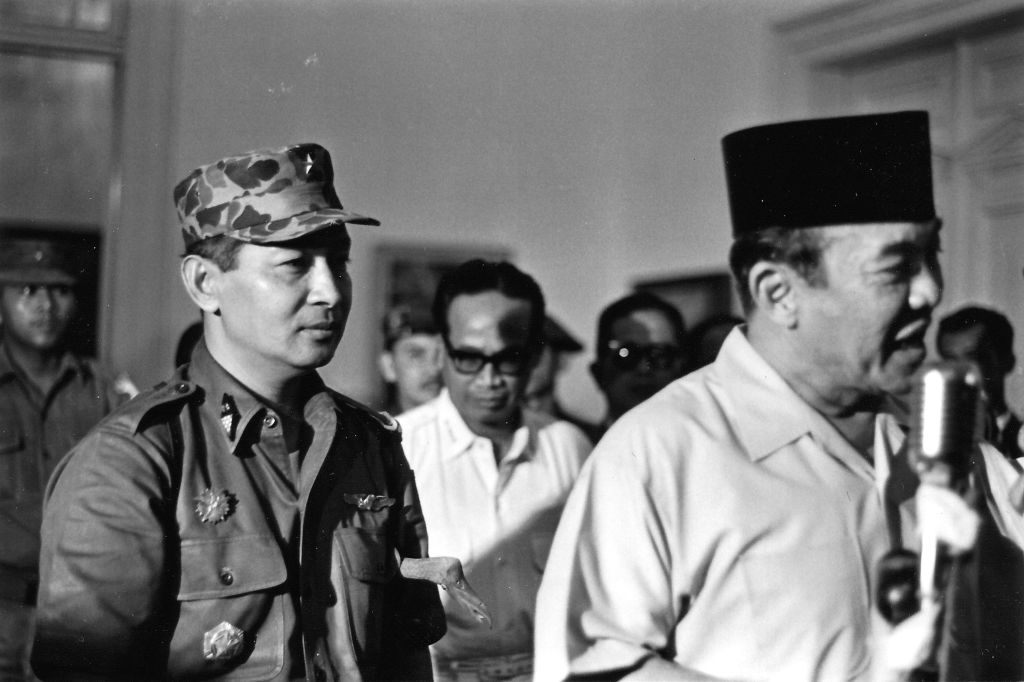
Indonesia’s then president Sukarno (pictured right) walks with Suharto (left) on March 11, 1966. Suharto seized power from Sukarno in a military coup before launching a mass murder of suspected Communists. (Beryl Bernay / Getty Images)
Ghosts and Gramsci can help us understand contemporary Indonesian politics. Like many of its Southeast Asian neighbors, the archipelago nation-state has a robust culture of the supernatural. There is even a provincial capital, Pontianak, named after the fierce ghosts of women who died during childbirth and seek gruesome revenge on young men.
The specter of General Suharto’s dictatorial New Order (1966–98) continues to haunt the nation. Indeed, we could take the Pontianak to represent Indonesia since the restoration of democracy. Like this angry ghost, the New Order died before it could deliver the next generation, and it continues to seek revenge from beyond the grave.
Likewise, contemporary Indonesia resonates with Antonio Gramsci’s famous concept of the interregnum: “The crisis consists precisely in the fact that the old is dying and the new cannot be born; in this interregnum a great variety of morbid symptoms appear.” The era of Reformasi from 1998 to the present, over two decades of tense elections and stifled reforms, is proving to be one of prolonged crisis, characterized by spectral visitations from the dead who either refuse to let go or seek revenge.