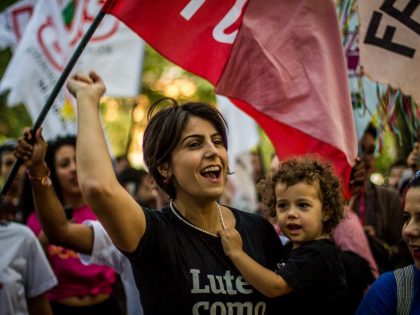
“Brazilian Inequality Is Female”
Brazilian vice-presidential candidate Manuela D'Ávila on misogyny in politics, the ruling class's motivations for keeping Lula jailed, and what's driving the far right's resurgence.
Brazilian vice-presidential candidate Manuela D'Ávila on misogyny in politics, the ruling class's motivations for keeping Lula jailed, and what's driving the far right's resurgence.

Today no one on either side of the political spectrum would present themselves as an enemy of choice. The historian and author of The Age of Choice, Sophia Rosenfeld, spoke to Jacobin about the complex legacy of an idea that helped forge the modern world.

Ken Livingstone’s legacy in London reminds us just how much democratic socialist leadership can do for a single city.

Mexican president Andrés Manuel López Obrador was elected on a platform of ending corruption and fighting inequality. But he hasn’t made ending the rampant violence against women in Mexico enough of a priority since taking office.
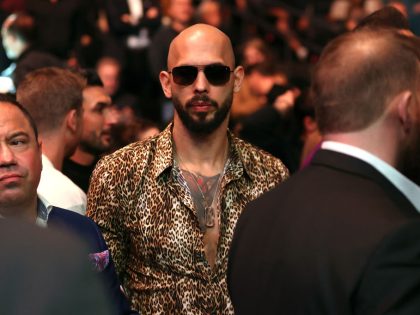
Male self-esteem is indexed to wealth, an unstable prospect in a highly economically unequal society. In search of an alternative source of validation, many young men are turning to misogynistic ideas. The Left needs to provide alternatives of our own.
Theresa May as prime minister, like Thatcher before her, represents a woman given equal opportunity to oppress other women.

Mexican president Andrés Manuel López Obrador has achieved more than just policy victories during his five years in office. He has reshaped the national political field and established a new cycle of left-wing governance.

From being less likely to graduate from college to experiencing much higher rates of “deaths of despair,” men and boys in the US — especially working-class men and boys — are suffering.

As Israel launches a brutal assault on Gaza with US aid, it’s important for Americans to stand in solidarity with the Palestinians — and to avoid lazy thinking that treats them as a single collective entity thinking and acting in lockstep.

The new corporate thriller Fair Play depicts an intra-office relationship gone sour — but asks audiences to relate to the relationship struggles of the 0.1%.

Netflix’s resident horror auteur is back with his take on Edgar Allen Poe’s The Fall of the House of Usher. You’ll have a good time — even if some of the nods to “sociopolitical relevance” might send your eyes rolling.
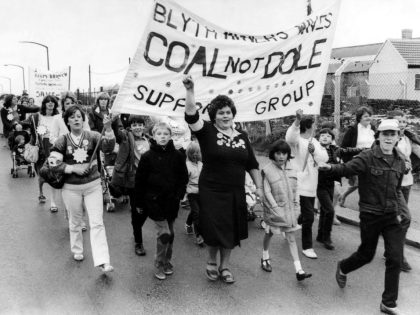
When Britain’s miners went on strike from 1984 to 1985, women joined the picket lines in unprecedented numbers. These women refused to be intimidated by the police or stay at home, and they left a lasting mark on the British labor movement.

Theatrical in their performances and Marxist in their politics, Floh de Cologne were one of the most remarkable bands to come out of West Germany’s Krautrock scene. The band tells Jacobin about their time as Europe’s only communist prog-rockers.

It’s not just that Australia’s mental health care system is underfunded. Austerity has bolstered reliance on quick, cost-cutting treatments like medication and cognitive behavioral therapy at the expense of long-term, socially oriented approaches.
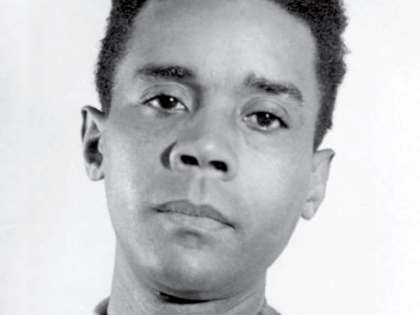
C. L. R. James spent his life crossing the boundary lines of race and class, from the colonial Caribbean to Britain and the United States. The world is finally starting to catch up with his pioneering works of Marxist history.

France’s Greens are splitting from the left-wing alliance and will run separately in the European elections. The party's campaign launch centered on esotericism, personal development, and dance therapy — showing how little it has to say to working people.

In Who’s Afraid of Gender?, Judith Butler seeks to explain the global right’s obsession with gender. Their latest book, however, fails to see that the aim of conservative scapegoating is to legitimize an unpopular political program.
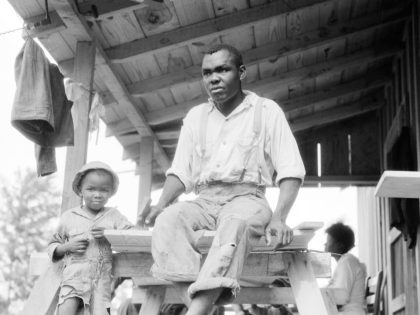
In 1930s Alabama, Communist Party members fought brutal repression to organize black and white workers in the Jim Crow South. Their efforts remain a source of inspiration for those fighting racism and exploitation today.
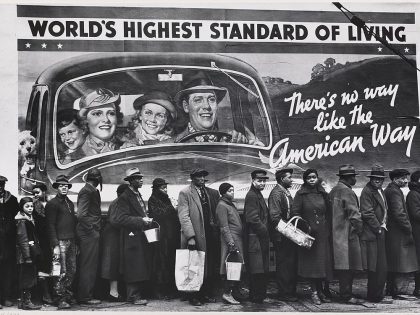
The New York Times’ David Leonhardt has written a compelling overview of the improbable rise and spectacular fall of the New Deal order. But he understates the difficulty in reviving a form of American social democracy.

South Korea’s legislative election was a blow to conservative president Yoon Suk-yeol, whose party was routed by its liberal opponents. But the vote also weakened the left forces seeking to challenge the dominance of two pro-business parties.