How France’s Intellectuals Became Reactionaries
France has always had right-wing thinkers — but they are more prominent now than any time since World War II. A decades-long counterrevolution against the Left has led to reactionary provocateurs reshaping French intellectual life.
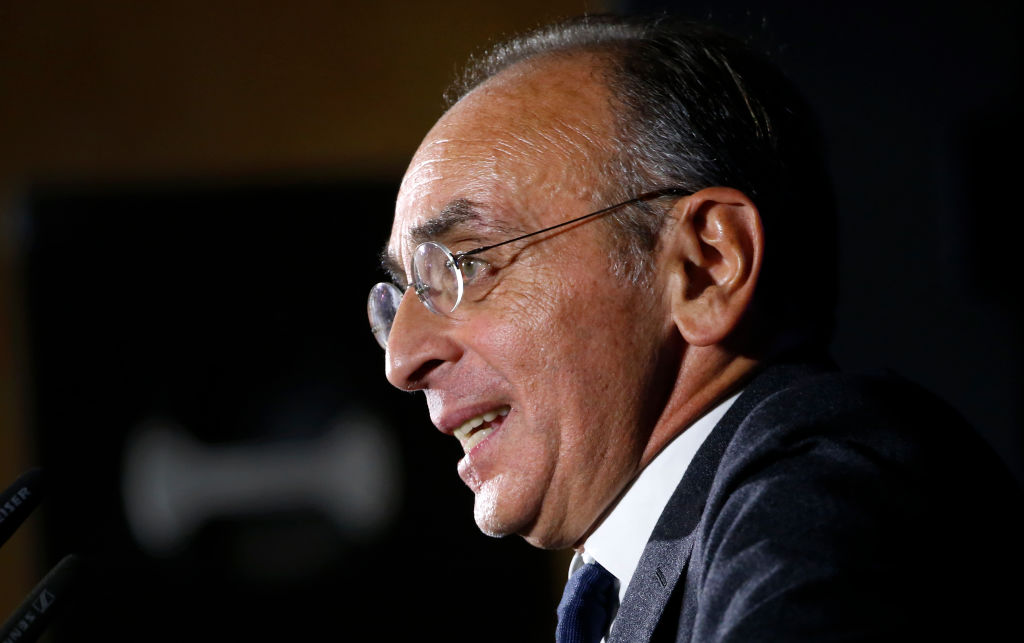
French far-right presidential candidate Éric Zemmour delivers a speech during a meeting of his electoral campaign on January 28, 2022, in Chaumont-sur-Tharonne, France. (Chesnot / Getty Images)
France’s rightward drift continues apace. While incumbent Emmanuel Macron is widely expected to secure reelection in April, polls credit the far right with almost 30 percent support — whether behind veteran candidate Marine Le Pen or Éric Zemmour, a TV personality repeatedly convicted for racist and anti-Muslim hate speech. The Left remains weak and divided, with polls showing its top candidates all far from qualifying for the second-round runoff.
This dreary climate is years in the making, driven by the decline of the labor movement, the failures of the Socialist Party (Parti socialiste, PS) — in particular, François Hollande’s presidency — but also an increasingly pronounced right-wing bent among a swath of the mainstream media and prominent intellectuals. This was again signaled in January as education minister Jean-Michel Blanquer took part in a so-called “anti-woke” conference at the Sorbonne, even as his colleagues in Macron’s government rail against the supposed creeping “Islamo-leftism” on campus.
To delve deeper into this shift in French public discourse, Jacobin’s Cole Stangler spoke to Frédérique Matonti, a political scientist, professor at the University of Paris 1, Panthéon-Sorbonne, and author of Comment sommes-nous devenus réacs? (“How Did We Become Reactionaries?”). In her book, published in November 2021 by Fayard, she aims to explain how France shifted from “one cultural hegemony to another,” looking at the key thinkers and themes that have the accompanied the transformation of its intellectual landscape from the 1980s onward.