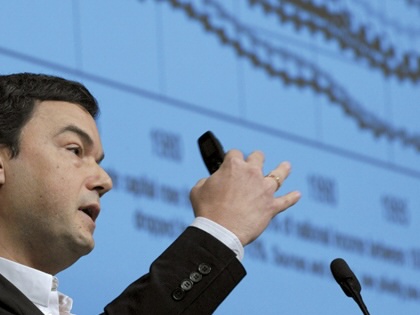
Thomas Piketty’s Utopian Socialism
The World Inequality Lab has produced the most ambitious redistribution plan in decades. But it asks the workers of the rich world to atone for empire rather than fight capital.
Virgilio Urbina Lazardi is a doctoral candidate in New York University’s Department of Sociology, where he studies industrial relations, comparative political economy, and development economics. He is a former organizer with GSOC-UAW Local 7902.
The World Inequality Lab has produced the most ambitious redistribution plan in decades. But it asks the workers of the rich world to atone for empire rather than fight capital.

The welfare state is essential for keeping the nonworking population out of poverty. But we shouldn’t discount the role of predistributive measures like strong unions and minimum wage laws in reducing inequality.

The 21st-century left has often argued that the solution to rampant inequality is income redistribution. But this may not be a silver bullet. What workers need is power over employers and the market.
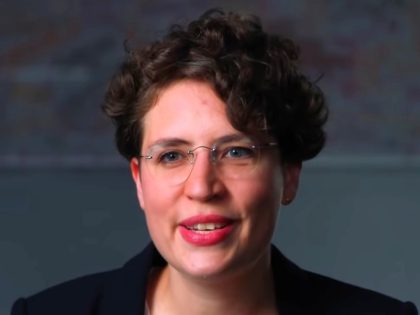
Eighteen months ago economist Isabella Weber faced intense criticism for blaming inflation on corporate profits. Now her analysis is regularly featured in the business press — and neoliberal ideologues are whining about it.

Viennese architect Margarete Schütte-Lihotzky is best known as the designer of the Frankfurt Kitchen, forerunner of modern fitted kitchens. Her work was informed by her communist politics — a cause in whose name she joined the resistance against Nazism.
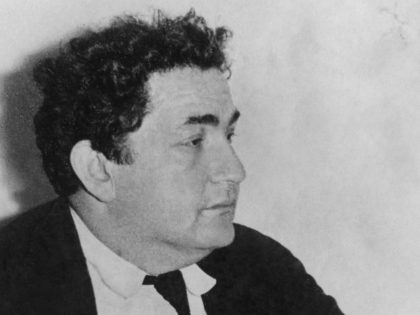
German theorist Fritz Sternberg, who wrote on the rise of the Nazis, the Cold War, and decolonization, remains an underappreciated figure in Western Marxism. His work offers crucial insights about the centrality of internationalism to socialist politics.

Tesla has announced plans for a nonunion factory in Berlin. Auto manufacturing going green was supposed to help workers, not hurt them.