Thomas Piketty’s Utopian Socialism
The World Inequality Lab has produced the most ambitious redistribution plan in decades. But it asks the workers of the rich world to atone for empire rather than fight capital.
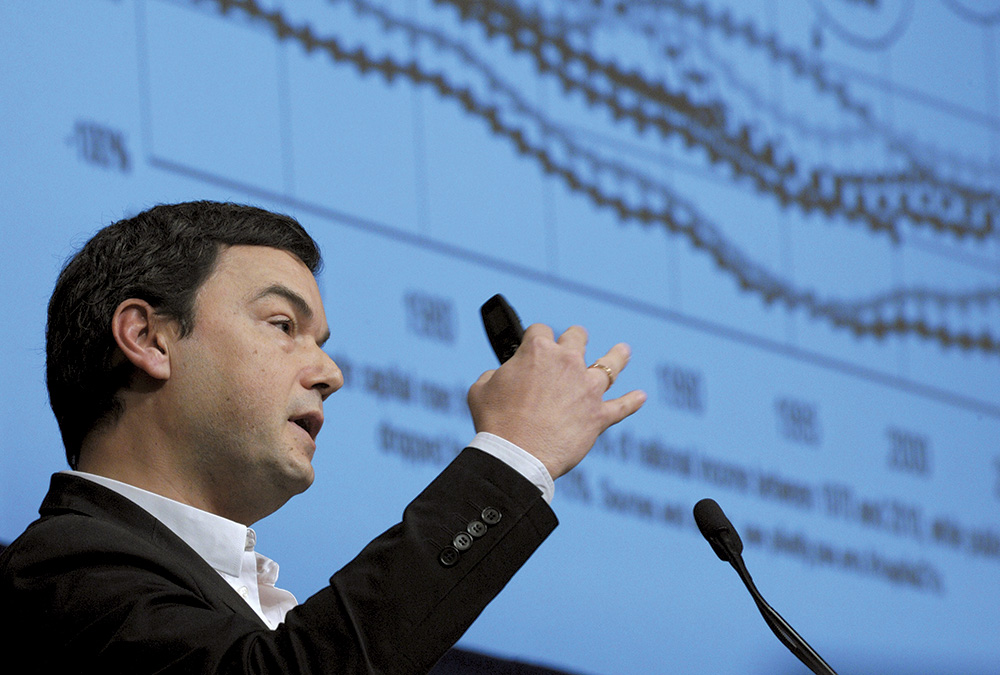
Has Thomas Piketty somehow forgotten that redistribution needs class power, not technocracy? (Eric Piermont / AFP / Getty Images)
In June, the policy world held its collective breath as the World Inequality Lab, the outfit headed by Thomas Piketty, released a report meant to serve as a capstone to years of extensive research on the elusive goal of leveling global incomes. Christened the Global Justice Report (GJR), Piketty and his collaborators promoted it as the first data-driven synthesis of two long-standing progressive ambitions that had remained more aspirational than actionable: dramatically reducing income and wealth inequality both within countries and between them, on the one hand, and achieving planetary sustainability in the age of global warming, on the other. The GJR, in short, aimed to demonstrate that the sort of inequality studies that had made Piketty famous with the 2013 publication of Capital in the Twenty-First Century could be used to navigate the trade-offs posed by the climate crisis.
At first glance, there is much in the report with which socialists would agree. It envisions, to borrow John Maynard Keynes’s phrase, the euthanasia of the billionaire class within a quarter century, primarily through confiscatory taxation. It proposes to democratize institutions of international economic governance, long dominated by the same cadre of rich nations, by implementing a per capita voting formula and introducing an international currency that would mitigate the exorbitant privilege of the dollar. And as part of its overarching concern for planetary limits, it calls for a drastic shift in the translation of productivity gains away from ever-greater material output and toward more leisure time. This has been a long-standing socialist demand, one that capitalism’s drive for profit has delivered on fitfully and only under sustained pressure from below.
Yet when it turns from the highlights to the machinery meant to achieve them, the report falls short. Far from an ambitious but feasible program that could be selectively used to rally the global left, the GJR retreats into the realm of fantastical thinking. Piketty and his collaborators passingly acknowledge the political constraints on building lasting coalitions of the dispossessed but ultimately sidestep them. Not unlike the schemes of the utopian socialists of the nineteenth century, the GJR flounders on the same obstacle: its proposals cannot cobble together a political constituency powerful enough to overcome the fierce resistance they would inevitably provoke from entrenched elites.