Cowboys and Italians
In the 1960s, Italian filmmakers took the cowboy out of America. They gave the western a wild, blood-soaked makeover that revived the genre for global audiences and imbued it with new political relevance.
Eileen Jones is a film critic at Jacobin, host of the Filmsuck podcast, and author of Filmsuck, USA.

In the 1960s, Italian filmmakers took the cowboy out of America. They gave the western a wild, blood-soaked makeover that revived the genre for global audiences and imbued it with new political relevance.

Based on a forgotten Stephen King dystopian novel, The Long Walk wants to be an allegory for America’s grindset mania. But unlike other works in this genre, it fails to deliver a bang and instead ends with a whimper.

Darren Aronofsky’s Caught Stealing sees the typically pretentious auteur shift gears toward fun and violence in late 1990s NYC. It’s a throwback to gritty 1970s filmmaking but set in the Giuliani era — the perfect setting for our downwardly mobile 2025.

Spike Lee’s Highest 2 Lowest attempts to remake a beloved Akira Kurosawa film about the injustices of a class-stratified society all while sidestepping class. Even Denzel Washington can’t save this misfire.

Nothing in film is more exposing than the big attempt at meaning and poignance that just doesn’t come off. Sadly, Americana stands exposed.

Zach Cregger’s Weapons is high-concept horror about the disappearance of a classroom of schoolkids. Once again, an innovative horror film has turned our age of anxiety into box office gold.

While it lacks the manic energy of the original, The Naked Gun reboot delivers laughs thanks to the ingenious casting of Liam Neeson and Pamela Anderson.

Will we ever get past the dominance of superhero movies in mainstream American cinema? Will they ever become any good?

Jaws is rightly celebrated as a landmark, generation-defining hit. But it’s not sufficiently recognized as a great 1970s film, exemplifying that rocky decade’s political ire, acerbic social critique, and the lingering practices of realist cinema movements.

For all of Eddington’s loud chaos, writer and director Ari Aster is expressing a fundamentally flat and stale vision of the world.

Reactionary hysterics over James Gunn’s Superman reboot bring some delight to America’s otherwise plainest superhero.

Jurassic World Rebirth is another entry in the dinos-eating-humans megafranchise. It is exactly what you would expect. For me, that works.

Brad Pitt’s F1 is the big, dumb racing movie America’s been waiting for. If you can stomach the sports movie clichés, you’ll probably have a good time.

The latest installment of the 28 Days Later franchise returns with more than zombies — it explores the strange new norms that follow collapse. It’s a vision of survival horror that focuses not just on the infected but on the ways humanity adapts.

Writer-director Celine Song’s Materialists follows a professional NYC matchmaker split between two charming suitors. It’s yet another attempt to update the Jane Austen formula, but without the poignancy and beauty of Song’s acclaimed Past Lives.
A Seth Rogen and Evan Goldberg satire of mainstream film’s IP problem — in which everything is an adaptation of something else — fails to excuse or address their own extensive IP crimes.

Ballerina is the female John Wick spin-off you didn’t know you needed. Ignore the critics — it’s fantastic.

Seth Rogen and Evan Goldberg mock Hollywood’s creative collapse in The Studio — while continuing to churn out sequels, reboots, and branded spin-offs.

At a time when academic and political repression is sweeping the United States, the 1942 screwball comedy The Male Animal offers a reminder of what courage in the face of crackdowns on a college campus can look like.

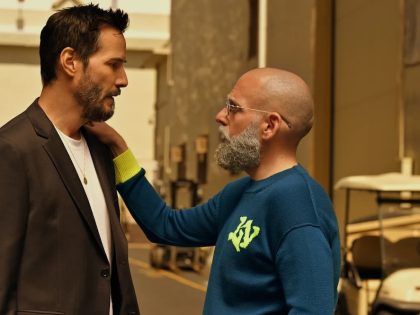
The excruciatingly funny Friendship finds comedian Tim Robinson pursuing a creepy bromance with Paul Rudd. It’s surprisingly well-done, using cringe humor to explore the growing phenomenon of male loneliness.