The Nowhere Man
Socialist leader Pedro Sánchez styles himself as the main barrier to Spain’s rising far right. Yet his record as prime minister shows how little he is doing to stop it.
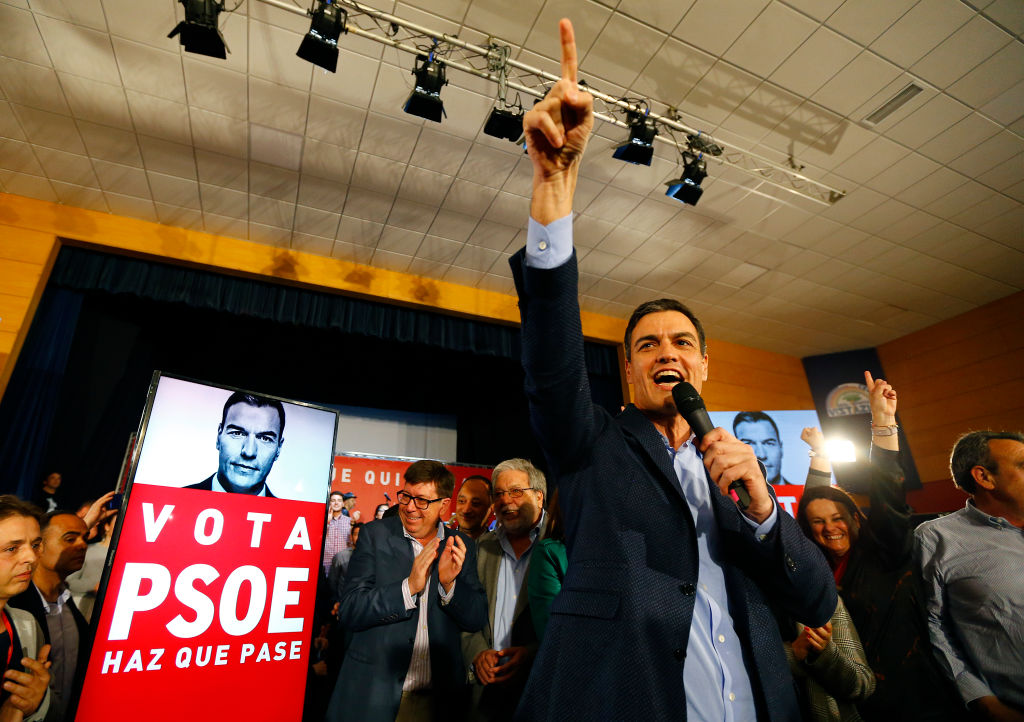
Spain’s Prime Minister Pedro Sanchez and Socialist Party (PSOE) candidate for the Spain’s general election reacts as he opens the election campaign on April 11, 2019 in Dos Hermanas, Spain. Spainish general election will held on April 28, 2019. Marcelo del Pozo / Getty Images
As Spain faces crucial elections this weekend, interim Prime Minister Pedro Sánchez looks set to be the big winner. Polling between 28 and 30 percent, his center-left Socialist Party (PSOE) is expected to be the largest force in the new parliament, even if not able to form a majority government.
In fact, even to be this close to power makes Sánchez’s party the envy of most social democrats across Europe. With France’s Socialist Party (PS) in terminal crisis (it secured 6 percent in 2017), and its German and Italian counterparts also in steep decline, the PSOE is the continent’s largest center-left force except for the UK Labour Party.
Given his government’s underwhelming record in office, Sánchez’s ability to buck this downward trend may look rather surprising. The forty-seven-year-old came to power ten months ago after removing former conservative Prime Minister Mariano Rajoy with a motion of no-confidence. Hopes were raised, particularly after his government agreed to an ambitious reform agenda together with the radical-left Podemos. The parties promised a reversal of public spending cuts, rent controls, a historic 22 percent rise in the minimum wage, and an end to a notorious “gag law” limiting free speech.