Zohran Mamdani’s Field Director on Knocking 3 Million Doors

Tascha Van Auken

The Zohran Mamdani campaign didn’t just have a charismatic candidate with slick videos. It built a grassroots army of over 100,000 volunteers knocking on 3 million doors. We spoke to the campaign’s field director, Tascha Van Auken, about how they did it.
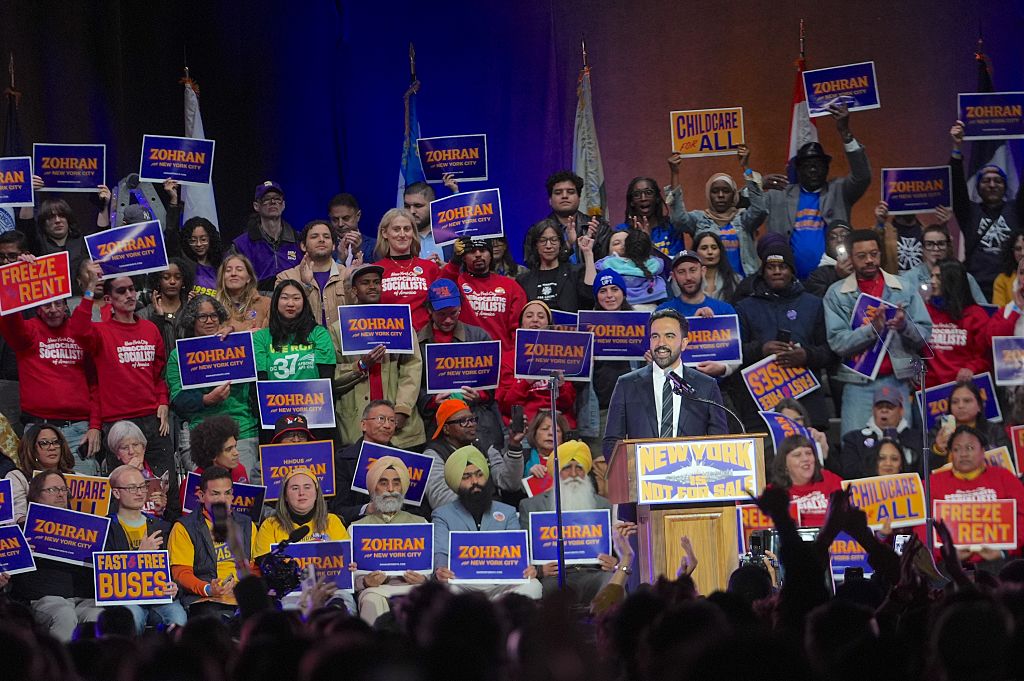
Zohran Mamdani’s enormous field operation didn’t come out of nowhere. As field director Tascha Van Auken explains, it was built over nearly a decade of campaigning through the New York City Democratic Socialists of America. (Selcuk Acar / Anadolu via Getty Images)

Interview by
Micah Uetricht

Most politicians who emerge victorious on election night don’t have their victory speech introduced by their field director. But most campaigns aren’t run like Zohran Mamdani’s, which saw an astronomical 100,000 volunteers knock on three million doors to deliver him victory in the New York City mayoral race. On stage that election night, it was Zohran’s field director, Tascha Van Auken, who spoke before bringing out the socialist mayor-elect.

Much about Mamdani’s campaign is worth studying. From its message discipline to its communication strategy to its successful building of a winning working-class voter coalition. But its massive field operation, led by Van Auken, has sometimes gotten short shrift in mainstream media accounts of the campaign’s success. That operation didn’t come out of nowhere. Tascha is a key architect of the broader New York City Democratic Socialists of America (NYC-DSA) field operation, and of its entire electoral strategy. Her work as a leader in NYC-DSA goes back to 2017, when socialists in New York City first started plotting out what it would take to run socialists for office and then win. Nearly a decade later, a socialist is taking office as mayor of New York City.

For the Jacobin Radio podcast The Dig, Van Auken spoke with Jacobin editor Micah Uetricht. You can listen to the conversation here. The transcript has been edited for clarity and brevity.


Micah Uetricht

I want you to start with your story, which means that we have to start not with Zohran’s campaign or the other socialist and nonsocialist campaigns you’ve been involved in, but with the Blue Man Group, where you worked for fifteen years in a wide variety of roles. Can you talk about working for the Blue Man Group and if and how it gave you skills that you put to use in politics?

Tascha Van Auken

Yeah, happy to. I think it’s really something that I draw on a lot in politics and on campaigns. On election night, one of my guests that I invited was one of my coworkers, and often my boss, from Blue Man Group. Because I wanted him to see this other space that I’ve been working in. That, for me, is very related to things that I learned from him and others while I was there.

My background when I was younger and growing up was much more in the arts and theater. I went to film school and spent a lot of my twenties trying to figure out what I wanted to do. And working at Blue Man Group was the first job I got that I really loved and grew in and learned a lot about.

I started working there as a casting assistant in 2005. That mostly involved going through résumés and scheduling appointments and a lot of administrative work. But one of the parts of the job that I immediately loved was working with actors — from the very beginning stages of doing really simple exercises with lots of actors coming through the door to later stages of bringing them through a callback process that was multiple days long.

I was there for three years, then was laid off when there was a big downsizing. I’m actually very glad that I was laid off, because that’s when I ended up jumping into the Barack Obama campaign in 2008. When I returned to Blue Man Group later, I continued to do casting but then also training. And the training process there is really unique. It’s an eight-week process where actors who have made it through the initial phases of the audition go through this intensive training into the character. But the real meaty part is the character of the Blue Man, which is a challenging process, because it’s more about removing layers than adding layers. You’re not putting on an accent. You can’t speak in this character. You’re not playing, like, Hamlet. You’re stripping layers away to the core of who you are. It’s a very vulnerable role. It’s all about human connection and vulnerability. So actors really would go through the ringer in a way, because you learn a lot about yourself going through the process to become this character. You learn about all these ways of communicating as a human that aren’t through speech and obvious gesturing.

It was a really cool place to learn how to build teams and work collaboratively with other people. One of the things that I definitely draw on from my time there, and I think about it all the time on campaigns, is that I learned how to create a space that really challenges people but is also very trusting and safe to experiment and try things in. Because without that, none of these folks could really learn to play this character. You really have to take a lot of leaps of faith.

I think about that in campaigns all the time, especially in the beginning of campaigns. If you’re in a room with a lot of people who are new and excited, how can you create the space where people feel, “OK, I can do this”? “I can take risks; I can learn; I can try things; I can make mistakes.” And we’re trying something really, really hard and really, really ambitious. But we’re doing it together. There’s a possibility in that that I really love. And I learned that working at Blue Man Group.

Micah Uetricht

I’m pretty sure this is the first time that the Blue Man Group is getting a mention on The Dig, so we should just mark that as a milestone moment here.

You just mentioned that your first real entry into politics was through the 2008 Obama campaign. When we on the Left talk about Obama these days, it’s mostly to talk about the disappointments and letdowns of his presidency, its unfulfilled potential. But the campaign did have this genuine grassroots movement character, and it engaged millions of people from around the country.

What do you see in your work on that campaign? What did you learn from it, and how did it impact the work that you would go on to do?

Tascha Van Auken

That campaign was so formative for me. It changed my relationship with politics and how I saw myself in it. When I think about that campaign, I also have to think about how I felt not just before the campaign but for years, my entire twenties — I had an interest in politics. I really cared about things. September 11 had a big effect on me — watching the war machine roll on afterward was very politicizing for me, the Iraq War, all of that. And I spent a few years floundering. I went to protests. Some of them were meaningful for a day, but I didn’t feel like I was getting to be a part of something that was moving the needle or changing anything.

I don’t think that’s a unique feeling. A lot of people feel that way. What drew me to the Obama campaign was he was an interesting candidate. But what pulled me in was the sense that there was a movement building around him. Something was happening that I didn’t understand and was exciting.

When I was laid off from my job, it was the first time in my life I had a little bit of financial wiggle room. I didn’t know anything about campaigns. So I decided I was going to figure out how to volunteer full-time for the last two and a half months. Then I happened to have a friend who knew somebody in Pennsylvania who was hiring in the last couple of months.

I got hired to work in a field office in Montgomery County, Pennsylvania. I was a volunteer coordinator, which is one of the best jobs in a field office, because you’re  engaging with people all day long. The thing that really pulled me into this campaign was the organizing strategy that was developed by Marshall Ganz, the longtime incredible organizer, that was all about building relationships, building leadership [among] volunteers, taking on leadership, replicating that, and being able to tell your story to people and hear theirs and figure out what our shared purpose is. So I think that the field operation on that campaign really set the bar so high for me. I’ve carried that with me from the first moment I walked into that office.

Micah Uetricht

The common sense on the broad liberal left and beyond is that the Obama administration made a huge mistake by organizing this enormous social movement around his campaign that inspired so many people like you and then letting it wither and die once he took office, not mobilizing that movement around the big fights that immediately came up. Did you feel like you saw that demobilization happen in real time after the election?

Tascha Van Auken

Yeah. I was so excited by this experience. And I remember hearing Organizing for America was going to be this big thing — we’re going to keep organizing to make all these things he’s been talking about possible. I remember feeling very excited about that. Then in the following years, I was continually like, “What happened to that?”

I don’t think I understood the enormity of it at the time. The thing that sticks out to me though is that two years later, I went back to Montgomery County, where I had been working, because some of the folks that I’d been working with were running a candidate for US Senate, and all of the volunteers that I had gotten to know and developed friendships with were working on this campaign and going door-to-door and making phone calls.

I remember asking, “Do you have all the IDs from 2008?” And the answer was “no,” because Obama was supporting a different candidate. I don’t remember the politics at the time, so who knows — maybe it was the right choice for him. I don’t know. But I remember thinking, “Man, that sucks. These are all the people that did the work, and they don’t have any of the product of their labor for that whole campaign. They have to start from scratch.” That’s bad — having a campaign own everything, and everything lives or dies with the campaign. That’s not good.

Micah Uetricht

The campaign was your introduction to organized politics. You get inspired by this movement built around his electoral campaign, but then it stops once the campaign is over. Why didn’t you get demoralized by that experience and leave politics forever? I assume that was the case for many people who were involved in that campaign and were inspired by it.

Tascha Van Auken

I don’t know. I had a lot of demoralizing experiences after that campaign. I was really lucky that that was my first experience, because I knew that it could be really good. I worked on a Senate runoff in Georgia right afterwards. It was not a good experience. It was probably more typical of what electoral campaigns are like: Nobody cares when volunteers walk in the office. There’s no understanding of how to build that mechanism. I worked for a short period of time in New York City on an issue campaign run out of a consulting firm — also a pretty demoralizing experience. At that point, I did step away. I didn’t know what to do with the experience I had, at that moment. I knew that I really liked the organizing piece and the field piece, but I also could see people don’t pay you very well to do that kind of work. So I didn’t see a future in it. So I went back to Blue Man Group.

Micah Uetricht

Then you went back into left politics, which doesn’t have a great recent track record, until very recently, of breakthrough victories that are the opposite of demoralizing. You were a real glutton for punishment.

Tascha Van Auken

I really was. There was something interesting about it to me. Occupy happened, which was another not-good experience for me. But when you have bad experiences, there’s a lot to learn from them if you’re paying attention. And I think I learned so much from trying to participate in Occupy, because that was the feeling I had the entire time I was involved — I was always trying to be involved and never could figure out how.

I came out of that feeling like, okay, strategy and structure is really important. A few years later, when I joined DSA, I remembered a lot of the experiences that I had at Occupy Wall Street as a road map for what not to do when you are building something big and popular.

Micah Uetricht

Regarding the demobilization of the movement for Obama after his election: because it has become common sense that this was a huge mistake of Obama’s, people don’t want to make that mistake again. Soon after Mamdani’s election victory came the announcement, for example, of Our Time, which is an organization that is not officially a part of the Mamdani administration, and you’re not officially a part of it, but it aims to continue the kind of organizing that led to Zohran’s win; to organize around his agenda while he’s in office. So it seems like people have learned that lesson not to repeat those mistakes.

Tascha Van Auken

I think so. Also, before Zohran ran, we were already in a very different place. His campaign was something that happened as a result of many years of organizing on the Left in New York City. So I started to view it as, like, the lesson was already learned. The piece that is very different is the organization — long-term organizing, and power-building, and running things that are strategic. His campaign came out of that; he came out of that. Everybody involved wants the organizing to continue and knows that it has to. But it’s still important for us to consciously think about that all the time.

NYC-DSA

Micah Uetricht

You got involved with NYC-DSA fairly early on in the organization’s rebirth after Bernie Sanders’s first presidential campaign in 2016, before the organization had elected any socialists to office. How did you come to DSA in the first place, and then what did you see in the organization in those early years that made you stick around?

Tascha Van Auken

I knew of DSA. I had been doing a lot of work as a volunteer in New York City and a little bit in the state for Bernie Sanders. There were DSA-run events for Bernie. After Bernie, I learned for the second time that you really need an organization. You can’t just have strong candidates, because this flash-in-a-pan excitement is good and important, but there has to be a container for it long term.

After Trump won, I needed to go organize someplace, and DSA was the only place I knew of. I also had been organizing with somebody in an all-volunteer group called Team Bernie NY, and she was a DSA member, and she told me, “There’s an Electoral Working Group meeting a few blocks from where we are now. Go there.” I went to that meeting, and it was friendly and structured and had different breakout groups to discuss different strategic pieces. People asked me what my name was; I had fun conversations; we hung out afterward. It was very easy. It was immediate — that’s where I’m going to go. And it wasn’t hard to stay. It was not hard to spend all my time doing it, because the energy in those first months was incredible.

Micah Uetricht

Before we get into specific campaigns, how would you generally characterize what the organization has built since you joined in 2017? Not just in terms of victories at the electoral level, but big picture in terms of strategy, culture, capacities. And why has it been so successful in producing left electoral victories and left leaders?

Tascha Van Auken

NYC-DSA is this incredible space and container for long-term organizing and strategic thinking. It is a place where people can come as newly politicized or politically curious and do meaningful work that is concretely building power. I have grown so much while I’ve been in this organization. I’ve learned so much; I’ve challenged a lot of ideas I had. When I first joined DSA, I had very polarized opinions about politics, and a lot of frustrations with electoral politics that wouldn’t necessarily have expressed themselves in very useful ways if I had not become part of an organization where I learned about what it means to organize other people within DSA. I had never participated in a democratic process.

I just said yes to everything when I joined because I really trusted the people who were asking me to do things, and I didn’t know what that meant. I remember being asked to run for convention delegate. The first convention I went to was life-changing for me. I wasn’t somebody that grew up with that kind of stuff in left spaces. When you’re practicing democracy, it changes you. DSA is that place for so many people.

Looking at the candidate forums that have happened this year, the amount of information that you get, the opportunities you have to learn about different districts and how and what it means to fundraise for a campaign, or fundraising for a campaign that has matching funds versus fundraising for a campaign that doesn’t, what ranked-choice voting means — all of these things are pieces that you have to know and understand, to weigh the strategic value of every endorsement. It’s so cool. It’s one of my favorite things that happened in the chapter, because you see people that came into the chapter a couple months ago standing up in these forums and asking strategic questions. We’re getting beyond the vibes of the candidate — “this would be fun,” or “we should do this because it’s the right thing to do.” We’re thinking more strategically. This organization has created the space to do that. That’s incredible.

Micah Uetricht

You’re talking about what I consider to be a pretty underrated part of the socialist organizing project in the United States. Most of the coverage and discussion about a group like DSA focuses on the politics the organization is pushing for.

Obviously, all of that is very central, but a really underrated part of an organization like DSA is its democratic character. Grace Mausser, the NYC-DSA cochair, wrote about this in Jacobin — that if you care about rebuilding democracy in this country, you should be happy with what NYC-DSA is doing, because it is democratic means that this organization is employing to win candidates. If you value democracy as a good, if you believe the stuff that we heard growing up about democracy as a civic virtue — that civic virtue is being practiced in NYC-DSA. And there aren’t very many other organizations that are practicing it in the way that DSA is.

Tascha Van Auken

That’s been the most meaningful thing about the organization for me. I don’t experience that anywhere else in my life. When people think about democracy, the limits of it are the voting booth. There are so many other layers to that.

Micah Uetricht

You mentioned the endorsement process of New York City DSA. I read lots of local news coverage of NYC-DSA, which has become increasingly difficult because now there’s so much of it. In that local coverage, it’s become a truism that the NYC-DSA process for endorsing candidates is particularly grueling. Can you talk a bit about what that process looks like and how NYC-DSA goes about choosing which candidates to support, what the criteria are, and whether you think the process has worked well?

Tascha Van Auken

It’s a good process, and Grace Mausser had a lot to do with shaping this process.

Micah Uetricht

Grace did have a lot to do with it. But she says in a previous Dig interview that you are the godmother of many of these processes and what’s been built in the organization. She’s crediting you!

Tascha Van Auken

There’s an Electoral Working Group (EWG), and the EWG’s candidate recruitment chairs spend a good amount of time recruiting candidates, talking to people who want our endorsement, figuring out which candidates make sense for the chapter, helping people understand what it means to run for office, having all of those conversations — which is really important and a lot of work. The EWG as a whole will make decisions about who then moves to an EWG vote. There’s a candidate questionnaire, a very lengthy one with lots of questions, and candidates have to fill that out and submit it by a certain date. Then there’s an EWG forum that is now citywide. It’s members only, and in order to vote in it, you have to have been a member for three months. And then you also have to do an electoral action at some point within a certain amount of time.

All the members who RSVP get sent the candidate questionnaire, as well as a district dossier, which the EWG research committee puts together on the district: what are the win numbers, how many votes do you need, what are the demographics, what is the history of the district?

Different members of the Electoral Working Group walk you through the information: What would it mean to fundraise for this campaign? The candidate then speaks; people ask questions. The candidate leaves, and there’s discussion and debate — usually a pro and con line, and then everyone who attends votes. If the candidate gets over 60 percent, they receive a recommendation vote that then goes to the branches. Sometimes it’s one branch; sometimes it’s more than one branch. The branches then vote, and then the final vote for it goes to the Citywide Leadership Committee (CLC). The CLC says yes or no, and then the candidate is endorsed. So it’s multistage process, and there is a lot of member input at multiple levels, as well as lots of opportunity to understand what it is you’re voting on and to ask questions.

Micah Uetricht

The Khader El-Yateem city council campaign in 2017 was the first city council race that NYC-DSA ran. El-Yateem is a Palestinian Lutheran pastor who ran for city council in Bay Ridge, Brooklyn. This was also an early campaign that Zohran Mamdani worked on. Did you meet Zohran back then? Did you work on the campaign with him?

Tascha Van Auken

I did meet him. He was the paid canvass manager. It was a very exciting campaign. Back then, we would have one campaign. The whole city would come out — people were coming from the Bronx to canvass in Bay Ridge, Brooklyn. During that campaign, we didn’t have our electoral strategy written. We were experimenting. We wanted to avoid signing people up at a meeting saying, “This is our endorsed candidate. Sign up to canvass,” and then sending them to the campaign and saying, “Here are our volunteers.” We wanted to make sure there was some mechanism for us as an organization to learn, lead, and grow, and retain the data that we were collecting from this campaign.

This was a different campaign than a lot of the ones we run now. Now DSA members are running these campaigns. There’s a lot more infrastructure in terms of it being run as a DSA campaign.

The benefit of that was we were able to build what we wanted, completely the way we wanted to see it. The culture of the campaigns . . . that’s when we first started having field leads. It was pretty much entirely volunteer. The downside was that we weren’t engaging with the rest of the campaign. And the campaign was doing really exciting work engaging with Muslim voters in the district.

It was interesting because it wasn’t really until get out the vote at the end of the campaign, when for logistical reasons, we had to all do the same thing together. You can’t really split up the election districts the way we had been, and we were all working together, and many of us had this feeling at the end like, it would have been cool if it was like this for the whole campaign. It would have been great to build relationships with all the people who are invested in this campaign and working on this campaign. So it was a really formative campaign for our electoral strategy to figure out what is the balance of our ownership over the structure of a campaign that also gives us room to build relationships and work collaboratively and in coalition with other groups and other people who are interested in electing the same person.

Micah Uetricht

You went on to work on other NYC-DSA campaigns: Julia Salazar‘s successful run for New York State Senate in 2018, which was the first campaign where New York City DSA won; Tiffany Cabán’s squeaker loss for Queens district attorney in 2019 (although Cabán went on to win a city council seat in 2021); and Phara Souffrant Forrest‘s successful run for New York State Assembly in 2020 (and you later served as her chief of staff).

So you’ve had a front-row seat to how this organization has developed its electoral capabilities and strategy over time. Talk a little bit about those campaigns.

Tascha Van Auken

Each one of them was a really big deal. Julia’s campaign in 2018 was the first one that was run completely by DSA members, by the end. We were able to get it off the ground in a really strong way, because we had all of these people who, the year prior, had learned how to lead canvasses and learned all of the field skills. So we had this incredible field team that basically created the infrastructure for the whole campaign.

That campaign really felt like proof of concept for us. We had written this electoral strategy based on our experience with El-Yateem’s campaign and Jabari Brisport’s city council run in 2017. Julia Salazar’s 2018 campaign was the campaign where it was like, OK, let’s see if this works. It was a district where we were running against a longtime incumbent. Lots of people in that district said it wasn’t possible to beat him. But we had a field plan and a path to victory. It was a really interesting time, because the electorate was younger than it had been in a while, thanks to Bernie Sanders running. So young people were voting in primaries in a way that they hadn’t.

Micah Uetricht

The “Commie Corridor” was forming.

Tascha Van Auken

It was. So we were really strategic about it. I remember a few weeks before the campaign, we were getting close, and the pressure was on. Looking at one of my friends in the Electoral Working Group, we were like, “This is the proof of concept moment.” Obviously a lot of other things were happening simultaneously. Alexandria Ocasio-Cortez happened. That was huge, injecting this bolt of energy into Julia’s campaign. But Julia’s win was a huge moment for the chapter.

Then Tiffany Cabán’s district attorney race happened. I think about that race a lot not just because of how close it was, but also because when we were starting Zohran’s campaign, field-wise, Tiffany’s DA race to me was the most comparable race to look at in terms of scale. And when we were thinking about the goals on Zohran’s campaign, I thought about how many doors we knocked on Tiffany’s campaign during get out the vote, which was a really large number — around 120,000. I remember thinking about that when we were thinking about Zohran’s campaign — like, we could knock a million doors if we knocked over 100,000 doors in four days on Tiffany’s campaign.

With Phara Souffrant Forrest’s campaign, we had a whole slate of candidates that year, and the entire state slate won. The lockdown happened in the middle of petitioning during that campaign. We had to switch from doors to phonebanking. And then the George Floyd protests were happening. After that year, we didn’t just have one socialist in office. We now had a whole crew of socialists in office.

It’s interesting to look back and see how each win or loss teaches you something and shapes you. It brings me back to the whole point of having a long-term political organization.

Micah Uetricht

What were the top-line lessons that you took after your involvement in all these campaigns for how to run a field operation?

Tascha Van Auken

Culture is really important. It’s something I always feel very protective of on campaigns. You can talk to people who’ve worked on run-of-the-mill, mainstream campaigns outside of DSA; the culture is really bad. People don’t feel respected. Maybe the campaign has some volunteers, but they’re not considered particularly important. You often hear you’ll make up a margin of 1–3 percent with the field operation. So maybe you just pay some people to do it.

Mainstream campaigns are all about a few people who know everything.

Micah Uetricht

The genius running the show.

Tascha Van Auken

Yeah, and it’s not a place where people can join and belong and learn and grow.

Micah Uetricht

It’s not a democratic structure.

Tascha Van Auken

No, not at all. That is really important. It’s important to have that structure where people can learn how to be political and realize that they have a role in politics. It always comes back to that for me, because that was my experience — going from feeling like I don’t have a role in this, I’m not smart in the right way, or I don’t write in the right way; I don’t do these things that I associate with politics. And then realizing, you actually don’t need those things. What you need to be able to do is talk to people and relate to people.

Having a culture and a structure where you are training people when they come in, giving them the tools to be successful, is really important. So you’re not just throwing people into a room and being like, “Here’s what we’re doing — good luck.” There’s structure; there are goals. You’re giving information. There’s a strategy.

A big part of it for me is also the thing I learned on the Obama campaign, ultimately from Marshall Ganz: the most powerful thing in field and on campaigns and in organizing is building relationships and being able to relate to people. And a piece of that is being able to access a little bit of vulnerability, which I think is very hard for people. So we need to make sure there are tools and trainings for people to understand: Why am I here? And be able to listen to other people about why they’re there, and connect with people.

Micah Uetricht

A lot of our discussion so far has focused on the strengths of this organizing model in the field. What are this model’s vulnerabilities? What are the weaknesses of this high-participation focus on democratic engagement and development of people?

Tascha Van Auken

You can’t control it. That’s the biggest one. It could be a weakness, but it depends how you look at it. I think probably a lot of campaigns don’t want that level of participation, because you are building a muscle and you can’t completely control it. So there’s a level of trust that has to happen.

That’s a big one for DSA. We have these structures. I trust them in the long term. I trust the decisions that we make collectively, even if I disagree with them. I trust that in the long run, the power of us making these decisions, even if they end up being the wrong one . . . We mess something up, but we’re doing it together, and it’s going to make us stronger in the long run. But that’s scary.

The more democratic we are and the more open our processes are, it means that a lot of people can see it and access it. All the press is writing about DSA, and some stuff that should be private is no longer private. That is not great. But what is more important than that is that we have this big democratic structure that everybody can participate in.

The DSA Field Model

Micah Uetricht

This is a very earnest belief in the power of democracy that you’re articulating here — even the weaknesses of this highly democratic model, you’re portraying as strengths.

We’ve been saying this word “field” over and over again. What activities does field entail?

Tascha Van Auken

Anything where you’re talking to voters. Door-to-door canvassing is field; phonebanking is field; street canvassing is field; petitioning is field.

Micah Uetricht

That’s opposed to things like mailers or TV ads or Instagram videos or whatever. It’s direct contact with the voters themselves.

The phrase “distributed organizing” has come up a lot in contemporary discussions of political strategy. Is this a phrase that fits what you all have done here?

Tascha Van Auken

I don’t know if that’s the phrase I would use. Sometimes when I hear “distributed organizing,” I get a little nervous, because it seems like it’s referring to people learning something, then setting people free. This group does one thing; this group ends up doing a different thing. I think I would use a “snowflake model” to talk about our organizing model, which is sort of like leadership replication.

There’s a difference between having a training and then sending people out, and there’s not a back-and-forth. . . . We had a structure where we trained a lot of people to lead canvasses and lead lots of other things, but it was all centralized. There was a central strategy. There was a lot of communication back and forth. We always wanted communication from the field leads who were leading canvasses, and from canvassers to field leads, so we had a really good sense of what was going on on the ground, so we knew if issues were coming up.

This has been the model for all DSA campaigns: We train a group of people to lead canvasses, and then they go to different parts of the district or the city. Volunteers come in. Those people are kind of like ambassadors — they are welcoming people into the campaign. They’re teaching them how to go door-to-door; they’re teaching them how to use MiniVAN [a canvassing app]. Then they’re usually doing some kind of social after the canvass. And then after a few canvasses, if they notice somebody who keeps coming back, maybe they ask them, “Do you want to learn how to be a field lead?” So they’re replicating themselves. That was the model, just on a much, much bigger scale.

Micah Uetricht

How would you characterize NYC-DSA’s role in this campaign? My read is that, from a number of the top staff positions down to many of the field leads in the volunteer base, NYC-DSA members were playing a central and indispensable role in the campaign. But as with most instances of socialists playing key roles in campaigns for anything good in this country, the socialist cadre at this campaign’s heart designed and organized the campaign in such a way that a flood of non-self-identifying socialists felt that the campaign was a welcoming place for people like them.

NYC-DSA has now grown at this point to something like 13,000 members, but there was something like eight times that many volunteers on the campaign as a whole. How do you see that interplay between the socialist core leadership of the campaign, but a leadership that welcomes a vast majority of nonsocialist people into the campaign?

Tascha Van Auken

It was very important to me that the field operation felt welcoming to anybody who wanted to join it, that it didn’t feel like a club or cliquey or anything like that. This is really at the heart of what it means to be in an organization like DSA and part of a leftist movement. We want to make sure there’s a place for anybody who wants to come in and find a place in politics. We have to be very generous and make sure that when people are coming in, we’re building something bigger than our organization.

And there were many other organizations that worked on this campaign. NYC-DSA was by far the largest and most represented in it, but there were many others. And it was really cool on this campaign to work across different organizations in an extremely collaborative, strategic, focused, disciplined way. It was really important for me on this campaign to see that we were facing outward through it. We weren’t facing inward.

Micah Uetricht

So Zohran tells close allies he’s thinking about running. He starts making the preparations sometime in 2024. The ball gets rolling, and you’re going to run the field program. So you’re at square one.

Describe to us, in those earliest moments of the campaign, what the preparations look like. How do you set up the organizing program in the beginning? Is there an NYC-DSA electoral field organizing manual that you’re drawing from? A manual from non-DSA campaigns? Is it from the campaigns you’ve worked on in the past? What are you drawing from as you’re putting together the plans?

Tascha Van Auken

I think the first thing we did was in December 2024 — the whole staff was four or five of us. It was very small, I basically worked with a bunch of folks on the DSA Electoral Working Group. This was when the DSA field launch for Zohran was. And we identified a group of people who wanted to help figure out how to do the launch. It was a little messy. We had to figure out what the model was for something so big.

Micah Uetricht

How many people were part of that core team for field in the beginning?

Tascha Van Auken

Probably about twenty people coordinating it and then people leading canvasses. And we had about eight canvass launches in different neighborhoods. At that point, it was all DSA members. And we had to kind of figure out, OK, here’s the script. We knew from the beginning we wanted to focus on the three affordability pieces: rent freeze, buses, childcare. We figured out what doors we were going to knock at the beginning. We went to rent-stabilized buildings, because we wanted to test out the script on some of the friendliest possible doors we could go to. We created a quick training for everybody who was leading canvasses; I think it was just on Zoom. Then all the materials were delivered to my apartment.

That was my first taste of thinking, oh, this is bigger than I’m understanding in my head. I had boxes of materials delivered. When you have a canvass, you usually bundle the lit in packs of fifty or seventy-five, however many doors people are going to. And I remember thinking, I can bundle it. I can get all the clipboards together.

Then two hours in, things were going wrong. We had volunteer drivers coming that night who were going to pick up materials and bring them to the person who was going to lead the canvass the next day (which was its own tricky scheduling thing: making sure that they were picking up and the person receiving it was available and they had each other’s information). We were getting closer, and I had to put out an SOS, and a few volunteers came over and helped me bundle. We were packing the bags as the drivers were arriving.  After the final bag was gone, I was like, oh man, this is what the whole campaign is gonna be like.

Micah Uetricht

Can you periodize the different phases of the campaign? Obviously, it grew quantitatively over time. But were there different periods of the campaign where you thought to yourself like, “OK, now we have moved into a qualitatively different phase of this campaign, and we now need to approach the question of field in a different way. We need to figure out new ways to scale it up, because it’s growing into a new beast in front of our eyes”?

Tascha Van Auken

I felt like that from the beginning. The excitement and numbers of people coming in from the beginning were large. You had the feeling of needing to keep up with enthusiasm from that very first canvass. That’s a great problem to have. We had our early canvasses in December and January. In January, we decided to have a big kickoff at Grand Army Plaza, and Zohran would speak. I hired two more field staff, so there are now three of us. We were preparing for that canvass, and we were like, we’ll probably have like two hundred people.

The day arrived, and five hundred people had showed up. It felt like total chaos. But everybody who canvassed said it was great. It was fast. It was easy. But that day alone felt like an escalation point, seeing enormous numbers of people coming out on a cold day in January. At that point we were like, OK, we have to figure out the logistics.

Petitioning starts in February, and petitioning is when you collect a certain number of signatures to officially get the candidate on the ballot. So we did all the early canvassing and realized that we had to launch canvasses across the city multiple times a week. A big thing we had to figure out was how to get materials across the city all the time, because you can’t just deliver them five times a week to the same location. So we developed a system of bins that people would host on their property that we would fill, and then field leads could go and get their materials. That was a huge innovation for us. It changed everything.

It’s hard for me to pinpoint exact escalation points, because it was constantly escalating.

After petitioning, you move into persuasion. It’s not hard to persuade people to like this platform and talk. When you talk about affordability, a lot of people are into it. And then the final phase is “get out the vote.” For the primary, we were dealing with how to scale up the logistics almost every week, figuring out a better way.

Micah Uetricht

What was your thought process about Zohran’s actual prospects for winning throughout the campaign? Was that impacted by what you were seeing happening in the field?

Tascha Van Auken

I feel like nobody’s going to believe me, but I had a sense of the possibility from the beginning. I’ll explain why. I remember the DSA endorsement process for Zohran. There were these member meetings that were very informal and much more about talking about endorsing a mayor, period, less than Zohran himself. I went to a couple of them, and at one, a member was like, “This is crazy. We can’t win.” And one person who I respect a lot was like, “I’m actually worried that he can win. What do we do if he wins?”

That was the first person I heard say it out loud. I don’t think I saw the possibility until I started going to more meetings and being in spaces where everyone would start out really skeptical, then people would start discussing what else we could do if we ran somebody for mayor? What does that open up? What does that create possibilities for? There are matching funds. There would be money to spend on organizing.

Micah Uetricht

Can you explain matching funds, for those who aren’t familiar?

Tascha Van Auken

The city has a public matching fund system. It matches your money eight to one. So if I donated $5, it would be matched with public money to equal $40. It’s a huge opportunity to raise a good amount of money and run a very serious campaign.

One of the things that excited me in those early conversations was just the idea that you could hire organizers and run a really cool field operation across the entire city. I remember going to those meetings, and people would start to imagine the possibilities of running a mayoral candidate, and everybody would leave really excited. There’s something about that that tells you what people are feeling in that moment. And I think that feeling that I saw others experience is probably something that people across the city were feeling. It was this real need for somebody to talk about this issue.

Micah Uetricht

Let’s say that someone sees a Zohran Instagram video. They like what he has to say. They hear him say at the end that they can volunteer by going to ZohranforNYC.com, and then they sign up for a canvass the next day and they show up. What does the process look like from there? How does that person go from that individual canvass to becoming a canvass lead six weeks later? How does a lead become a coordinator? What is the sort of scaling up mechanism for someone like that who shows up and has never done anything like this before?

Tascha Van Auken

If they show up to a canvass, they get greeted by the field lead and maybe other other regular canvassers. The field lead will talk about why everybody’s there today and oftentimes share why they’re personally there, what it means for them. If it’s a small enough group, they might go around in a circle so everybody can introduce themselves and share why they decided to show up today. Then there will be a training on how to canvass; the field leads will model the scripts, doing a practice door-knock. If you’re new, they’ll pair you off with another person. Sometimes, depending on the neighborhood, if there’s a specific language need, they might ask who speaks the local language. If you’ve never canvassed, you’ll get a quick training on MiniVAN, the app we use to track everything. And you will also get added to a WhatsApp chat so you can communicate with the field lead and with the other canvassers and ask questions.

Everybody goes out, you’re told when to return, and you go canvass. If you’re new, you do it with a partner, and you can watch them first and then give it a try. If you’re seasoned, you may go off on your own. Then usually everybody returns three hours later, turns in materials, and debriefs. You may go to a coffee shop or a restaurant or a bar afterward and hang out with people. And then if you continue to go back, you might get asked if you want to be a field lead. If you do want to be a field lead, your name gets added to a list for the next field training — about three hours in person where we go through some public narrative work. That’s Marshall Ganz organizing stuff: talking about why we’re there, then running through the nuts and bolts of leading, leading a canvass and running through the strategy, like, “What are we doing? What are our goals?” Answering questions, getting to know each other.

Usually new field leads will shadow a field lead or lead the canvass with a couple others first. Almost every time, field leads are paired up. Four field coordinators help staff coordinators schedule field leads. One of the very challenging things was, how do you have 700 field leads, and sometimes twenty or thirty canvasses a day in multiple neighborhoods? How do you schedule people? How do you confirm people? How do the field leads who are leading together on a shift have each other’s information? The field coordinators would often help schedule and answer questions and build those relationships with the field leads. There’s a lot of volunteering outside of that too, around phone banks and office management. But that’s the central part of the structure.

Micah Uetricht

It seems like volunteer canvassers are not subjected to rigorous socialist political education and indoctrination as they’re onboarded. So how is it that so many volunteers from these campaigns end up joining DSA and become socialists and start thinking strategically about politics?

Tascha Van Auken

I love that question. I can’t necessarily answer it, but I like to think that when they enter a space that is coordinated and friendly, and they can tell their time isn’t being wasted, and they’re doing something exciting that is building toward something exciting, that they want to be a part of it and learn more about it and keep doing it.

Often when canvassers came to the canvasses, they were surrounded by DSA members. I don’t think you need to go into socialist education for people to understand that these are the people who are leading this. The vast majority of our field leads joined DSA by the end. Often the field leads would talk about how it’s important to keep organizing after this campaign, and DSA and some other member organizations are really important.

Micah Uetricht

I’m sure you don’t want to take anything away from the communications team on this campaign. But were you a little frustrated when you heard that the sole lesson that some in the mainstream media and Democratic Party leadership took from Zohran’s victory was that candidates just need to post more? In some accounts of the campaign, you didn’t hear anything about the one hundred thousand volunteers and the three million doors that were knocked on.


So the takeaway became an easy one for the Democratic establishment to hear: Just do what you’re already doing but put it on TikTok. Which misses the substantive politics of the campaign obviously, without which none of this would have been successful. But it also misses this incredible field operation. Were you frustrated to hear that narrative in the media?

Tascha Van Auken

Not really. My experience is that the press has spoken about field more on this campaign than I’ve ever experienced on past campaigns. And you had Zohran going on national television talking about signing up for a canvass shift. So to me, it felt like a big step forward.

Micah Uetricht

What is the interplay between field and the rest of the campaign? What’s taken from the field that then reshapes the rest of the campaign?

Tascha Van Auken

There was nice interplay between all the departments. Everybody who started on the campaign was a real movement person and understood the holistic ecosystem that we were trying to build. The digital team, by the end of the campaign, was producing incredible videos of field work and voters and volunteers. None of it was unidirectional. Digital folks would get to know many of our field leads well, go and follow a lot of these canvasses, and trail people. Sometimes digital team members would come back and say, “I met this great canvasser.” They had this incredible understanding of the power of all of these people doing field across the city.

Some of the videos they created about the field work — I’ve never seen anybody produce videos like that about field work. It was so cool. When you have so many people out there actually talking to voters, it grounds the entire campaign in the reality of what people are feeling and thinking and talking. We would get asked all the time, “What’s happening in this neighborhood? What are our numbers here? What is the qualitative feedback here?” A lot of the feedback would help us know that we are staying on the right track — we shouldn’t change our script, we should keep talking about affordability. Because it was enormously popular.

The biggest thing is, when you have real people talking to real people all the time, everywhere, it helps you be grounded in a sense of what’s happening.

Micah Uetricht

The acts of door-knocking, petitioning, doing poll site visibility on Election Day, and the many other aspects of a field operation are pretty intimate acts, often a bit intimidating to people. I’m very much an extrovert. I like talking to people, even strangers, about lots of things but maybe especially politics. But when I’m door-knocking, I’m showing up at somebody’s door, they’re a complete stranger, I’m trying to convince them of an important political decision thirty seconds after I tell them my name. This is intimate. It’s imposing. It can be uncomfortable. People are sometimes rude to you. People chase you out of buildings. It’s a kind of intense activity.

Yet it’s maybe the most rewarding political activity that I engage in. At its best, I’m connecting with another human being over what their struggles are. I’m acting as a sounding board about the state of the world for people who don’t often get heard. And I’m inviting somebody to take a leap toward a vision of a different society, in a different world, when I’m talking about a socialist campaign. That’s a really beautiful, transformative, grounding thing. It moves politics from something you consume to experiencing politics in the wildness and weirdness and beauty of the world. And who knows what the one hundred thousand people who had similar experiences are going to go and do with that transformative experience?

We’ve been discussing this kind of deep engagement with people through a field operation. Beyond winning a campaign, that kind of operation is a very heavy human thing to have in your hands.

Tascha Van Auken

Yeah, it is. I am not extroverted naturally. I always have to warm up when I start door-knocking. Every single time, I’m very nervous at the beginning. I remember on Julia’s campaign in 2018, there was a whole discourse around door-knocking being great for introverts, because it helps an introvert push past that initial trepidation. But then you lose a lot of the preconceived notions you have about people. It is very transformative.

One of the things I really loved about the canvassing operation on this campaign, and the way people have been talking about it, is I’ve heard in the past, people will say, “it’s just canvassing. It’s transactional. It’s not deep.” That has never sat well with me. And I haven’t ever really been able to completely articulate why. I think on this campaign, I was able, by the end, to feel like, canvassers are talking about a different vision of something. And you’re asking somebody, what’s their vision? Can they share in that? Do they have something else they want to add? And you’re inviting them to join the campaign.

So to me, it’s always been so much more than transactional. It is a transformative experience for the person canvassing.

Micah Uetricht

The election is now over, and Mamdani has to turn to implementing his agenda. There are some on the Left who are focused on saying that now, leftists have to focus on keeping Zohran accountable, or holding his feet to the fire — to demand that he stay true to the kind of socialist principles that he campaigned on. This is the stance the Left has often demanded of its own elected leaders or others with progressive principles.

But it seems inadequate in this moment, because it’s essentially an expression of powerlessness. It assumes that all we can do is throw rocks from the sidelines at elected leaders, rather than act as a partner that can create the conditions in which that elected leader can succeed. And while there will surely be many moments when critique of Mayor Mamdani will be warranted, it seems more important to focus on how this army of over 100,000 volunteers can grow and can help Zohran overcome the incredibly powerful forces that he’s going to be up against. These are the kinds of things that are important for people to think seriously about, not just to treat Zohran like any other politician who you need to yell at when you’re upset with him.

Tascha Van Auken

We should see Zohran’s governance as something that we are a part of and also responsible for. In the same way this campaign was all of ours to shape and build, the next four years is all of ours to shape and build. Our role is to make sure the political conditions are helping to make all of that happen.

It’s disempowering to think, OK, we did it. Now it’s your job, and we’re just going to stand here and say you’re not doing what we want and get mad.

Micah Uetricht

As people are parsing the lessons from this campaign, many have emphasized how unique New York City is, and that you can’t replicate the campaign elsewhere. You obviously can’t directly replicate anything from anywhere and just drop it somewhere else. But I also think that the core of this campaign — the relentless focus on economic populism and bread-and-butter issues and a strong positive message and dedication to mass grassroots field operation — actually can be replicated all across the country. Those are the most important aspects of the campaign, and there’s no reason why those things can’t be run elsewhere.

Tascha Van Auken

I think a lot of the pieces of it can be replicated, but the circumstances and the political landscape will be different everywhere. A mass leadership model is really important for us to learn how to replicate in a lot of places, because without that, you just can’t scale up. You can’t do big things.

Micah Uetricht

What’s the next big swing that people should be looking to take?

Tascha Van Auken

Governing. We have to make sure that we do it really, really well. That’s a huge swing — maybe even a bigger swing.