As Germans Drink Alone at Home, Community Pubs Are Closing

Sascha Döring
Julia Damphouse

Skyrocketing prices and stagnating real wages are forcing more and more pubs to shut their doors. The closing of neighborhood pubs means the loss of leisure space, and of the community built around it.
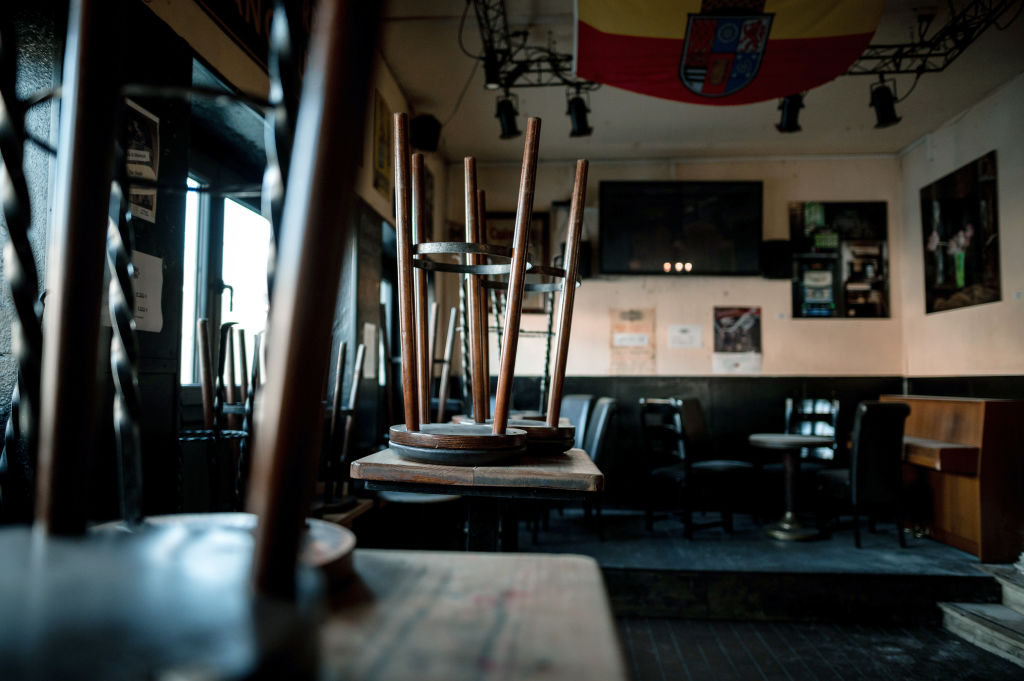
In Germany’s largest state, half of pubs have closed over the last two decades. It’s a grim sign of how rising prices are forcing people into a more atomized existence. (Fabian Strauch / Picture Alliance via Getty Images)

In 1976, Peter Alexander — probably the most famous German-language ballad singer of the postwar era — released a song in tribute to his local boozer. He sentimentally invoked a nostalgic popular memory of “the little pub on our street, where life is still worth living.” But not everyone could relate: Alexander received an indignant letter from a schoolteacher, chastising him for glorifying the pub. Life’s meaning, the educator insisted, should be found in more wholesome venues: the church, the theater, or private family life.

These days, the teacher and his ilk can rest easy: the pub the song called a “little piece of home” is a thing of the past. Pubs are disappearing. In Germany’s largest state, North Rhine-Westphalia, almost half of all pub owners have thrown in the towel in the last twenty years. In Brandenburg, eastern Germany, the government recently reported that in some districts more than 70 percent of pubs have closed their doors over the last decade. The much-lamented demise of pubs is the talk of the town in Germany and the world over.

But the reasons for the decline are far from self-explanatory. It is true that the COVID-19 pandemic was a disaster for the hospitality industry, and even many pub owners who held on are still paying off aid and loans. That crisis was soon followed by the war in Ukraine, leading to skyrocketing heating, electricity, and food costs — not only for venues but also for their guests, whose tighter budgets meant fewer evenings out.

Trade associations also bewail high bureaucratic hurdles and staff shortages. Pub owners preparing for retirement often simply cannot find successors. As a consequence, these once vital institutions of community life in villages and urban neighborhoods are rapidly disappearing.

All these problems are tangible and real, but we should not be under the illusion that the small pub on our street only came under real pressure with the pandemic. In fact, some regions have been complaining about the constant decline in drinking establishments for ten or twenty years. This also has something to do with lifestyle changes and new consumption habits among young people.

The Rise of the Couch

Thirty years ago, the average German drank 133 liters of beer a year; today, that figure is 88. According to the OECD, per capita alcohol consumption has fallen far less, but breweries and traditional beer bars are still struggling.

There are many signs that people are going out less overall, and when they drink, they are more likely to sip their Aperol spritz from the comfort of their own living room. One US study dates the beginning of this trend to the early 2000s. In Germany, too, the couch is increasingly becoming “the epicenter of modern leisure activities,” according to a report by the Foundation for Future Studies of the tobacco company British American Tobacco. This is a bad omen for a society that is already marked by excessive isolation and doomscrolling. Almost half of sixteen-to-thirty-year-olds in Germany feel lonely today, and dependence on social media appears to play a major role in this.

Faced with these devastating figures, it is hardly surprising that politicians are responding with alarmism to the dying pub culture of Germany. In Brandenburg, the conservative Christian Democrats (CDU) recently called for a special support program to preserve village pubs — a total of €7.5 million, with up to €150,000 paid out to individual establishments. The money is meant to be used for investments in “modernization, digitization, and barrier-free conversion, as well as the promotion of multifunctional service centers in rural areas.” It remains to be seen how far digitization measures will really be able to help Brandenburg’s struggling pubs.

One thing is certain: this conservative party’s attempt to cast itself as the savior of rural culture is particularly disingenuous. For decades, Germany’s mainstream parties have at best ignored the structural problems contributing to the decline of pubs and at worst actively fueled them. High electricity, water, and food prices, stagnating real wages, and skyrocketing commercial rents in cities and towns have not descended upon German pubs and their patrons as if through some natural disaster. They are the result of political decisions made by parties in government.

The Pub Crawl and the Labor Movement

Pubs have a long tradition in the socialist labor movement. Even today, organized pub crawls are held in London in memory of a memorable evening in the 1850s, when the friends Karl Marx, Edgar Bauer, and Wilhelm Liebknecht let a pub night get so out of hand that they found themselves fleeing from police. A few decades later, Karl Kautsky warned that the pub was the only place in Germany where the lower classes could come together and discuss their common affairs: “Without the pub, the German proletariat would have not only no social life, but also no political life.”

The image of smoke-filled pubs where workers with soot-smeared faces discuss the problems of class struggle at rustic wooden tables seems today like a scene from a costume drama. But the fact is that the pub, as the center of social life in working-class neighborhoods, really was an indispensable pillar of working-class social and political public life. Not only were political meetings organized here, but news was exchanged and friendships were formed.

The rise of the pub was thus inextricably linked to industrialization and the emergence of a modern working class, which, by the end of the nineteenth century, if not earlier, had blossomed into a coherent social force thanks in part to their after-work beers. Following the defeats of the labor movement in the 1980s and 1990s, the gentrification of formerly proletarian neighborhoods, and the deindustrialization of entire regions in eastern Germany and other areas now referred to as “structurally weak,” many traditional working-class milieus have dissolved, but without bringing class society to an end.

The current decline of neighborhood bars, ostensibly causing so much concern among Brandenburg CDU politicians, is largely the result of a successful class struggle from above, which has atomized the formerly well-organized working class and extended even into their private lives.

That’s not to say that support measures aren’t useful. Subsidies can clear renovation backlogs, and the removal of unnecessary bureaucratic hurdles may simplify the operation of many establishments. These measures should be carefully examined by politicians in consultation with trade unions and industry associations. Ultimately, this will not change the fact that many restaurants can only operate at a loss under conditions of comparatively low wages and high costs for food, rent, and energy.

Pubs for All, and All for Pubs

Over the past decade, the business model of many establishments in the hospitality industry has been based primarily on the ruthless expansion of low wages and temporary, poorly paid “mini-jobs.” This low-wage model is more common in hospitality than in any other sector of the German economy — more than half of all employees are affected. The fact that the main hospitality-industry trade association simultaneously complains about the shortage of skilled workers in the hospitality industry and about “rising wage pressure” is now a symptom of the generalized schizophrenia of German capital.

Most solutions are based on keeping unprofitable businesses alive at the expense of their workers, demanding they accept ever lower wages and longer working hours. But there is a way out of this mess that breaks with capitalist criteria, to everyone’s benefit. In many villages and small towns, associations and cooperatives are now forming to take over pubs threatened with closure or to revive pubs that have already been shut down.

Pubs managed by collectives have been a familiar feature in cities for decades, but now the model is finding its way into rural areas. In some cases these initiatives are entirely self-organized, while in others the local community provides financial support to purchase the properties or cover the rent. There are already examples of initiatives like these in North Rhine-Westphalia, Thuringia, Hesse, Bavaria, and several other federal states. In my tiny village in western Saxony, where there is only one bakery left and where the old village hall has been deserted for many years, the village community got together a few years ago and now organizes a volunteer-run pub night once a month.

The Left should promote projects like this and get involved wherever possible. Especially in eastern Germany, where the socialist party Die Linke still has a strong presence in some local councils, there may be opportunities for local politics that engage local people and have a tangible impact on their everyday lives. There seems to be a lot of interest in initiatives like this. For years, many in rural areas could do nothing but grit their teeth and resign themselves to watching their communities fall into decline. But now, in many places, real alternatives to rural exodus and isolation are emerging.

This is a very welcome development. We know that socially isolated people are more receptive to right-wing politics. That’s why the Left needs to support the social spaces that bring people more joy in life wherever possible, and that includes pubs. Back in 2017, researchers at the University of Oxford found that regular visits to the neighborhood pub make people happier and create larger social networks. So put your cell phone away in the evening and head to the pub around the corner, if you still have one. Cheers, comrades!

Share this article

Contributors

Sascha Döring works as public relations secretary for the Socialist Youth of Germany – The Falcons. He lives in Berlin.

Julia Damphouse is a historian of European socialism. She is a member of the editorial board for the English-language Complete Works of Rosa Luxemburg.

Filed Under