The Uprisings in Bangladesh Will Not Be Stopped
The assassination of Sharif Osman Hadi, the youth leader who rose from Dhaka’s 2024 uprisings, has reignited mass revolt and exposed the limits of Bangladesh’s elite-managed democracy.
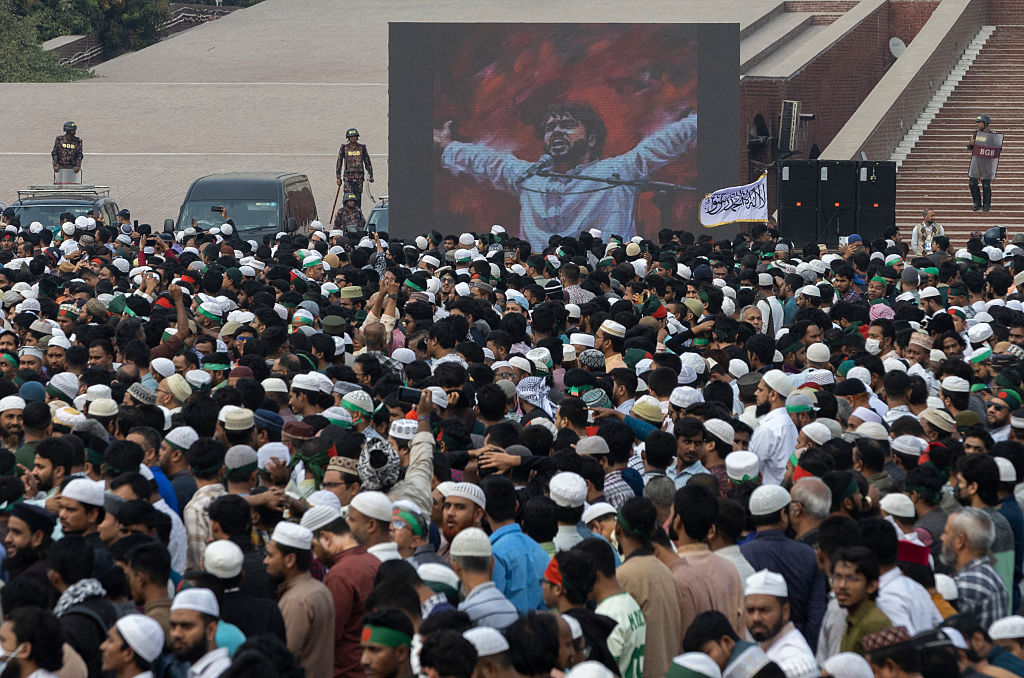
Mourners attend the funeral of the murdered youth leader Sharif Osman Hadi in Dhaka on December 20, 2025. (Abdul Goni / AFP via Getty Images)
DHAKA, Bangladesh — December 19, 2025. Dhaka’s winter air was thick with tear gas, burned paper, and the lingering smell of destruction. Near Shahbagh Square, students and workers surged toward the charred remains of the Prothom Alo and the Daily Star newspaper buildings, waving banners that read “Who Killed Hadi?” and “Media of the Elite, Enemy of the People.”
Streetlights flickered over broken glass and debris of the previous night’s violence. Police crouched behind water cannons. This time, the protesters chanted not for wages or jobs but for justice for Sharif Osman Hadi, the thirty-three-year-old firebrand whose life and death have once again turned Bangladesh into an epicenter of revolt.
On December 12, Hadi was shot by masked assailants while leaving a mosque in central Dhaka. He had been preparing to contest the February 2026 elections as an independent candidate — the first political figure to emerge from the post-2024 youth uprising to challenge the country’s entrenched political order at the ballot box.
After nearly a week fighting for his life in a Singapore hospital, Hadi died on December 18. The arrival of his coffin at Hazrat Shahjalal International Airport ignited the spark. Within hours, thousands poured into the streets.
By December 19, Dhaka was under curfew. But the uprising had already spread — from Chittagong’s industrial belts to Rajshahi’s university campuses, from the border towns of Jashore to the tea gardens of Sylhet. Protesters attacked police outposts, government offices, and, most symbolically, the headquarters of the country’s largest media networks.
The Unfinished Revolution
For fifteen years, Sheikh Hasina, the daughter of Bangladesh’s founding father and the country’s longest-serving prime minister, governed with an iron grip, cloaked in the institutions and language of democracy. Her government presided over years of economic growth but also crushed dissent, muzzled the press, and reduced elections to rituals of control.
When her regime finally collapsed in August 2024, toppled by a student- and labor-led uprising, many inside and outside Bangladesh hailed the moment as a democratic rebirth. Western embassies praised a people’s transition, and international media celebrated what they called the “Bangladesh Spring.”
But the celebrations masked a deeper unease. The revolt that ended Hasina’s rule had not yet delivered on its promise. What emerged in her place was a fragile caretaker order: a democratic transition without democracy.
In the weeks after Hasina’s fall, student groups and young activists who had paralyzed Dhaka through protests and mass strikes began searching for a path from the streets to formal politics. For a moment, it seemed possible that the youth who had driven that uprising might transform protest into power. At the center of that hope stood Sharif Osman Hadi.
A Dhaka University graduate in political science, Hadi emerged from the 2024 uprisings as both a symbol and a strategist. Rejecting allegiance to the country’s dominant parties — the Awami League and the Bangladesh Nationalist Party — he positioned himself as part of a new generation seeking to rebuild the country’s politics from below.
As spokesperson for Inqilab Moncho, Hadi became a leading voice for youth mobilization, civic participation, and democratic reform. By late 2025, he was preparing to run as an independent candidate in the upcoming national elections. His assassination this month sparked nationwide protests and an outpouring of grief.
Meanwhile, the energy of the 2024 youth movement was colliding with the realities of governance. By early 2025, a temporary government led by Chief Adviser Muhammad Yunus had taken charge, promising stability and elections while struggling to contain unrest.
Hadi remained active through this period, appearing at rallies and public forums as one of the most visible political figures to emerge from the post-2024 movement. His killing shocked the nation, triggering protests, detentions, and renewed questions about whether Bangladesh’s promised transition would ever reach its destination.
A Democracy Managed From Above
To understand the rage now sweeping Bangladesh, one must see how the promise of “transition” obscured the continued power of the ruling class.
After the uprising that drove Prime Minister Sheikh Hasina from office, Yunus’s caretaker government was tasked with restoring stability and preparing elections. Presented as temporary and impartial, it quickly became mired in controversy, as its handling of unrest, civil liberties, and reform was contested amid mounting clashes and political tension.
In practice, the caretaker government’s priorities aligned closely with those of Bangladesh’s economic elite. Restoring financial stability and reassuring investors took precedence, with global lenders like the International Monetary Fund (IMF) and the World Bank backing a familiar program of economic adjustments.
The garment industry, which employs more than four million people and drives Bangladesh’s exports, remained untouched. Its profitability continued to rest on low wages and weak labor protections — conditions that have produced recurrent strikes and unrest, including the mass garment workers’ protests of 2023.
Hadi’s movement, organized through Inqilab Moncho, unsettled the country’s political and business establishment. His call for greater social equity, stronger labor rights, and a decisive break from the patronage networks of the old elites alarmed both political and business leaders. In the months before his assassination, prominent commentators increasingly portrayed him as an idealist out of step with Bangladesh’s economic realities.
Hadi sensed the danger closing in. In his final public appearances, he warned that Bangladesh’s new generation of reformists faced entrenched interests that would never relinquish their power peacefully. Days later, he was gunned down in Dhaka, confirming the fears he had long voiced.
The Media as Battlefield
The torching of Prothom Alo and the Daily Star shocked many in Bangladesh and drew widespread condemnation from journalist associations and international press freedom groups, which denounced the attacks as assaults on media independence.
For years, these newspapers had positioned themselves as ethical lodestars: English and Bengali newspapers shaping elite- and middle-class opinion in the capital. But to the many young protesters from working-class families who took to Dhaka’s streets in 2024, they often appeared less as watchdogs than as the polished face of establishment consensus.
While the papers reported the unrest and urged restraint, many demonstrators accused them of siding with elite interests and political power — particularly amid outrage at state repression and forced disappearances.
After Yunus’s caretaker government took power, these media houses amplified official messaging centered on “economic recovery” and “reconciliation.” Coverage of Hadi often framed him as a confrontational populist threatening stability rather than as a product of a mass democratic movement.
That framing endured. When he was killed, many of his supporters saw the media not as witnesses but as accomplices. The attacks on the news offices were not random acts of mob violence; they were symbolic retaliation against institutions widely perceived as complicit in sidelining the revolution.
“It is not freedom of press they defend,” says Arifa, a twenty-three-year-old protester speaking by phone after a night spent barricading roads. “It is freedom of profit.”
His anger echoes a broader, if uneven, erosion of trust in mainstream media seen in other countries where outlets are closely entwined with political and economic elites. In Bangladesh, where television channels rely heavily on corporate sponsors and donor funding, the line between journalism and public relations has grown increasingly thin.
Hadi sought to bypass these constraints by engaging directly with the public online, combining grassroots reporting with political education. But none of the platforms he launched achieved lasting reach. Efforts to amplify youth perspectives were repeatedly disrupted by censorship and shutdowns.
The burning presses have since become a potent symbol of Bangladesh’s media crisis; a reckoning over what happens when “press freedom” is widely perceived to serve power rather than the public.
India’s Shadow
If Hadi’s death exposed Bangladesh’s internal contradictions, it also sharpened external ones — above all, concerns over India’s influence in the country.
For decades, India and Bangladesh have maintained close ties, with New Delhi viewing Dhaka as a key partner in South Asian geopolitics and regional connectivity. Under Hasina, bilateral relations deepened through defense agreements, joint military cooperation, and expanded trade and infrastructure projects, even as strategic competition with China and questions of economic influence remained part of the broader regional context.
That relationship was thrown into uncertainty in August 2024, when Hasina fled to India, abruptly ending her long rule and leaving New Delhi closely associated — fairly or not — with the old political order.
In the aftermath, Indian officials publicly emphasized stability and the need for peaceful, credible elections. But relations grew strained amid disputes over Hasina’s continued presence in India and security concerns surrounding Indian diplomatic missions to Dhaka.
When protests erupted following Hadi’s death, demonstrators chanted, “Delhi, Hands Off Dhaka!” Outside the Indian High Commission, thousands waved placards accusing India of “shielding murderers” and “exporting counterrevolution.”
India’s government condemned the violence and denied any involvement in the country’s internal affairs. Yet the perception of interference has persisted, fueling nationalist rhetoric and the deepening mistrust that continues to shape Dhaka–New Delhi relations.
A familiar regional pattern is at work. From Sri Lanka’s IMF negotiations to Nepal’s constitutional crises, New Delhi is often seen as acting less as a democratic partner than as a manager of instability — seeking continuity over transformation when strategic or economic interests are at state.
“We fought [for] one liberation in 1971,” a student organizer said over the phone, referring to Bangladesh’s war of independence. “Now we are fighting [for] another, from the shadows cast by our friends.”
The Generation Without a Leader
The political vacuum left by Hadi’s assassination is profound. Within his movement, grief has mingled with fear. Major offices have been attacked, and social media has been flooded with competing narratives — some portraying Hadi as a “foreign agent,” others branding his followers as extremists.
Yet the energy unleashed by Hadi’s death has not dissipated. Across Dhaka and other cities, thousands have taken to the streets demanding justice, chanting Hadi’s name. At several universities, students have held sit-ins and protests in his honor. Demonstrations continue to disrupt traffic and block key roads, while public mourning has spread beyond the capital, with nationwide rallies calling for accountability.
His death has, paradoxically, radicalized a new generation. “He taught us that politics is not waiting for permission,” says Munir, a garment worker, who first joined the protests in 2024, speaking by phone. “Now we know what that costs.”
Bangladesh’s struggle for change has long carried a heavy toll. Noor Hossain, shot dead by police during a pro-democracy protest in 1987, became an enduring symbol of resistance. The 2019 killing of Abrar Fahad, a university student beaten to death at Bangladesh University of Engineering and Technology, sparked nationwide protests against campus violence and political intimidation. Together these episodes underscore the risks faced by youth movements confronting entrenched power.
But Hadi’s death feels different. It comes at a moment when youth movements worldwide — starting with Chile’s Primera Línea during the 2019–2020 uprising to Nigeria’s #EndSARS protests against police brutality to the Gen Z–driven revolts across South Asia — have grappled with the same dilemma: how to turn street energy and moral authority into durable political influence without being crushed or co-opted.
After the Fire
Days after Hadi’s death, Dhaka was tense under a heavy security clampdown. Yunus’s caretaker government deployed police and paramilitary forces to “restore order.”
Armored vehicles stood at key intersections; soldiers guarded the roads leading to the capital’s press district. At the site where Hadi last spoke in public, mourners gathered with red flags and candles, chanting his name and demanding justice for a generation that has refused to be silenced.
In a narrow alley nearby, a group of young people shared tea by candlelight. They spoke of exhaustion, of comrades missing or in jail, but also of stubborn hope. One of them, Shakib, a university dropout, put it simply: “They killed a man. Not the idea.”
His words capture the paradox of Bangladesh today: a country suspended between rebellion and resignation, its streets haunted by the memory of a revolution that almost was.
The question now is not whether the youth will rise again — they already have — but whether the world will hear them this time, beyond the static of managed democracy and media spin.