Debt: An American Tragedy

Kristin Collier

After learning her mother took out $200,000 of debt in her name, Kristen Collier felt betrayed. Her new book traces how it pushed her to expose unscrupulous lenders who upend the lives of millions across the US.
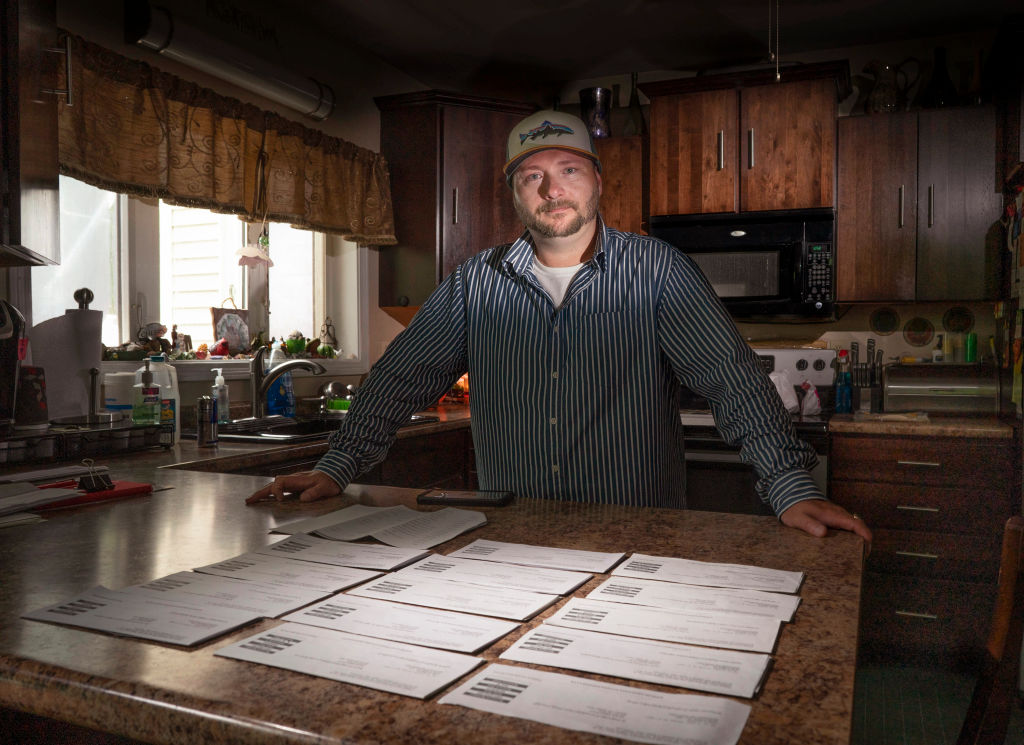
Debt — from student loans and medical bills to credit cards — shapes American life. (Gregory Rec / Portland Press Herald via Getty Images)

Interview by
William Harris

It is easy to find good reporting and commentary on the US student debt crisis, but there has been little writing that captures how the crisis feels for those living through it: the way debt threatens relationships, health, and people’s hopes for the future. Kristin Collier’s new book, What Debt Demands: Family, Betrayal, and Precarity in a Broken System, steps in to fill this gap.

On its face, What Debt Demands is a memoir of the author’s rather particular and extreme experience with debt. In 2008, as she sat in a bank office applying for her first credit card, Collier learned that her mother had stolen her identity, taken out an enormous amount of student loans in her name, and left her with over $200,000 in debt. This is the book’s opening. What follows, however, is not so much a family drama as a social one.

In Collier’s hands, the unreal, sudden, fantastical feel of her debt becomes not just a private affliction but a symbol for the multiplying zeroes and hemmed-in futures that shape the lives of the vast majority of American college students. By blending history, cultural criticism, and interviews with other debtors into her own story of navigating a predatory loan system, Collier captures the experience of debt in its felt totality, writing a memoir that manages to tell the story of an entire oppressive system and what we need to do to overcome it.

Will Harris spoke with Collier about her book in Chicago on December 8, at the worker-owned bookstore Pilsen Community Books.


William Harris

Maybe we can begin with the story of your debt.

Kristin Collier

I learned about the debt, for the first time, from the loan officer who handed me a credit report with fifteen or so items I had never seen before: debts for credit cards, student loans, a few debts in collection. None of it made any sense, and I thought that a stranger must have taken my identity, which was partially true. Someone had taken my identity, and I learned, after I called my mother for help, that it was her.

It was such a heartbreaking and fracturing moment. My mother explained that she needed the money because my parents were going to lose our family home. It felt hard for me that I was being asked to take on the survival of the family. But it also sort of made sense, because I had trouble conceptualizing the loss of a home. I thought, “Okay, this money went to our home, which is sort of for a good reason, and we’ll figure out how to fix it later.” A few months later, I got a call from my aunt to say that my mother had been arrested for workplace embezzlement. In that conversation I learned that this was not just a matter of potentially losing a house but that my mother had a gambling addiction.

At first, I thought that there would be a way to remove this debt from my name, since the loans were not actually mine, but I could not easily do that for reasons unique to student loans. I spoke with lawyers, and it seemed like the only way that the private lenders who owned the debt were going to release me from it was if I pressed criminal charges, which I did not want to do. I didn’t feel like involving the criminal legal system was going to be good for my mom or good for me or good for our relationship, and I knew right away that I didn’t want to take that avenue.

Another complicating factor is that student loans are for the most part protected from being discharged in bankruptcy, so that was not an option either. I realized I would have to keep paying these loans. And because the interest rates were very high, it felt like I was going to pay them until I died.

William Harris

Once they’ve learned the backstory, a reader might expect two possible paths for your book. You can see one story going toward reconciliation and forgiveness, and another toward anger and personal justice. But your book does something else. It moves beyond a narrowly personal register and frames debt as a broader, collective burden, affecting wide swaths of society. How do you make that connection?

Kristin Collier

The book captures the personal journey I went on as a borrower, trapped in this system, slowly becoming aware of the predation and inequality that was entrenched in the model. At first I felt intense shame and isolation. Debt often creates that emotional experience for borrowers. Culturally, we’re told that to be in debt is to be failing morally, especially if we can’t pay that debt back. Even though I hadn’t acquired the debt, I also felt that way. I didn’t talk about debt with friends or colleagues; if I did talk about it I did so in very limited ways because I was embarrassed.

Gradually, that experience of shame and guilt shifted outward as I placed blame on the lenders and the government. I can remember a particular turning point, when I first began to understand it was not about me or my mom or any one person’s decision. I needed my loan servicer, American Education Services, to send me paperwork, so I could refute each individual loan that they managed. But they wouldn’t send it to me. I would call them, and they would say, “We already mailed it to you,” and they hadn’t.

Then I would ask, “Could you email it to me?” And they couldn’t email it to me, and they also couldn’t fax it to me. Eventually I got a lawyer involved, and then I needed to sign different kinds of permission for him to communicate with them, but they also wouldn’t send me those permissions, and so my lawyer couldn’t talk to them. It became sort of darkly funny how hard it was to get information about the loans. The level of security around the paperwork stands in absurd contrast to the security around the actual loans.

As I began to research the book, I tried to understand and capture the system I was ensnared in, interviewing borrowers who hadn’t experienced fraud but had knowingly taken out student loans and were suffering just as much as I was. Some of them borrowed the average amount of money, around $30,000, and they found jobs after school, and they made loan payments on time. In these cases, everything worked as it was supposed to, and yet they now owe significantly more than they borrowed and are watching their futures collapse. Nothing that was promised has been delivered.

William Harris

How did that system develop? What is the history behind the expansion of student debt in the US?

Kristin Collier

The contemporary loan system was born out of the Higher Education Act of 1965, which was the largest expansion of higher education in US history. That legislation doubled the budget for higher education, provided necessary aid to historically black colleges, and offered grants to poor students — making college accessible for people who had previously been shut out. But it also created a tuition model for education, which is different from how K–12 education is funded. Rather than the state directly funding colleges, colleges charge students tuition, and the state provides aid, to the degree it does, through grants or loans.

One of the first loan programs was a guaranteed loan program. The federal government created this public-private partnership, where private banks issued loans at interest rates lower than elsewhere in the private market, and then the federal government offered private banks interest-rate subsidies. If students didn’t pay back the loans, the government would pay back the loans for the students. This was a lucrative arrangement for banks, and eventually this loan program was phased out because it was much cheaper for the government to cut out the middlemen and offer loans directly to students. But loans remained baked into the funding model. So as more and more people wanted to go to school, and school became more expensive, the federal government expanded the loan program, which was easier, politically, than universally funding higher education.

William Harris

Your book grounds this history in memoir and narrative. One effect of that is that words we might normally read in private ways become newly apparent in all their social meaning. The word “betrayal,” which appears in your subtitle, is one example of that.

Kristin Collier

The most obvious betrayal is that of my mother. But the other betrayal that animates the book is the government’s. Our leaders did not fight hard enough to give us free public education, the only system capable of addressing the inequality that the lending system has both produced and reinforced. It’s only this system that can offer us the education we deserve, one that can change all our lives.

And that betrayal produced a second: a private student loan market that is wildly unregulated. The student loan product my mother used was called a direct-to-consumer loan. She was able to borrow $30,000 at a time, with interest rates as high as 14 percent. My school did not have to certify the loan, which meant that my lender had no idea what the tuition was or what other kinds of aid were offered. These loans were not dispersed to schools but directly to borrowers’ bank accounts. And often these loans would be listed on the aid letter, so students assumed that these were being offered by the school or the federal government, which would mean they came with more generous repayment plans and protections. Lenders sold these loans to investors and became incredibly rich. These loans should never have been offered to any student and should not have been available for my mother to abuse. Our government that should, at the minimum, protect us did not.

It’s been harder for me to linger on my mother’s betrayal because my primary instinct is to understand what happened to me in a social and political and historical context. But she did harm me, and that harm was only possible because she was my mother and had access to my social security number, my signature, and my birthdate. The betrayal was familial and intimate and felt, because of our physical ties, almost bodily. The question of forgiveness is everywhere in the book. As a young narrator and as an adult researcher and writer, I’m trying to understand what it would mean to forgive my mother and trying out new definitions over and over. I want to know what I owe her and owe myself, and I don’t know that I really figure that out.

This idea of forgiveness becomes complicated by the government’s usage of this language with us borrowers, when it relieves us of our debt through Public Service Loan Forgiveness or through another discharge mechanism. Their word choice suggests that we have erred, and they have been kind and gracious, rather than the truth: they have erred, and we are owed cancellation.

William Harris

I’m curious about the challenge of describing debt as an experience. You talk about debt as a kind of haunting, a Kafkaesque nightmare, or a conflation of past, present, and future.

Kristin Collier

When I was living with debt, I struggled to explain to people how it felt. This difficulty was then replicated again in my life as a writer. Haunting felt like a useful metaphor because debt is very visible to the borrower but no one else. No one could see the fear I felt using my debit card to buy groceries, worried that a wage garnishment would mean it was rejected.

My debt was both sort of dead and bureaucratic and numerical and then entirely alive, coming to me in the form of debt collectors or debt notices that followed me everywhere. I described a particular debt in the book, which returned to me later after I thought it was discharged, as a zombie debt, which I later learned is a common term for resurrected debt that collectors try to illegally collect. A zombie can be surreal or uncanny, stalking you, forcing you into contact with something that looks human but isn’t. It’s another great metaphor for debt, which is absolutely the opposite of the real human relationships that make life worthwhile.

William Harris

Lastly, in addition to being a writer and teacher, you are an organizer with the Debt Collective, an organization that works to abolish debt. What has been your experience organizing around debt, and how does that influence how you see the future of debt? During the Biden administration, it looked like student debt might be canceled en masse. Meanwhile, new forms of debt continue to proliferate. People buy groceries with $30 increments they get from apps. Sports gambling has become a mass phenomenon. How do you think about the future of debt, and where do you see hope?

Kristin Collier

The Debt Collective is a union of borrowers, born out of Occupy Wall Street, when a group of organizers got together and started buying up and canceling debt. We are still fighting for debt cancellation today. The Debt Collective also works to create better social provisions to keep people from getting into debt to begin with. So we’re fighting for universal higher education, free school lunch, universal health care, and social housing. The future of debt contains both abolition and a robust social safety net.

Your reference to the Biden administration is a really useful example of relief that once seemed impossible. Biden himself fought for some of the worst bankruptcy reforms. He’s from the credit card capital of the country, and historically he has been against broad-based cancellation.

Through the efforts of organizers, however, Biden did an about-face and issued mass cancellation while also reanimating the Public Service Loan Forgiveness Program, which had been entirely stalled. And he followed through on the promise of borrowers’ defense, which is a pathway you can use to discharge debts if your school defrauded you. Together, these programs led to billions of dollars in debt cancellation. Biden didn’t want this cancellation, but borrowers forced his hand through debt strikes, by telling their stories publicly, by leaning on elected representatives, and by building coalitions with unions across the country.

These past victories tell me that victory will be possible again in the future. People are suffering. Student loan delinquency rates are at the highest they’ve been since 2010. That’s true with automobile loans and credit card delinquency rates too. There are all these metrics telling us that people can’t afford their lives. But we can organize to change this and to build a better world.

In October, before the book came out, I led a narrative workshop with the Debt Collective where I helped people craft their own stories about debt. I’m a totally unknown person. No one had ever heard of me. Yet so many people came. And they shared their experiences and bits of writing. Many of us want to tell these stories about debt, not just as a way to heal but as a way to engineer a larger change. Through collective work, of course, we always have hope.

Share this article

Contributors

Kristin Collier is the author of What Debt Demands: Family, Betrayal, and Precarity in a Broken System.

William Harris has written for n+1, New Left Review, the Los Angeles Review of Books, the Point, and others. He studies English literature and teaches writing at the University of Chicago.

Filed Under