The Domestic Costs of CIA Covert Action Abroad Run High
As the CIA has waged war through covert actions across the globe, the consequences have blown back on American shores with deadly consequences. Last month’s killing of two West Virginia National Guard members in Washington, DC, appears to be just such a case.
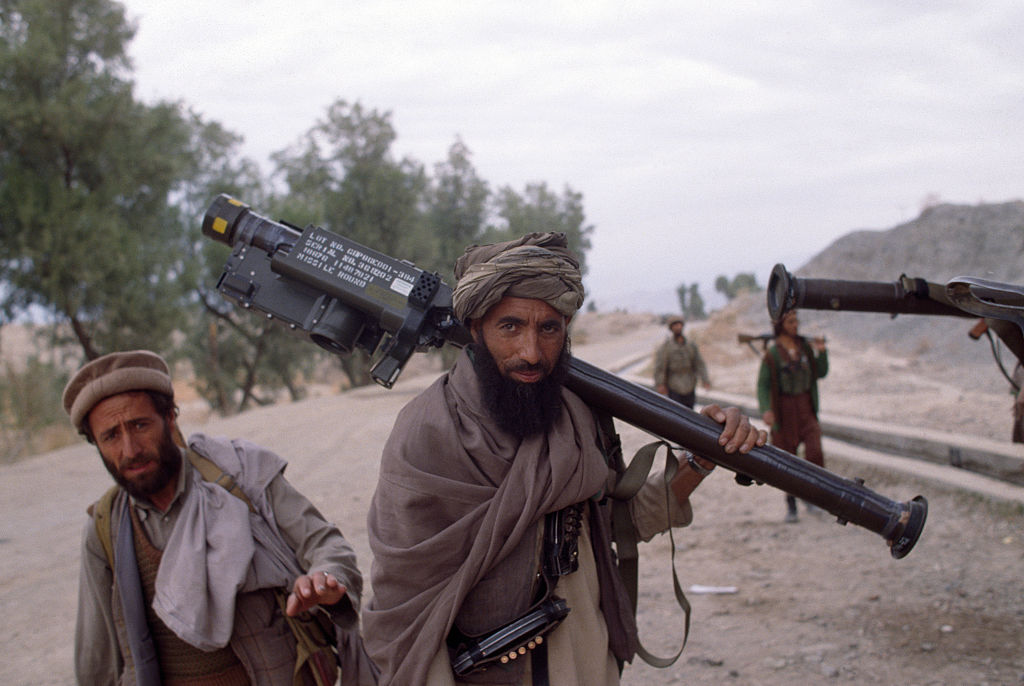
The consequences of the CIA’s hubristic machinations around the world frequently blow back on American shores with deadly consequences felt by ordinary Americans rather than elites. (Robert Nickelsberg / Getty Images)
On the evening of November 26, Andrew Wolfe and Sarah Beckstrom were stationed outside the Farragut West Metro Station in Washington, DC. Both were members of the West Virginia National Guard. As part of Donald Trump’s attempt to transform Democratic-voting cities into war zones, they had been sent to the nation’s capital. The two young West Virginians were approached by a man who opened fire, shooting both of them. Wolfe was critically injured; Beckstrom was murdered.
The killing of twenty-year old Beckstrom was a heinous, senseless act of violence. Trump and his supporters, like politicians throughout US history, have cynically latched onto this tragedy to justify Trump’s decision to deploy American troops against American citizens in cities where their presence is unwelcome. And as the alleged shooter, Rahmanullah Lakanwal, was an Afghan refugee, the Trump White House has doubled down its xenophobic policies, promising to “permanently pause migration from all Third World Countries.”
But the alleged shooter is not any ordinary immigrant. Lakanwal was brought to this country thanks to his work with the Central Intelligence Agency (CIA) as part of what can only be described as a death squad. As horrific as the shooting was, it is not the symptom of the “American carnage” Trump falsely claims is laying siege to cities where the majority of Americans did not vote for him. Instead, the killings are part of a deep, systemic problem, one that is deeply inconvenient for political elites across the spectrum.
As the CIA has waged war through covert actions across the globe, the consequences of their hubristic machinations have blown back on American shores with deadly consequences. And those consequences are seldom felt by the elites who push the wars, but rather felt by ordinary Americans.
Death Squads
Rahmanullah Lakanwal was formally charged with the murder of Beckstrom. In a hearing that took place while he was in a hospital bed, he pleaded not guilty. Like all people charged with a crime, he is entitled to a presumption of innocence. But assuming the government’s case against him — which is indisputably very strong — is true, his background raises alarming questions.
Lakanwal was brought to the United States in 2021 as part of Operation Allies Welcome, a program designed to evacuate Afghans who aided the US war in Afghanistan, in part because their assistance to the US war rendered them especially vulnerable to Taliban retaliation. Lakanwal had been a veteran of the “Zero Units,” a CIA-backed paramilitary force noted for atrocities. According to reports, Lakanwal first began participating in the CIA units at age fifteen. While that puts him just barely below the age of a prohibited child soldier under international law, it is a remarkably young age to be placed in combat.
And it appears his participation continued until the United States’ withdrawal from Afghanistan. Lakanwal is currently twenty-nine, meaning roughly a third of his life was spent fighting in these units. Not only is the young age at which Lakanwal first began fighting for the CIA stunning, so too is the longevity and nature of his service. While some media reports refer to the Zero Units as “elite” counterterrorism or paramilitary units, they are more accurately described as death squads.
According to a Human Rights War report, the CIA-backed units were guilty of extrajudicial killings of civilians. The units often received US air support and were at times accompanied in their missions by US Army Rangers. The Zero Units were closely associated with “night raids,” “kill or capture” missions that take place at the homes of alleged insurgents at night. As they involved more killing than capturing, night raids were essentially a program of assassinations.
In his masterful book The Fort Bragg Cartel, journalist Seth Harp has documented how these targeted assassinations came to be a hallmark of post-9/11 foreign policy. Faced with an insurgency in Iraq, the Bush administration employed a strategy of assassinations, including through the use of night raids.
The shift in Iraq from conventional war to assassinations by Special Forces was masterminded in large part by General Stanley McChrystal. When Barack Obama campaigned for president, he called for an escalation of the US war in Afghanistan. This was part of his perverse contention that the real problem with Bush’s Iraq War was not the criminality of the invasion or human toll of the war, but that it was a “dumb war” that distracted from the good war in Afghanistan.
Apparently impressed by the bloody success of extrajudicial killing in Iraq, Obama exported this strategy to Afghanistan. He expanded not just the use of night raids but also the global use of drones in targeted killings, making the expansion and institutionalization of assassination as the chief weapon in US foreign policy Obama’s greatest legacy.
It is this assassination program that Lakanwal spent a third of his life carrying out. According to Drop Site News, Lakanwal was one of several members of a Zero Unit arrested in Afghanistan “after Zero Units killed Afghan police forces in Kandahar they were supposed to be defending.” His imprisonment was very brief. Granted full impunity by the Americans, the Afghan state had virtually no authority over members of the CIA-backed death squad. During his brief detention, the CIA kept paying Lakanwal. And then they brought him to the United States.
Lakanwal’s potential motive remains unclear. His lawyers have disputed the government’s charge that he ambushed the two National Guard members, claiming “all the known evidence of Mr. Lakanwal’s allegiances show his solidarity with US military personnel.” Those who knew Lakanwal report he increasingly experienced personal crises, potentially caused by post-traumatic stress disorder.
That a member of what was essentially a CIA-run death squad allegedly carried out a domestic attack is troubling but not unprecedented. Long before the CIA was in Afghanistan as part of the “global war on terror,” it funded the armed Islamist mujahideen in Afghanistan, first against Afghanistan’s pro-Soviet government, then, following a Soviet invasion, the Soviet Union itself. Marketed at the time as freedom fighters, the anti-Soviet militants were at the root of the movements that the US government would later deem terrorists.
The transformation of yesterday’s allies into today’s enemies did not hurt the CIA’s standing within American life. The shift from fighting the Soviet menace to the terrorist threat continued to allow them to enjoy large budgets with which to carry out shadowy operations across the globe. But it did produce a number of temporary embarrassments for the CIA.
The CIA’s Last Afghan War
Before the September 11 attacks, individuals with clear ties to the anti-Soviet mujahideen were accused of being involved in terror plots against the United States. In some of the cases, they reportedly received visas from the CIA to come to the US. Revelations that Omar Abdel-Rahman, known as the Blind Sheik, had received a CIA visa prompted media discussion about “blowback,” the CIA’s term for unintended consequences from its covert actions. In spite of serious reporting from mainstream media, the CIA downplayed these types of connections, and the stories were quickly memory-holed. Although these incidents remain shrouded in mystery to this day, they offer insights into how the CIA’s covert wars abroad come home.
Roughly thirteen years before the United States launched its post-9/11 war in Afghanistan, Lt. Col. Robert Anderson was stationed at the John F. Kennedy Special Warfare School at Fort Bragg. Under his command was Ali Mohamed, a former Egyptian military officer and naturalized US citizen. Anderson had become increasingly concerned about Mohamed, whom he deemed a fanatic. Shortly after the meeting, Mohamed informed his fellow military members that he would be taking his vacation to go to Afghanistan to fight the Soviets alongside the mujahideen. When he returned, he gave belts from the uniforms of Soviet soldiers he boasted of having killed as souvenirs.
Mohamed’s choice of vacation was not merely unorthodox. As a uniformed soldier, going to fight on behalf of a foreign force flies in the face of military regulation. Anderson wrote up multiple reports with the intent to have Mohamed court-martialed. His efforts were thwarted. This led Anderson to reach a second conclusion: that Mohamed was “sponsored” by US intelligence, most likely the CIA.
It was not just that Mohamed was able to freely travel to fight alongside the CIA-backed mujahideen that triggered Anderson’s alarm. It was his strange background. A naturalized citizen, Mohamed was born in Egypt, where he was both an officer in the Egyptian military and a member of the Egyptian Islamic Jihad, the latter of which had assassinated Egyptian president Anwar Sadat. One of the assassins was even in the same military unit as Mohamed.
At the time, Mohamed was not in Egypt. He was at Fort Bragg, training at the same special forces school he would later be employed by. Nonetheless, in 1984 he was dismissed from the Egyptian military due to his suspected “extremist” ties. According to the CIA, Ali walked into the Cairo embassy looking to become an asset. They either rejected him outright or quickly decided he was untrustworthy.
Yet just a year after being dismissed from the Egyptian military, Mohamed boarded a plane to the United States. On the flight, he met an American divorcée. Six weeks later, they were married. He quickly obtained a green card and then US citizenship. Within a year after being in the United States, he enlisted in the military. And once again, he was at a Special Forces training school at Fort Bragg. As Anderson would later tell journalists, one would have a better chance of winning the lottery “than an Egyptian major in the unit that assassinated Sadat would have getting a visa, getting to California . . . getting into the Army and getting assigned to a Special Forces unit.” Unless, of course, they had some help from friends in US intelligence.
Anderson is not the only one to reach the conclusion that Mohamed’s arrival in the United States was the work of US intelligence. A decade after he first came to the US, the Boston Globe reported this was part of a CIA visa waiver program. Journalist Peter Lance, who covered Ali extensively, similarly reported it was the CIA who brought him to America. The CIA has denied this.
If Mohamed had merely been a potential CIA asset in its Afghan war, he would likely be forgotten. But Mohamed turned out to be a double agent for al-Qaeda. In this role, he personally met with Osama bin Laden and provided training based off of US special operations manuals. He also participated in plots to kill US soldiers and the 1998 al-Qaeda bombings of US embassies in Africa. Here the US government finally caught up with him. He was charged with the embassy bombings. In order to avoid a death sentence, he pleaded guilty.
Yet the strange circumstances that marked nearly every aspect of the al-Qaeda double agent’s life continued. Mohamed was never sentenced. Purportedly, this was because he had become a US intelligence asset cooperating by sharing what he knew about Bin Laden. Over a quarter century later, his whereabouts are still completely unknown, as he is presumably under the protection of US intelligence.
Protecting the CIA’s Covert Actions Doesn’t Come Cheap
Remarkably, Mohamed’s indictment for participating in the al-Qaeda bombings of US embassies was not the first time he was mentioned in a US terrorism prosecution.
In 1993, the World Trade Center was bombed. Facing backlash over their failure to prevent the attacks, the Federal Bureau of Investigation (FBI) escalated its surveillance of Muslim and Arab individuals in the New York area, eventually accusing the Egyptian cleric Omar Abdel-Rahman along with nine others of plotting to blow up New York City monuments and assassinate US politicians and Egyptian dictator Hosni Mubarak.
To accomplish this prosecution, the US government turned to the seditious conspiracy statute, a broad law passed after the Civil War to make it a crime to conspire to levy war against or overthrow the US government. The defendants were represented by a number of prominent leftist attorneys who argued the charges were concocted in order to retaliate against them for their views. Much of their focus at trial was on the extremely troubling FBI informant at the center of both the monuments case and the actual prosecution of the World Trade Center bombing prosecution. Some of the defendants took the stand to say they were training to fight in Bosnia, not carry out domestic attacks in the United States.
One of the defendants made another claim in their defense. El Sayyid Nosair, who had assassinated the extreme Zionist rabbi Meir Kahane (who was himself connected to separate terror attacks in the US and Israel), gave as his defense that he was actually part of a CIA program to fight the Soviets in Afghanistan. To support this claim, his lawyers entered into evidence that he had received training from Mohamed.
Before plotting al-Qaeda attacks on US embassies, Mohamed traveled to the New Jersey area to provide the accused US-based terrorists military training. Much like with Bin Laden’s men, those trainings were based on manuals from the US military. All of the defendants were convicted. And while Mohammed’s role in training what the US alleged was a terror cell has become an official part of the story, the government denies it was part of any covert action.
The man who trained Bin Laden’s bodyguards and a terror cell in the United States and planned al-Qaeda bombings had worked for a US special warfare school. He occupied that position in spite of his troubling past in Egypt and kept it even as he traveled overseas to fight with foreign forces. Everyone who encountered Mohamed from his commander at Fort Bragg to the defendants in the monuments plot believed he was working for the CIA. This conclusion has been reached by the journalists who have studied him. CIA covert actions rely on unsavory, untrustworthy, and dangerous characters. Shielding them comes at a cost.
Mohamed’s training was not the only possible CIA connection that turned up as the supposed terror cell was scrutinized. How the Blind Sheik, who was on a State Department terror watch list, was able to travel in and out of the United States and ultimately obtain a green card, became a major question. New York magazine reported that one of the Blind Sheik’s trips to the US in the 1980s was sponsored by the CIA with the hopes of rallying support for the anti-Soviet mujahideen fighters. In fact, between 1986 and 1990, each of the six visas received by the man the United States would later declare a terrorist threat were approved by CIA employees.
That the CIA possibly, as part of its covert actions, brought to the US the man at the center of what was then the largest terrorism trial in US history understandably raised outrage in the media and in Congress. An official inquiry exonerated the CIA of intentionally bringing the Blind Sheik to the United States. Instead, CIA officers said they simply made a mistake, not realizing who he was six separate times.
While such dramatic incompetence is possible, especially from the US intelligence community, it is difficult to accept at face value. The Blind Sheik’s name was on a State Department watch list, and his group was the subject of CIA surveillance. In the United States, he was watched by the FBI, who clearly understood who he was. And in 1990, the New York Times published an article noting the Blind Sheik was both on a terror watch list barring him from entering the US and was living in Brooklyn.
Decrying the entry as a mistake, State Department officials told the paper of record his visa would be revoked. This meant that federal officials knew exactly where the Blind Sheik was and that he was not supposed to be there, and that they were talking to the media about it. Yet in spite of this, he was granted a green card — again dubbed a mistake. Confounding matters further, after the Blind Sheik had his immigration status revoked, he allegedly left the US and returned, something that should have been impossible.
The blind CIA letting the Blind Sheik into the United States is certainly an embarrassment. But it was a convenient one. Ron Kuby, a famed leftist attorney who represented the accused during the World Trade Center bombing and seditious conspiracy trial, argued that the US had attempted “to create a right-wing Islamic version of the Abraham Lincoln Brigade,” the group of Communist Party–affiliated Americans who went to Spain to fight in the civil war against fascism. Highly motivated and armed and trained by the United States, once the CIA moved on, the accused terrorists became a liability.
By putting the focus on incompetence, all of this gets obscured. Instead of blowback, the conversation shifted to the US’s supposedly loose immigration laws. The United States was in the midst of a terrorism panic that sought to demonize Arabs and Muslims and blame First Amendment protections or post–Church Committee restrictions on the intelligence community for making us less safe. And it’s a dynamic that appears to be unfolding again with Lakanwal.
More and More and More Blowback
Once again, an individual tied to CIA covert actions in Afghanistan stands accused of an act of violence within America. Such an action does not call for a broad-brush attack on immigrants, nor does it warrant further expansions of the national security state or militarization of domestic policing. It demands a serious review of how CIA covert operations, far from making us safer, make the world more dangerous.
Such a conversation is desperately needed. The United States may have ended its post-9/11 war in Afghanistan, but the CIA is still very much in the covert action game. In the last decade, it is an open secret that the CIA has armed Syrian rebels, trained Ukrainian paramilitaries, and is now authorized by Donald Trump to take “lethal actions” inside Venezuela. It remains to be seen whether such actions will produce their own blowback. But if our own recent history is any indication, the answer might be yes.