Learning From Defeat in Chile

Giorgio Jackson

Chile’s left-wing alliance took power with huge optimism in 2022, but hopes of changing the constitution, or even securing reelection, soon faded. Former minister Giorgio Jackson tells Jacobin what went wrong.
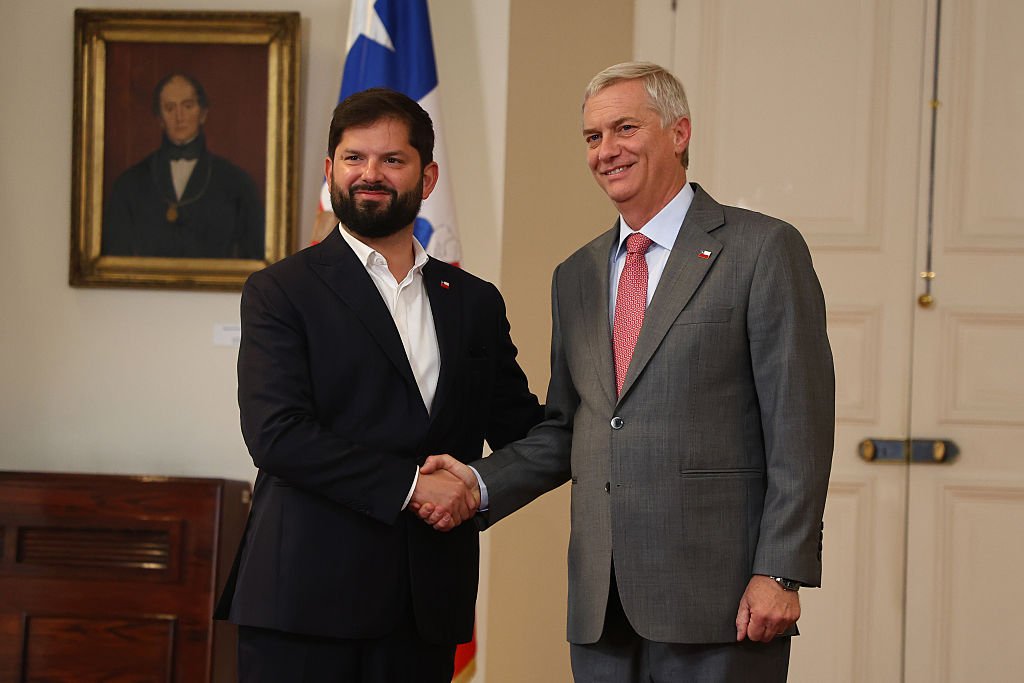
Chile has made a sharp turn to the right with the election of Augusto Pinochet admirer José Antonio Kast. (Marcelo Hernandez / Getty Images)

Interview by
Pablo Castaño

After years in which Chile promised a rupture from neoliberalism, Sunday’s elections were a major setback. While the Left’s joint candidate, Jeannette Jara, a Communist Party member and recent labor minister, narrowly headed the first-round ballot, the runoff handed victory to the far-right José Antonio Kast.

It was bad news for supporters of outgoing president Gabriel Boric’s government. One was Giorgio Jackson, previously minister secretary-general and minister of social development and family between 2022 and 2023. A founder of the party Revolución Democrática, he was among the promoters of the Broad Front that brought the Left to power in Chile four years ago, following the far-reaching social revolt (estallido social) of 2019. This process had promised a new constitution for the country, but the proposed new document was defeated in a 2023 referendum.

Like Boric, Jackson began his political life as a student leader, part of the new political generation that has in recent years sought to dismantle the neoliberalism inherited from Augusto Pinochet’s dictatorship. In an interview with Pablo Castaño for Jacobin, he discussed the legacy of Boric’s government and what Kast’s arrival means for Chile.


Pablo Castaño

Is this result a punishment for Gabriel Boric’s government?

Giorgio Jackson

Just before the 2023 constitutional plebiscite [promoted by the Left from within government], inflation was at 14.1 percent annually. Consequently, Boric’s government experienced a very rapid drop in popular approval, remaining in the 30 percent band throughout its term. After the referendum [in which citizens rejected the Left’s constitutional proposal] the government made a pragmatic shift, and the share of support and of opposition was set in place: around 55 percent were against the government and around 30 percent in favor.

We are handing over an economy that is in much better shape than the one we received. In fact, poll results regarding economic perception have been improving for several months now, as well as economic indicators. But there was a crisis of expectations regarding what this new generation represented. Certain events affected the credibility of that promise of change.

Pablo Castaño

How will Boric’s government be remembered?

Giorgio Jackson

There is a positive assessment to be drawn — and it is going to spread wider — in terms of the material advances for the working class. It brought the largest increase in the minimum wage in the last twenty-five years, an agreement on pensions that gives the highest jump in the OECD, making public health care free — which is something super important for seventeen million Chileans — and the law on alimony payments, which has generated payments of three trillion pesos [more than $3 billion] from fathers who had not paid child support. I believe the public approval for the Boric government’s record will grow as time passes, but unfortunately it did not serve to catapult a successor to the presidency with continuity of government.

Pablo Castaño

These are the first presidential elections with compulsory voting. How has this new element influenced the result?

Giorgio Jackson

This factor had the greatest influence; it has changed the dynamics of political relations in Chile. The electoral roll is fifteen million people. The usual thing was for about eight million to vote, and now a little over thirteen million are voting. It’s a total overhaul.

Pablo Castaño

How do you assess Jeannette Jara’s campaign?

Giorgio Jackson

The campaign had two challenges: trying to defeat the ghost of anti-communism and build beyond the Boric government’s base of support. I believe Jeannette Jara was an extraordinary candidate. She succeeded in keeping the coalition united, in presenting long-term proposals, and in understanding that gaining new voters meant going outside the comfort zone of our discourse. It wasn’t enough, but I wouldn’t blame the defeat on the candidate or on the people who worked on the campaign.

Pablo Castaño

Boric’s government was heir to the 2019 social uprising. Does Kast’s victory mark the end of the political cycle opened with that wave of protests?

Giorgio Jackson

This election marks the end of the cycle that began with the 2006 student mobilizations. They had questioned the foundations of the [Chilean state] bequeathed by the Pinochet dictatorship, particularly regarding education. And from that moment on, mobilization processes with different repertoires of action begin to develop, questioning the bases upon which both Chile’s democracy and development model were established. The 2011 protests amplified that structural critique even more. Since then, there has been an open hegemonic dispute in Chilean society regarding social rights and the constitution. This array of mobilizations did not stop at educational or social issues but also concerned individual liberties, indigenous peoples, socio-territorial and environmental issues, the feminist movement, the movement for pensions . . .

That buildup of mobilization peaked in 2019 with the social uprising, which was not something planned and organized by social movements or political parties. Rather, it was an urban revolt, much less coordinated than a social movement. The institutional response was to launch a process for writing a new constitution for Chile.

Pablo Castaño

Why did this new political cycle beginning in 2006 fail to establish itself?

Giorgio Jackson

We can speak of five contemporary factors. The first is economic stagnation and very low growth in the last decade compared to the previous one, which, of course, limits the options for working families to achieve good material conditions. The second was demographic change: the total fertility rate went from 1.92 children per woman to 1.16 children per woman. It’s a very rapid change that alters the population pyramid, to which we need to add migration: in 2002 Chile had 173,000 migrants, while by 2024 there were 1,600,000, a very rapid jump. The third point is the decrease in poverty, from 27 percent in 2006 to 6.5 percent in 2022 [beneath the poverty line of $260 per month income]. The political subject no longer identifies as poor, but increasingly as an aspirational middle class, if one very vulnerable to falling into poverty.

The fourth point is the technological revolution. In 2006, student mobilizations were done through Photolog. In 2011, it was Facebook and Twitter. In 2019, it was WhatsApp, TikTok, Signal, Telegram, Instagram. All this platformization gives a different perception of the political times, a change in how people conceive of political processes. And the fifth factor is the increasingly important role that organized crime and illegal trade networks have taken on in Chile in the last two decades. A certain type of more violent, more public crime may not have radically changed overall crime numbers, but it has had real media repercussions and impacted citizens’ perception of insecurity.

Pablo Castaño

How about the introduction of compulsory voting?

Giorgio Jackson

What happens with these five million people who had not been participating in politics and who, overnight, were told, “If you don’t vote, you’ll be fined”? This population does not anchor themselves to the traditional alternatives but rather gravitates toward a Johannes Kaiser [far-right candidate who placed fourth in the first round] or a Franco Parisi, who was the surprise [a populist, “neither-left-nor-right” candidate who came in third].

We will have to listen. We need to adapt our proposals to take account of the priorities of those populations who are suffering economic insecurity, and suffering fear due to the perception of crime in their neighborhoods. They are real problems that we cannot minimize. We must try to better understand, before accusing anyone of ignorance or blaming voters for the result. We have to understand what is happening, so that in four years’ time we’ll be an attractive option again.

Pablo Castaño

What do you believe will be Kast’s political priorities as president?

Giorgio Jackson

It remains to be seen, the only thing we know is his past. We have no idea how he will behave, even less so with a coalition, with the traditional right and with Kaiser’s National Libertarian Party, which in recent years have kept falling out with each other. There will be ministers from Chile Vamos [traditional right] and from Kaiser’s camp. Kast is the president-elect in Chile who has [compared to past winners] the lowest vote share in the first round. So he must be aware that he was elected thanks to votes that were lent to him in the runoff, and which were ambivalent. Every step he takes in any direction will subtract from his base of support; every step can be a misstep.

I think it was a tactical mistake, for him, that his first choice was to go and see Argentine president Javier Milei and emphasize that he wants to learn from the Argentine experience to decrease inflation and poverty. This will lose him support even among his own voters. Chile has an inflation rate of 3.4 percent, and Argentina one of more than 30 percent, and Chile since 1990 has decreased poverty, except for the exception of the pandemic period, while Argentina is at very high levels of poverty.

It also remains to be seen how Chile Vamos will handle itself [with regard to Kast], seeing how in Argentina, La Libertad Avanza [Milei’s party] swallowed up Propuesta Republicana [the traditional right in that country] and what measures they will adopt to try to prevent that from happening.

Pablo Castaño

It’s surprising that a candidate nostalgic for Pinochet’s dictatorship has won the elections. What influence does the memory of the dictatorship have on Chilean politics today?

Giorgio Jackson

Kast’s campaign was skillful in trying to push that issue into the background, not responding to any of the questions over potential pardons for people in prison for their role in the dictatorship’s crimes. In recent years there has been a partially successful right-wing attempt to create a false equivalence between Pinochet and Salvador Allende. It’s a setback compared to the first twenty years of the return to democracy regarding memory, where several right-wing actors had recognized the Pinochet dictatorship’s crimes.

If we conduct a survey in Chile on whether to pardon human rights violators from the dictatorship, a very high percentage of voters would be against it. These right-wing forces build their leadership not so much with regard to the specific facts of the dictatorship but more in terms of the resolve and determination they show. They appeal to people who say, “I like him because he says what he thinks.” It’s performative. In focus groups, voters come out saying, “Even though this guy is a far-rightist, a Pinochet supporter, I’m going to give him a chance because on my scale of concerns security comes before historical memory.” So even accepting that flaw in the candidate, there is a much more priority-driven impulse. I believe all of Chile knew this candidate was a Pinochet supporter, but that wasn’t their priority, the reason they voted for him.

Pablo Castaño

During the campaign, Kast has been seen speaking on the phone with various Latin American and European far-right leaders. Who will President Kast resemble more: Milei, Giorgia Meloni, Nayib Bukele . . . ?

Giorgio Jackson

He doesn’t have Milei’s charisma and has a religious, military tradition, closer to Brazil’s Jair Bolsonaro but with less histrionics. His first speech was a preview that rhetoric is not his strong suit. We must be watchful of what he is going to do.

Pablo Castaño

What impact do you think Kast’s victory will have in Latin America?

Giorgio Jackson

It’s very important, because it feeds the narrative that there is no alternative, that it is inevitable that the Right will come to power. But it’s not inevitable; we must try to find and anticipate the factors that explain it. In each country it’s different. We must learn and react.

Pablo Castaño

How do you think the Chilean left will evolve after this defeat?

Giorgio Jackson

The Left today has a coalition different from the one we had four years ago. In this election, it presented itself in a unitary manner, with the most progressive part of the Concertación governments [center-left and centrist coalition that governed Chile from 1990 to 2010], the tradition of the Communist Party and the Broad Front. I hope we can cultivate this coalition with the greatest fraternity. The differences we have must not be denied, but they should not prevent harmonious coexistence.

If we don’t understand the tectonic shift that took place in terms of the new voters, if we keep speaking to the same base through the same channels and with the same words, we have no chance of being an alternative in future contests. We have to understand that the lenses through which we look at reality and with which we perceive citizen support and support for popular demands have changed. There is a political subject that has emerged to stay, that rejects a linear left-right spectrum.

Parisi said that he was “neither facho nor commie” and placed himself in a space that was not the center but rather another plane that does not respond to the left-right axis. We must listen and, on that new terrain, see what priorities fit with a progressive project and try to start addressing those issues.