In Jersey City, Socialists Beat the Democratic Machine
Democratic socialists Jake Ephros and Joel Brooks triumphed in their runoff elections for the Jersey City Council in New Jersey last week. Jacobin followed them at the tail end of their victorious campaigns.
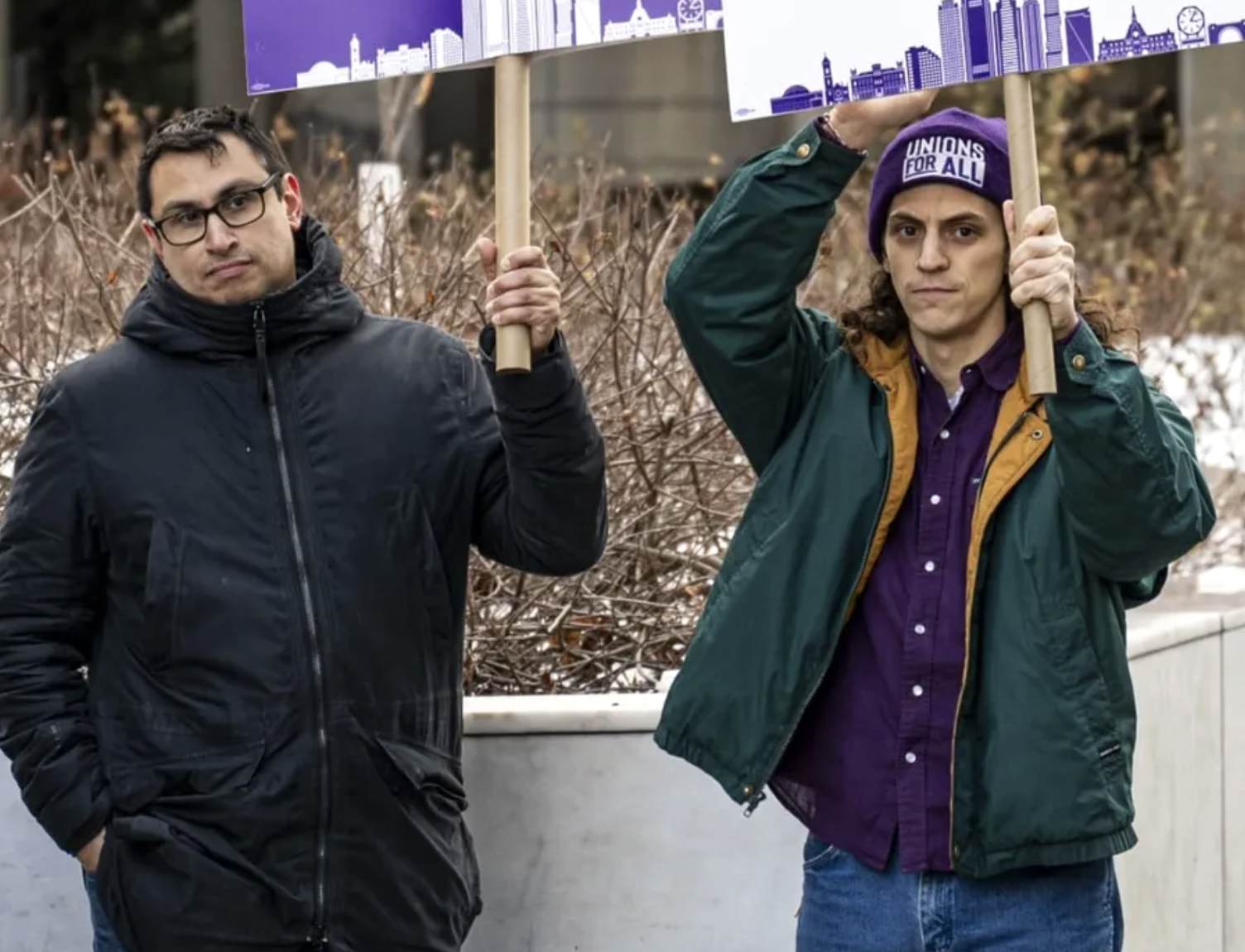
Joel Brooks’s and Jake Ephros’s victories in Jersey City represent the confrontation of an ascendant municipal socialist movement and a weakening statewide Democratic political machine. (Hudson County DSA / @hudcodsa / Instagram)
By 5:30 p.m. on December 1, the December sun had already set when Jake Ephros stopped by his campaign office in Jersey City’s Ward D to pick up a new voter contact list. With about twelve hours to go before polls opened in the city council runoff, Ephros was knocking on as many doors as he could.
It had been a long race for him. Ephros announced his candidacy back in June 2024, a full eighteen months prior to the final vote. But the early announcement seemed to have paid off. As he walked to the evening’s canvassing turf, Ephros was repeatedly stopped by neighbors, friends, and strangers who recognized him. Most were supporters, while some were undecided. At least one was coming back from their own door-knocking shift on behalf of Ephros’s campaign. Ephros greeted each person warmly, tried to remember where he met them, and thanked them for their support or asked what else he could do to earn it.
While Ephros hit the frigid streets, his staff worked out of a small campaign office right on the neighborhood’s main avenue. The campaign headquarters is surprisingly inviting. It’s bathed in a warm light and tastefully decorated with furniture salvaged from Facebook Marketplace. Yet for all its homey touches, the storefront is still a campaign office; the drop ceiling and microwave repeatedly tripping the breaker make that apparent.

On the walls hang a number of pictures, including one of Ephros and his fellow Democratic Socialists of America (DSA) member and city council candidate Joel Brooks with New York City mayor-elect Zohran Mamdani. In twenty-four hours, Ephros and Brooks would become the first New Jersey socialists to be elected in around a century. And like Mamdani, they would do it by helping defeat the attempted mayoral comeback of a disgraced former Democratic governor.
Brooks’s and Ephros’s victories in the December 2, 2025, Jersey City Council runoff election represent the confrontation of an ascendant municipal socialist movement and a weakening statewide Democratic political machine. Their election has charted new ground in New Jersey and suggests what the future for democratic socialism in the tristate area might look like.
Election Day
Between canvassing shifts, Brooks spent Election Day in his campaign office, trying to warm up. If the previous night had been frigid, then Election Day was glacial — and was made worse by the continuous rain. Every so often, Brooks would pop outside for a quick smoke, while volunteers made calls or filtered in from the field.

All campaigns are tiring, but this time felt harder than the last for Brooks. This was his second campaign for Jersey City Ward B, after narrowly losing in 2021. The economic situation and a certain level of political exhaustion made fundraising more difficult compared to the pent-up energy of the pandemic. And since his first campaign, Brooks had also become a father and was now navigating all the joys and stresses of parenting a toddler.
But despite his fatigue, Brooks was a stronger candidate today than in 2021. He’s better known in the ward, and his team built an aggressive voter contact operation. By Election Day, according to his staff’s numbers, his and Ephros’s campaigns had knocked 71,000 doors, supplemented by 122,000 phone calls. With the help of 422 canvassers, the campaigns had reached 15,000 people — more than one in six Ward B and D residents.
“Coming out of the November election . . . that we led in-person Election Day voting, vote by mail, and early voting was just a sign to me that, OK, our methodology is working,” Brooks says. “The DSA difference, which is sustained and quality-voter contacts by knocking on doors and making phone calls — it’s just a different level of conversation that our folks have versus other campaigns.”

For New Jersey assemblymember-elect Katie Brennan, that difference was also apparent. Brennan is a progressive who won her seat in November with the help of the New Jersey Working Families Party. On Election Day, she walked along Central Avenue with Ephros, handing out flyers at bus stops and talking with supporters.
“Jake has done an incredible job in really pounding the pavement in Ward D and has been out there,” Brennan said. “Every time that I’ve canvassed for Jake, whether it be on Election Day or whether it be several months ago, I had very similar encounters. He wasn’t new to almost anybody because he had already done so much and hit so many doors. They had heard about him; they had heard from him.”
The campaigns Brooks and Ephros were able to build stem in part from the North New Jersey DSA chapter’s (NNJ-DSA) expanding capacity. Since at least 2019, NNJ-DSA has been involved in several campaigns that have brought in new organizers and strengthened existing ones. These include a 2019 Jersey City campaign to regulate Airbnbs, Bernie Sanders’s 2020 campaign, anti–Immigration and Customs Enforcement (ICE) detention protests in 2021, Brooks’s 2021 city council run, establishing tenants’ right to counsel in Jersey City, and, most recently, organizing with the Uncommitted National Movement. For Brooks, each of these campaigns built on the previous work of NNJ-DSA, helped the group earn credibility, find political allies, and gain valuable experience.
Sewer Socialism in the Garden State
The evening before Election Day, Ephros canvassed one man who had said his big issues were parking and keeping the neighborhood clean. Ephros mentioned that a significant part of his platform is the re-municipalization of Jersey City’s trash service, and that other neighbors have also had complaints about the private company the city contracts to pick up garbage — that the streets sometimes feel messier after the trucks roll through. The man agreed with Ephros’s pitch and thanked him for running.

Similar to Mamdani, Ephros and Brooks have centered affordability and quality-of-life issues in their campaigns. The pair have foregrounded safe streets, universal childcare, universal rent control, and stronger municipal services, while also tying these to their socialist politics.
“[Socialism] can’t be abstract. It can’t be academic only,” Ephros explains. “If we want to win popular support, we need to pick up the trash. We need to pave the roads. We need to keep people in their houses.”
What Needed to Go Right
Brooks’s and Ephros’s campaigns were also helped by a number of outside events breaking their way.
In 2023, the incumbent mayor of Jersey City, Steve Fulop, announced that he would not run for reelection in 2025. Simultaneously, the New Jersey Democratic Party lost one of its strongest tools to ward off progressive challengers when a March 2024 federal court injunction would ban the use of “the county line” on ballots, while the local Hudson County Democratic machine was distracted by interparty fights in the aftermath of legislative redistricting.
To succeed Fulop, the establishment meanwhile would line up behind Jim McGreevey, a disgraced former governor with long-standing ties to the Kushner family and other real estate developers and who resigned in 2004 amid allegations of sexual harrassment, cronyism, and campaign finance irregularities. If Fulop’s departure presented an opportunity, then McGreevey’s candidacy represented a perfect foil to campaign against.
Ephros and Brooks launched their campaigns during the summer of 2024, with the first election scheduled for November 4, 2025. By late February, the incumbents in both of their races had announced that they would not seek reelection, making the races open contests.

On top of these developments, Donald Trump’s chaotic return to the White House and Mamdani’s June primary victory across the river further energized voters, which led to new volunteers and supporters.
“The week after [Mamdani’s primary victory] was insane, to be honest,” Ephros says. “At the doors, the energy from Jersey City residents hearing that we were out there using the same language, being, more importantly, part of the same organization — it was pretty nutty.”
Coalition
After the November 2025 election went to a runoff, it became clear that a McGreevey mayoralty was not inevitable. Progressive organizations and unions rallied around McGreevey’s progressive opponent, city council member James Solomon. Both Brooks and Ephros would be facing McGreevey-aligned candidates in their runoffs and so they joined Solomon’s slate.
The resulting progressive coalition would end up spanning the NNJ-DSA, the New Jersey Working Families Party, and New Jersey senator Andy Kim, as well as several unions and local officials.

That coalition proved to be very powerful on election night. In addition to Brooks and Ephros, city council candidates affiliated with Team Solomon swept every position, and Solomon himself defeated McGreevey for mayor by an almost two-to-one margin. Yet campaigning together and governing together are entirely different things. While Brooks and Ephros will represent a significant block on a progressive city council, they will still have to navigate political disagreements with the new mayor on key issues.
“I think we’re going to [figure out] how to govern together and what our red lines are and what theirs are,” Brooks says. “I think there’s more in common than [not], but you know, Team Solomon did not run on universal rent control, universal childcare. So we hope that they see that those are really important things to Jersey City residents and that people in Ward B and Ward D voted for that.”