US, Israel Target Civilians as Iran Escalates War to Survive
The US’s bad faith engagement in its negotiations with Iran have undermined any chance of a quick deescalation of the war. Fighting for its survival, Iran will give Israel the regional war it craves.
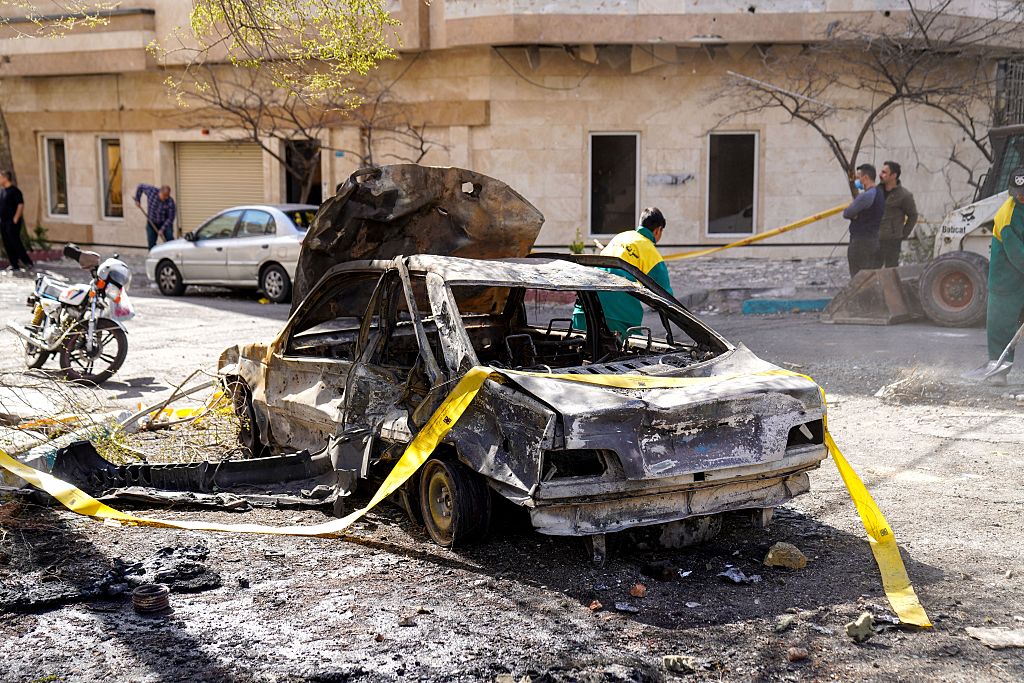
After having started an illegal and ill-planned war on Tehran, Donald Trump is losing control of a conflict that Iran is escalating and widening. (Amir Kholousi / ISNA / AFP via Getty Images)
In response to Donald Trump’s claims that Iran was appealing to Washington to negotiate, Ali Larijani, the most powerful man in the Islamic Republic, issued a terse statement in Farsi: “There will be no negotiations with the United States.” Tehran is wary of accepting a ceasefire as it did at the end of the Twelve-Day War launched by the United States and Israel in June, which it calculates would simply give its enemies time to regroup and attack again in a matter of months.
The killing of Supreme Leader Ali Khamenei has clarified the minds of military planners by making it clear that Iran must escalate to survive. Tehran’s strategy is to exact a cost against the US and Israel great enough to secure a durable peace. Larijani dismissed Trump’s war aim of destroying Iran’s mobile ballistic programme and navy as “delusional fantasies” and accused the president of sacrificing US soldiers for Israel.
In the wake of America’s decapitation strike against Khamenei, who perished with up to two hundred senior military and civilian figures, as well as two generations of his family, Iran’s war is being run by the Supreme National Security Council, chaired by Larijani. A new Provisional Leadership Council is being convened with President Masoud Pezeshkian, judiciary chief Gholam-Hossein Mohseni-Ejei, and Ayatollah Alireza Arafi as members. The Assembly of Experts, a body of clerics appointed directly and indirectly by the supreme leader, is now working to select his replacement. The Islamic Republic is an interlocking network of institutions that check and balance one another, designed to survive decapitation.
The Iranian state remains coherent and is now working to defend the Islamic Republic and exact a cost on its attackers. In the first two days of fighting, at least three US jets have been shot down. The Kuwaiti Ministry of Defense stated that “several” US warplanes had crashed over their territory. Iran is surrounded by US bases, particularly along its southern coast in Kuwait, Qatar, the United Arab Emirates, and Saudi Arabia.
The United States and Israel tend to avoid flying over Iranian airspace so as not to expose themselves to antiaircraft fire, because Iran’s capabilities have been bolstered by Russia since the June war. The US and Israel prefer to fire missiles from jets hovering in neighboring air spaces. The United States claims that the jets were shot down by friendly fire. Either way, two days into the war it appears the US has lost more air assets than they have since its war against Vietnam, fifty years ago. Iran has launched waves of ballistic missiles at Israel. While Israeli military censorship is effective at obscuring the damage caused by the strikes, there have been reports that the number of casualties is higher than Tel Aviv claims.
Iran, which has a Cold War air force inherited from the shah for which it struggles to acquire new parts, has received MiG-29 Su-35 fighter jets and Mil Mi-28 attack helicopters from Russia. “I guarantee you behind the controls of a lot of those MIGs and a lot of those Su-35s are Russian pilots,” said Stanislav Krapivnik, a former US soldier and commentator on Russian military affairs on March 1, “because it takes about a year to train up a pilot from nothing.” Beijing also reportedly struck a deal with Tehran for anti-ship missiles and intelligence on US naval positions.
Over half of Tehran’s population, a metropolis of some seventeen million people, has fled to the surrounding countryside or to smaller towns. “It’s deserted there,” said one resident. “When people heard the bitter news [about the strike against a girls junior school, killing 165], they were worried we would be turned into Palestinians.” The civilian death toll is considerably higher than during the Twelve-Day War, with a hospital and several police stations bombed, in violation of the laws of armed conflict.
Videos have emerged of scores of buildings in Ferdowsi Square in central Tehran flattened. Reports are emerging of “double-tap” strikes against police stations, a signature Israeli tactic of killing paramedics and family members arriving at the scene. In one video that has circulated widely on the internet, an Iranian woman can be heard saying, “They killed all my people. They bombed them once. People went in to help; they bombed again. Oh, our youth, our youth.” One Tehran resident, who is staying outside of the city with his family, was driving a block away from Khamenei’s compound when it was struck on the morning of February 28. “I was in my car and pulled over, and I saw a bomb hitting the place and a big plume of smoke. The dust covered us. It was a very huge bomb, and it destroyed the whole block.”
Iran’s military strategy to demoralize the United States has two parts. On the one hand, it seeks to create an energy crisis, which will disproportionately affect the US, the biggest oil and gas consumer in the world. Iran is striking ports, oil tankers, and oil infrastructure in Saudi Arabia and Qatar. Qatar, the world’s biggest gas exporter, halted production entirely following strikes on March 2, and Saudi Arabia’s biggest oil refinery has also been shut down after strikes.
The rationale is that generating a global economic crisis will put global pressure on the United States to stop its war. Iran is also trying to destroy as many expensive military assets and kill as many American troops as possible, which is seen as a neuralgic issue for Trump’s domestic base, many of whom are decrying a US war of choice with no pretext or realistic plan. Iran is using its older missiles to force the United States and Israel to expend their expensive interceptors, thereby saving its more advanced solid fuel missiles for when its enemies are more vulnerable. It appears to be prioritizing radar assets to expose high value US naval assets and crew to Iranian ballistics.
The United States has confirmed that Iran killed four US soldiers and injured five in strikes at unidentified locations. Trump himself said he expects the number of US deaths “to be quite a bit higher.” It is possible that these soldiers were on board the US aircraft carrier Abraham Lincoln, which Iran claims to have struck, although the US denies the strike landed.
“The US aircraft carrier Abraham Lincoln was struck by four ballistic missiles,” said a statement by Iran’s Islamic Revolutionary Guard Corps, which warned that “the land and sea will increasingly become the graveyard of the terrorist aggressors.” If Iranian claims are true, this is the first time a US carrier has been hit by enemy fire since World War II.
Tehran also seeks to expand the war. “From the Iranian point of view, the expansion of the battlefield has a strategic value,” wrote Ali Hashem, who visits Iran regularly, in Amwaj Media. “By spreading the risk to the region, Iran aims to make sure that the military pressure exerted on it will cause instability in the energy sector and among America’s allies.” In addition to striking US bases in Arab nations on the other side of the Persian Gulf, Iran has struck in the vicinity of British naval assets in Bahrain and Cyprus, prompting UK prime minister Keir Starmer to reverse his position of depriving the US military of the use of Diego Garcia, its military base in the Indian Ocean. Iran also struck the UAE’s Al Salam Naval Base, home to the French Navy, and appears to be targeting US Persian Gulf allies’ lucrative tourist infrastructure, hitting Dubai’s iconic Burj Khalifa tower, the Burj Al Arab hotel, the Palm Jumeirah island, and the international airport.
The killing of Ali Khamenei, which has been met with a mixture of anger and jubilation inside Iran and around the Shiite world, has triggered renewed attacks against United States and Israel across the region. In countries with significant Shiite minorities such as Lebanon and Bahrain, as well as in Indian-controlled Kashmir, mass protests erupted to mourn the death of the second most senior cleric in Shia Islam.
In Iraq, protesters and Shiite militias attempted to besiege the green zone, where around one thousand US troops remain stationed. Hezbollah, weakened by Israel’s decapitation strike against its senior leadership in 2024, struck northern Israel with drones and missiles.
Three days in, Trump’s war against Iran is already spiraling out of control, and once again the fate of millions depends on an inner calculation known only to a president who is both hubristic and fickle. In January, as Trump amassed a “beautiful armada” in the Persian Gulf and Indian Ocean, he explained how he makes decisions. “Yeah, there is one thing. My own morality. My own mind,” the president said. “It’s the only thing that can stop me.”