There Is no Pretext or Plan for the US-Israel War on Iran
Framed as a strike on “evil,” Washington and Tel Aviv’s attacks leave Iran with few off-ramps. Tehran’s incentives now point toward escalation as a matter of survival.
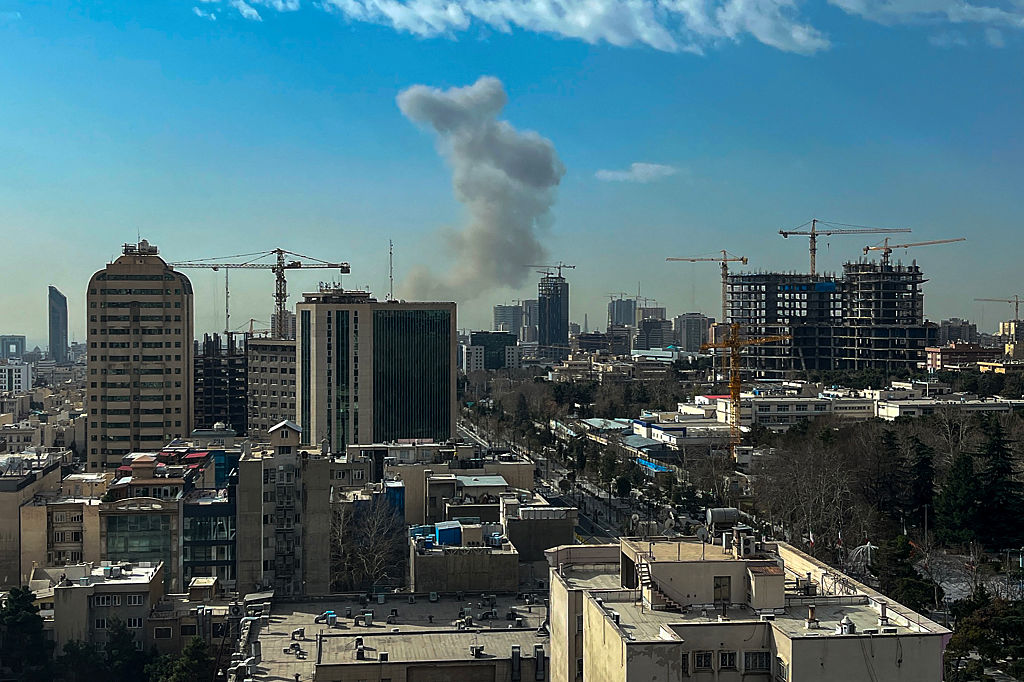
A core claim of Trumpism was that the Right was turning the page on Bush-era neoconservatism in foreign policy. Today’s attack on Iran is yet more proof of just how false that claim always was. (AFP via Getty Images)
Hours after Tehran had agreed to the unprecedented concession of eliminating its nuclear stockpile, Donald Trump announced the launch of a “massive and ongoing” US and Israeli air war to topple the Islamic Republic. Trump claimed that he had launched Operation Epic Fury because Iran had refused to negotiate and “just wanted to practice evil.” The Israeli Defense Forces announced their commencement of hostilities in a tweet that “Israel has a right to defend itself.”
At 9:45 a.m. local time in Tehran, Israel and the United States used high-altitude bombers, jets, and cruise missiles to strike military and civilian targets across the vast country. Both Supreme Leader Ali Khamenei and President Masoud Pezeshkian were targeted in the attacks. Israeli media is filled with reports that Khamenei, who has ruled Iran for nearly thirty years, is dead, a claim rejected by Iranian media. (Sources inside Iran have reported that Khamenei’s son and daughter-in-law have been killed.) Strikes also targeted Islamic Revolutionary Guard Corps (IRGC) general Mohammad Pakpour as well as Iran’s minister of defense and its chief of intelligence. A girls’ school in Minab in southern Iran was also struck. The death toll now stands at fifty, with a similar number wounded. According to domestic media, the victims are as young as seven. The houses of Mahmoud Ahmadinejad, president from 2005 to 2013, and former prime minister Mir Hossein Moussavi, who has been under house arrest for seventeen years, were also targeted, indicating the United States and Israel wish, at best, to remove any pretenders to power outside of their control or, at worst, to create a power vacuum at the top that could precipitate a civil war.
Tehran has responded by launching a first wave of ballistic missiles against Israel and targeting US military assets in the region. Iran is surrounded by US air and naval bases housing some forty thousand troops. Strikes have been reported in the vicinity of the US Ali Al-Salem Air Base in Kuwait; the US Navy’s Fifth Fleet in Bahrain; the Al Udeid Air Base in Qatar; and the US Al Dhafra Air Base in the United Arab Emirates. Explosions have also been reported in and around Riyadh, the capital of Saudi Arabia, home to significant US military assets. Iran has closed the Strait of Hormuz, the choke point for a fifth of global oil supplies.
Israel has made a calling card of using the prospect of peace as a tactic to prosecute wars against its enemies. In June, during the last round of US-Iranian negotiations over the nuclear file, Israel killed Tehran’s chief negotiators and tried to decapitate the civilian government on the first day of its twelve-day war against Iran, which the United States joined on the last day. In September, when diplomacy over the Gaza war was nearing a ceasefire deal, Israel attacked Hamas’s political wing in Doha.
From the US perspective, negotiations with Iran have been framed by Trump’s desire to win a deal more advantageous to the United States than the “terrible” deal Barack Obama finally negotiated in 2016, after over a decade of diplomacy between Tehran and the world powers. During his first term, Trump unilaterally exited the deal and has since assumed a maximalist position in negotiations with Tehran consistent with the long-standing Israeli demand that Iran must be denied its right to enrich any uranium.
In a revealing omission on February 21, Trump’s chief negotiator Steve Witkoff said the president had been surprised that Tehran had not simply “capitulated” to US demands. Following this statement, both sides appeared to be nearing a deal; Iran acceded to Trump’s demands to say the “secret words” that “we will never have a nuclear weapon” and agreed to enrich uranium only up to the requirements to produce medical isotopes and power its single nuclear power station.
Trump, like his predecessors, has been hamstrung in negotiations because the US option to grant significant sanctions relief — the only thing Iran wants — requires congressional approval. But Congress has strong bipartisan support for hawkish policies against Iran, not least due to the long-standing influence Israel’s lobby AIPAC has had on the legislature, financially supporting the campaigns of friendly candidates if they vote in line with Israel.
For decades Khamenei has pursued a policy of so-called strategic patience designed to deter US and Israeli violence, or at least keep it within the grey zone of covert operations, sabotage, and assassinations. But since October 7, 2023, Israel has, with US support, waged a pitiless genocide against Palestine and regional wars against Iran’s allies in Lebanon, Syria, Iraq, and Yemen, which provided the means for Tehran to maintain strategic depth against Israel, and therefore the United States. Now that Iran is experiencing a second unprovoked attack, all incentives point to escalation, which in the current circumstances means ramping up counterattacks up to and including a full-scale war.
The problem for the United States and Israel is that while they are able to kill a lot of people and sow terror among the Iranian population, it is vanishingly unlikely that their war aim of bombing Iran into a revolution — or at best a coup d’état — will be successful. Air wars have historically never alone been successful in achieving regime change. In Germany and Kosovo, the air wars were fought in tandem with an occupying army. In 2025 the United States gave up its air war against Yemen’s de facto government. Tehran will be mindful of 1983, when it supported Lebanese Shia militias during the Lebanese civil war in their attack against US troops and shipping, which resulted in Washington withdrawing its troops under fire.
Since June, Iran has also been receiving unprecedented support from Russia and China. Moscow has been working with Tehran to reconstitute its air defenses, and China is providing anti-ship missiles. A private Chinese company close to the military has made public satellite imagery on the positions of US naval assets, which observers have interpreted as a signal by China that it could support Iran with real-time intelligence to defend itself.
Contemporary US domestic politics also has little capacity to sustain significant American loss of life. Iran appears to have a short-term strategy to absorb the strikes and try to quickly exact maximum cost on the United States and Israel in the hope that regional actors, who fear wider destabilization, will successfully lobby the United States for a ceasefire. In the longer term, Iran has prepared for a sustained and bloody war. Khamenei has appointed his successor and instructed the appointment of four tiers of military officials in the case of decapitation strikes. Tehran will aim to kill enough Americans to end the war by destabilizing Trump at home.