Deportation Was Always Political

From its beginnings, deportation has been a tool used to threaten, suppress, and break dissent. ICE’s targeting of political enemies like Mahmoud Khalil is no exception.
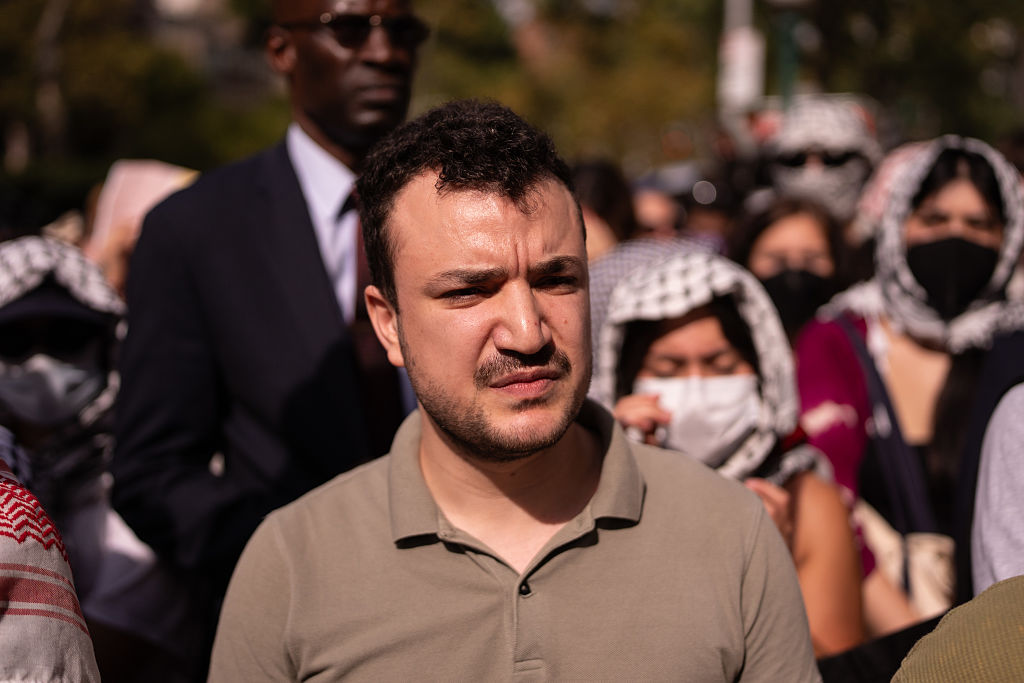
Mahmoud Khalil serves as a transitional object for ICE and CBP, a way for them to move from brutalizing undocumented migrants to brutalizing documented ones and, finally, disposing of citizens like Alex Pretti who stand in their way. (Adam Gray / Getty Images)

Eleven days before immigration agents shot Alex Pretti dead in the street — before they fired four bullets into his back, paused, and then fired six more into his motionless body — they’d had a prior altercation with him.

Pretti, a thirty-seven-year-old intensive care unit nurse, had raised his boot and kicked out the taillight of an unmarked SUV. Agents stopped their vehicle in the middle of the street, slammed him to the frozen asphalt, breaking his rib, and then fired pepper balls at shocked onlookers. Video of the incident shows Pretti was carrying a legally registered handgun, the same one that was taken from him moments before he was fatally shot, but he never reached for it either time.

After his murder, it was reported that Immigration and Customs Enforcement (ICE) agents had previously exchanged information on Pretti, possibly adding him to a database the Department of Homeland Security (DHS) is compiling of protesters in 2026. Speculation then quickly spread online that Pretti had been targeted by agents and publicly executed for daring to kick their vehicle.

We’ll likely never know if Pretti was overtly targeted or not (agents appeared to kill Renée Good two weeks earlier for simply acting as an observer), but the suspicion is not totally unreasonable. We have many examples of ICE and DHS specifically targeting people that the US mainstream press would call, if they lived in a faraway country, “political dissidents.”

It is, after all, what happened to Mahmoud Khalil, a Palestinian student organizer at Columbia University. In March 2025, Khalil was kidnapped in front of his pregnant wife by DHS for his pro-Palestine organizing and illegally held in an ICE detention facility for three months.

Another instance was the abduction of Rümeysa Öztürk, a Turkish doctoral candidate at Tufts University, who was snatched off the street by masked agents and illegally held in ICE detention after writing a single op-ed in her campus newspaper calling for divestment from Israel.

A third was the illegal detention of labor organizer Alfredo “Lelo” Juarez Zeferino in Washington state. After his truck was stopped by ICE agents, he refused to open the door, demanding that they show him a warrant. Instead, ICE smashed his window, dragged him through the broken glass, and disappeared him to an unmarked warehouse that operates as a secret ICE holding site.

There is a direct line between the illegal abductions of Khalil, Öztürk, and Juarez Zeferino — all immigrants — and the murder of Alex Pretti, a US citizen. From its beginnings, mass deportation has been a tool used to threaten, suppress, and break dissent, eroding the protections of freedom of speech and the right to assembly. Once this erosion is normalized against noncitizens, these protections can then be more easily taken from citizens as well, even to the extreme end point of murdering them in broad daylight in the middle of the street.

Deportation’s Origins

The targeting of political enemies by Donald Trump’s DHS might seem totally new to some, but the practice is as old as deportation itself. Indeed, the modern deportation system was invented to target dissidents. The law that the Trump administration has cited to strip Khalil of his permanent residency in the United States, for instance, is the Cold War–era Immigration and Nationality Act used to target communists for deportation.

But the practice of modern deportation goes back significantly further, to nineteenth-century Europe, when capitalist governments rolled out widespread expulsion laws in order to sweep away unsightly masses of poor foreign workers, most of whom were former peasants uprooted by industrialization. These new laws also specifically targeted growing numbers of socialists and communists attempting to organize those very same workers to demand better labor conditions. The message was clear: become the exploitable labor that the capitalist requires or disappear.

Within decades, similar laws made their way to the United States. As Adam Hochschild has written, in 1919 the US deported 249 men and women in what was the country’s first mass deportation of political dissidents. The deportations were the culmination of the Palmer Raids, a series of brutal immigration sweeps overseen by then attorney general William A. Palmer. Ten thousand people were arrested across the United States between 1919 and 1920, the vast majority of them workers involved in labor organizing.

The raids placed all immigrants — but especially Russians and Italians, who were presumed to be the most militant — under suspicion of polluting the nation’s capitalist, Christian values with dangerous socialist ones. Emma Goldman was their most famous deportee. Afterward, in a statement whose syntax feels eerily proto-Trumpian, Palmer promised New Yorkers that they would see many more deportation ships “sailing down their beautiful harbor in the near future.”

ICE’s “War on Terror”

ICE is the twenty-first-century instantiation of that promise. In the aftermath of 9/11, the George W. Bush administration claimed terrorists were trying to enter the United States through its southern border, a threat so great that it required a state of exception at home — the erosion of asylum law, the militarization of the border, and the hypersurveillance of everyday life.

The timing was critical. After the end of the USSR in 1991, and with the Soviet spy now extinct, the United States was in search of a new ideological boogeyman. The attack on the Twin Towers gave America a new national enemy in terrorism, and ICE — along with DHS — was invented to fight the terrorists supposedly infiltrating our home. The only problem, of course, was that these terrorists slipping through the border didn’t exist.

For two decades, in the name of fighting terrorism — a signifier that, with DHS head Kristi Noem’s labeling of both Good and Pretti as “domestic terrorists,” has reached new heights of meaninglessness — ICE has been permitted to enact its delusions on some of the world’s poorest and most vulnerable people at our border. It is impossible to ignore the projection going on here. ICE, in its supposed hunt for domestic terrorists, has become our great domestic terrorist organization.

Tasked with circumventing and destroying the law rather than enforcing it, ICE’s purpose is not merely to detain and deport migrants — though this is certainly its bread and butter — but to now carve a path for Trump’s progressively more open authoritarian ambitions.

This is what made Mahmoud Khalil a convenient and strategic early target soon after Trump took office. He serves as a kind of transitional object, a way for ICE to more concretely move from brutalizing undocumented migrants and apprehending “terrorists” to brutalizing documented ones like Khalil and, finally, disposing of citizens like Alex Pretti who stand in its way.

Deportable Dissidence

Mahmoud Khalil was twenty-nine years old when, last year, Homeland Security entered his apartment building during the night and arrested him in front of his eight-months-pregnant wife without a warrant.

After Khalil spent three months illegally locked away in an ICE detention facility, separated from his wife and newborn son, a judge ruled that his approaching deportation was unconstitutional, and he was released. However, just weeks ago, another judge overruled that decision on a jurisdictional technicality, leaving Khalil open again to deportation.

Where he’d even be deported to, however, is not certain. Born in a Palestinian refugee camp in Damascus, Khalil fled to Lebanon during the Syrian revolution, before arriving in the United States and becoming a permanent resident. With the ongoing genocide in Palestine, Khalil could become effectively stateless were he to be deported.

Since October 7, 2023, many Palestinians have warned that the unchallenged violence of a US-backed genocide would eventually boomerang back to the imperial core. Israel is like the blueprint for ICE’s fantasy state — a country run by a complex series of internal walls and border checkpoints, in which an entire underclass is actively labeled terrorist in order to be dispossessed of their rights, land, and lives.

For decades, Israel has acted as a wartime laboratory where Global North militaries and corporate enterprises might combine their efforts in birthing freshly horrifying weapons to dominate Palestinians. It is incredibly common that the next place these technologies are used is at the US-Mexico border; ICE and DHS have had a long-standing collaboration with Israel.

There is also obviously an ethnoreligious component to all of this. Khalil and other Middle Eastern and Muslim organizers are easy for ICE to slot into their terrorism delusions.

But here again history repeats itself. One of the great victims of nineteenth-century expulsion laws was none other than Karl Marx, who, like Mahmoud Khalil, was twenty-nine years old when he was hunted down by secret police in the middle of the night. Marx was living in Brussels, after having already been stripped of his citizenship in Prussia. Like Khalil, he was arrested for the vague accusation of being a danger to national security and separated from his wife and small children. And, as might happen with Khalil soon, Marx was ultimately expelled from three countries and forced to live the rest of his life as a stateless refugee.

As a Jew, Marx also faced racialized discrimination. The conflation of the Jewish people and communism eventually became so great, in fact, that the Holocaust was in part carried out under the pretense that Jewish people were somehow naturally born communists, genetically destined for a “Judeo-Bolshevism” that threatened to destroy the Christian achievement of capitalist civilization.

Today a similar conflation is wielded against Khalil — simply being Palestinian and asserting that Palestinians possess and deserve dignity in equal measure to the rest of humanity is equated with terrorism. Last month, DHS official Tricia McLaughlin stated that the Trump administration planned to deport Khalil to Algeria, a country in which he has never lived.

His removal would be tragic but poignant; Khalil’s ancestors were Algerian revolutionaries forced to flee and resettle in Palestine in the nineteenth century. His “return” would not be to the colony they knew but to the independent country they struggled to emancipate.

In this is a lesson about ICE’s push to deport political dissidents. You can hunt the revolutionary and arrest the worker, you can fill the deportation planes and prisons, you can try to wall off the whole world, but in the end the world always comes back.