Trump Will Not March Quickly to Victory Over Iran
The US/Israeli attack on Iran has inflicted heavy damage on its command structure, but the Iranian system is designed to withstand such pressure. We should expect a more protracted war than last summer, with political factors key to the final outcome.
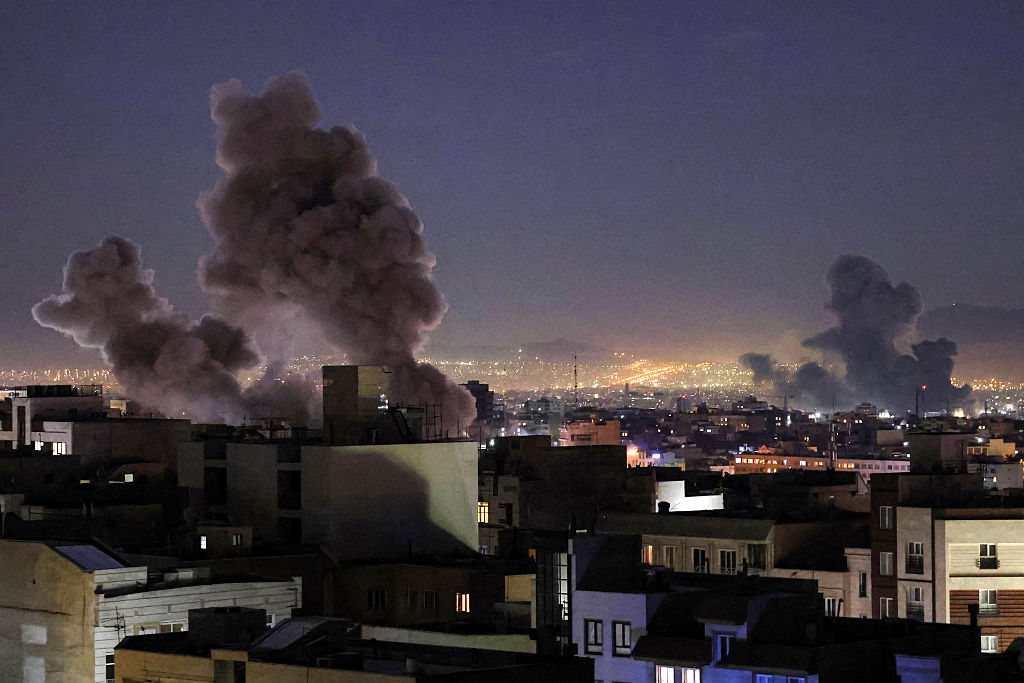
Tehran’s goal after the US/Israeli attack is survival plus deterrence restoration: convince Washington decisive victory is elusive, impose enough cost to force a pause, and avoid conceding the missile program that it views as the last line of defense. (Atta Kennare / AFP via Getty Images)
- Interview by
- Daniel Finn
Andreas Krieg is an associate professor at the Defence Studies Department of King’s College London and the author of Socio-Political Order and Security in the Arab World. He spoke to Jacobin about the US/Israeli attack on Iran, the nature of the Iranian response, and the likely course of events over the coming weeks and months.
What has been the military balance sheet of the US/Israeli campaign and the Iranian response to it so far?
The United States and Israel appear to have achieved what they most wanted in the opening phase: momentum, freedom of action in the air domain, and a disruptive effect on Iran’s senior command and control. The strikes look designed to create a corridor for follow-on operations and to push quickly from air defense suppression into sustained pressure on missile infrastructure and remaining sensitive nuclear nodes.
Iran’s response, however, has been more expansive than many in the Gulf expected. The standout feature is not precision but breadth and repetition: multiple waves across several Gulf states, with heavy interception but enough leakage and debris to cause damage and real psychological shock.
In Qatar, for example, the dominant pattern still looks like trajectories oriented toward Al Udeid and associated military systems, but debris and the occasional miss have brought the war into residential areas. In the United Arab Emirates, the perception has been far more alarming because the pattern of incoming fire is experienced as less bounded and more city-level, with civilian sites hit and public panic rising.
So I would describe the balance-sheet as a coalition that has seized initiative in the air and imposed leadership and infrastructure costs, while Iran has succeeded in widening the theater and raising the political and economic price for US partners.
What do you think determined the timing of the attack? Was it inevitable that a campaign on this scale would be launched sooner or later, after the US military buildup in the region?
I don’t think an operation of this scale was inevitable in a deterministic way, but the buildup created a credibility trap. Once you assemble a posture that is visibly strike-capable, you either have to extract a deal that looks like a win or you have to accept the reputational cost of stepping back. The decisive moment often comes when leaders conclude that the diplomatic track is not closing the key gaps and that waiting makes the problem harder because the target disperses, hardens, and adapts.
Israel’s influence matters here too. If Israel believes any negotiated outcome leaves a long-term threat intact, it will push for action or threaten to act, and that can compress the US decision timeline. From what I can see, the buildup didn’t make war certain, but it made delay politically harder and made “doing something” more likely once negotiations hit their familiar limits.
How important was the internal crisis of the Islamic Republic after the repression of protests at the start of the year in prompting the United States and Israel to act?
The internal crisis in Iran after the crackdown on protests likely played a role as an enabling condition rather than a single trigger. It may have contributed to a sense in Washington and Jerusalem that the regime was under stress and that pressure could produce elite fracture or at least deepen internal dysfunction.
But I would caution against overreading that. States under external attack often close ranks, and fear can suppress mobilization rather than catalyze it. The protest cycle matters for legitimacy over the medium term; it is a less reliable predictor of immediate collapse in the fog of war.
What do we know, so far at least, about the ability of Iran to maintain leadership continuity after the assassinations of the supreme leader, Ali Khamenei, and other senior figures?
On leadership continuity, the key point is that Iran was built to survive leadership shocks. Even with the reported assassination of Khamenei and other senior figures, the system has mechanisms for interim authority and succession management, and it is capable of operating in a more decentralized, mission-command mode for a period.
The uncertainty is how long that can be sustained before the system needs clearer central direction to prioritize resources, manage signaling, and prevent freelancing. If a successor or an interim steering group consolidates quickly, Iran can calibrate and regain coherence. If consolidation is slow or contested, you get more volatility, more tactical autonomy, and a higher chance of miscalculation or overreach.
What appears to be the thinking behind Iran’s response to Israel and the United States? Has it demonstrated capacities to hit back that were not used last June?
Iran’s response logic looks fairly consistent with its deterrence playbook, but more escalatory in breadth than last June. The aim is to show that this is existential and that Tehran will not absorb punishment quietly.
Strategically, it is trying to impose pain where the coalition is politically sensitive: US bases in host countries, Gulf airspace and trade flows, and the psychological sense that the war can be kept “over there.” Even if Iran says it is targeting US bases rather than Gulf societies, imprecision and debris make that distinction meaningless on the ground.
I think Iran has also demonstrated a willingness to sustain repeated waves rather than fire a single symbolic salvo, which is important because it signals endurance and seeks to erode confidence in air defense as a guarantee of safety.
How will US-aligned states such as Saudi Arabia and the UAE respond to the targeting of US bases on their territory?
Saudi Arabia and the UAE are likely to treat the targeting of US bases first and foremost as a domestic security crisis. The immediate response will be to harden air and missile defense, manage public reassurance, and coordinate quietly with Washington on force protection.
I would not assume that translates into enthusiasm for offensive participation. Both governments have strong reasons to avoid being seen as cobelligerents in an open-ended war, especially if the conflict is already damaging their “safe hub” reputation.
What may change, though, is their tolerance for continued Iranian pressure: if strikes continue and civilian anxiety rises, they will push harder for an off-ramp and simultaneously tighten practical security cooperation with the United States, even if they keep political distance from Israel’s objectives.
What we are seeing today already is that Saudi Arabia, Qatar, and the UAE are going ever closer to forward defense that could see them firing at launch sites in Iran in defensive operations.
What impact is this likely to have on the global price of oil, and what impact will that have on the outcome of the war?
The oil effect is a risk premium driven less by actual supply loss so far and more by the market’s fear of what comes next: disruption to the Strait of Hormuz, port strikes, insurance spikes, and sustained airspace closures.
Higher prices can raise revenues for producers, but prolonged disruption threatens the region’s operating model and can rapidly become a global political problem. That matters for the war because it compresses Washington’s runway and increases external pressure to cap the campaign, while also increasing Iran’s leverage if it can credibly hold trade flows at risk without triggering overwhelming retaliation.
From the perspectives of the leadership teams in Washington and Tehran, what is the likely endgame? Should we be anticipating a much lengthier conflict than the Twelve-Day War of last summer?
As for endgames, Washington’s likely “mission accomplished” is a political narrative built around degrading the missile threat, damaging sensitive nuclear infrastructure, protecting US forces, and then pivoting back to diplomacy from a position of strength. Israel’s definition is broader: it wants a long-term outcome in which Iran cannot rebuild strategic capabilities and in which Israel retains freedom of action to strike again if it tries.
Tehran’s endgame is survival plus deterrence restoration: convince Washington that decisive victory is elusive, impose enough cost to force a pause, and avoid conceding the missile program, which it views as the last line of defense after the collapse of its regional network. I do think we should anticipate something longer and messier than the Twelve-Day War, though that does not necessarily mean a constant high-intensity air campaign.
A more realistic picture is a protracted contest with spikes and pauses: an intense opening phase, followed by a degradation campaign at a lower tempo, while Iran tries to keep pressure on Israel and on US partners in the Gulf. The critical variable is whether Iran’s leadership consolidates quickly enough to control escalation and whether Washington can define criteria for stopping that it can sell domestically without being dragged into a longer war by events.