The Supreme Court May Legalize Donald Trump’s War on Iran
Donald Trump’s attack on Iran may set off a showdown over the president’s authority to declare war. The case could end up in court, giving conservative justices a long-awaited chance to end Congress’s ability to limit presidents’ warmaking powers.
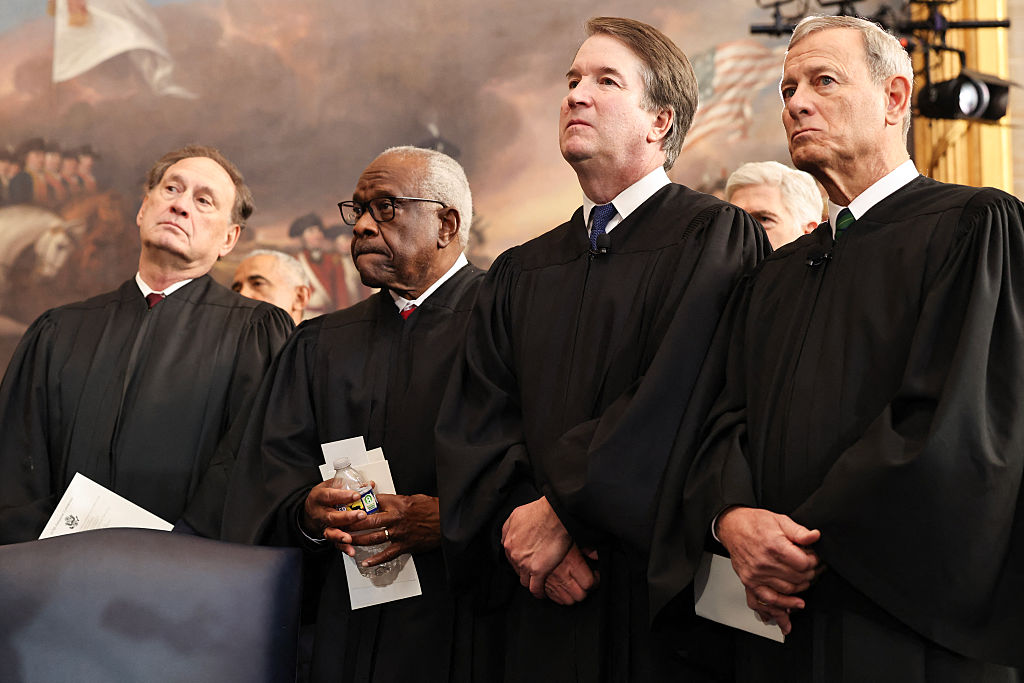
President Donald Trump’s new war in Iran was launched without congressional authorization or proof of an imminent threat. The war could give conservative Supreme Court justices the opportunity to strike down the War Powers Resolution. (Chip Somodevilla / POOL / AFP via Getty Images)
“Do you think the president has the authority to invade Iran tomorrow without getting permission from the people, from the United States Congress, absent him being able to show there is an immediate threat to our national security?”
As recounted in the Lever’s upcoming new season of the Master Plan podcast, this was the big question then-senator Joe Biden pressed Supreme Court nominee Samuel Alito to answer during Alito’s nationally televised 2006 confirmation hearing almost exactly two decades before Donald Trump launched his new war in Iran.
“Well, that is a question that I don’t think is settled,” Alito responded. “The president has the power of the commander in chief. I think there has been general agreement, and (previous) cases support the authority of the president to take military action on his own in the case of an emergency, when there is not time for Congress to react.”
Alito’s answer is no longer a historical artifact. It could become a live issue as Congress potentially votes this week on a resolution invoking the War Powers Resolution to try to halt or limit President Donald Trump’s new war in Iran, which was launched without congressional authorization or proof of an imminent threat.
Any showdown over warmaking powers — whether over the passage of a new war resolution or over enforcement of the existing statute — could ultimately end up in court. Such a case could give conservative justices their long-awaited opportunity to end Congress’s power to limit presidents’ warmaking powers and to explicitly strike down a post–Vietnam War–era law many on the Right have questioned.
“I Do Not Think We Would Want to Concede Any Definitive Role”
The 1973 War Powers Resolution declares that the president can only “introduce United States Armed Forces into hostilities, or into situations where imminent involvement in hostilities is clearly indicated by the circumstances” when there has been “(1) a declaration of war, (2) specific statutory authorization, or (3) a national emergency created by attack upon the United States.”
But ever since Congress overrode President Richard Nixon’s veto and passed the law, conservatives have sought to limit it — or render it powerless.
In addition to Alito, Chief Justice John Roberts has joined the attack.
In a 1984 memo entitled “War Powers Problem,” Roberts — then an associate in Ronald Reagan’s White House counsel’s office — advised the Reagan administration to oppose legislation extending tax benefits to veterans who served in Reagan’s unauthorized military deployment to Lebanon. Roberts argued that the administration should oppose the bill simply because it mentioned Congress’s constitutional power to declare war.
“I do not think we would want to concede any definitive role for Congress in terminating the Lebanon operation, even by joint resolution presented to the President,” Roberts wrote in the memo, which he authored only months after Congress passed a Lebanon War Powers resolution aiming to limit the president’s power to keep troops deployed.
Though Reagan signed the resolution, he declared that “the imposition of such arbitrary and inflexible deadlines creates unwise limitations on Presidential authority to deploy United States Forces in the interests of United States national security.”
“I do not and cannot cede any of the authority vested in me under the Constitution as President and as Commander in Chief of United States Armed Forces,” Reagan wrote. “Nor should my signing be viewed as any acknowledgment that the President’s constitutional authority can be impermissibly infringed by statute.”
Roberts later wrote that the legislation “will be revised so it contains no references to a Congressional role in terminating the Lebanese operation.”
During his September 2005 Supreme Court confirmation hearing, lawmakers explicitly questioned Roberts on whether Congress has the authority to stop a war. Roberts never answered the question directly, instead only answering that Congress “has the power of the purse” and that he couldn’t provide an answer for a hypothetical question.
“That’s a question that I don’t think can be answered in the abstract,” Roberts said. “You need to know the particular circumstances and exactly what the facts are and what the legislation would be like. . . . The argument on the executive side will rely on authority as commander in chief and whatever authorities derive from that. So it’s not something that can be answered in the abstract.”
The Unitary Executive
Justice Brett Kavanaugh has seemingly come down on both sides of the issue regarding limiting presidential war power. In a 2015 Appeals Court ruling, the conservative judge wrote that “in justiciable cases, courts should not hesitate to enforce constitutional and statutory constraints on wartime activities.”
Kavanaugh added that the courts should not “unilaterally recognize new limits that restrict US officers’ wartime activities” and cited a previous Supreme Court ruling that stated courts “should indulge the widest latitude of interpretation to sustain” the president’s national security authority.
Additionally, Justice Clarence Thomas has also questioned whether Congress has the power to rein in presidential power related to national security. In a dissenting opinion for a 2004 Supreme Court case, Thomas wrote that the Constitution gives the president “primary responsibility” over national security and foreign policy.
“This Court . . . has accordingly held that the President has constitutional authority to protect the national security and that this authority carries with it broad discretion,” Thomas wrote. “Congress, to be sure, has a substantial and essential role in both foreign affairs and national security. But it is crucial to recognize that judicial interference in these domains destroys the purpose of vesting primary responsibility in a unitary executive.”
The unitary executive theory — pushed in the mid-2000s by Steven Calabresi, a former Reagan administration staffer, clerk for Justice Antonin Scalia, and cofounder of the powerful conservative group the Federalist Society — argues that the president has limitless power over the executive branch and total control over the military.
The Federalist Society has played an influential role in helping select conservative Supreme Court justices. Its former executive vice president, Leonard Leo, has played an integral role in this process by using his billion-dollar dark-money networks to help wealthy groups and individuals hide their donations to conservative causes.
In 2025, the Lever reported on how Leo-connected dark money operations have helped billionaires, fossil fuel empires, and arms dealers quietly fund influential anti-Muslim think tanks advocating for war in Iran.