I Saw the Roots of Mandelson’s Rise and Fall
“The people whose company I enjoy most are those from a strictly bourgeois background,” Peter Mandelson wrote to his childhood friend Steve Howell in 1973. It was, Howell observes, deeply ironic that these connections would ultimately bring him down.
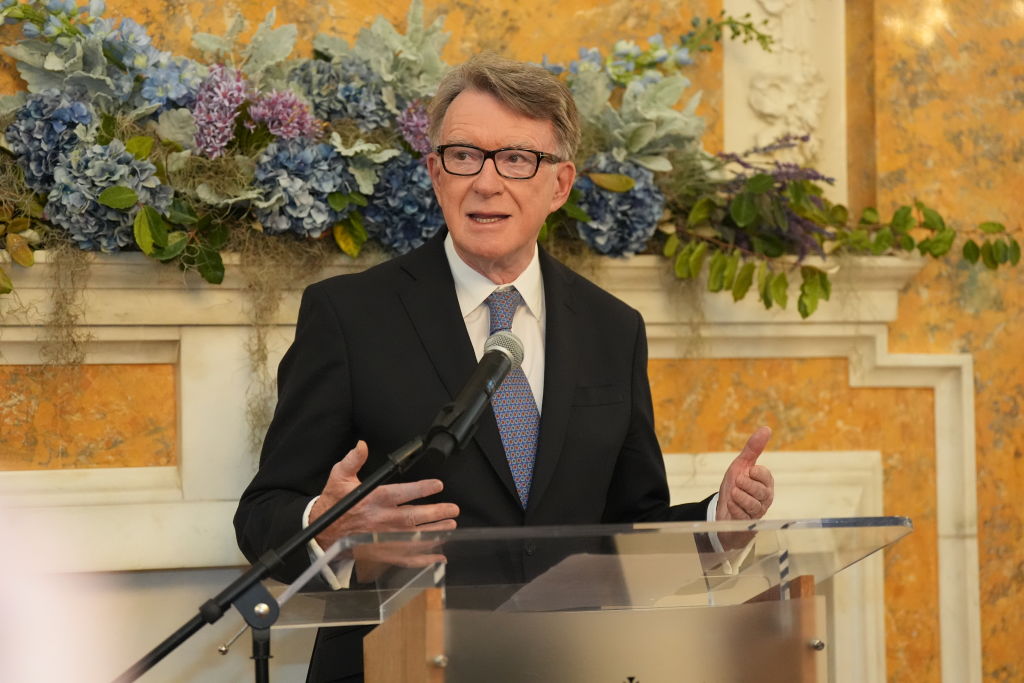
For almost 40 years, Peter Mandelson stood in the shadows of Labour governments, exerting influence over their policies through undemocratic means. By exchanging access for money and status, he represented the worst tendencies of British politics. (Niall Carson / PA Images via Getty Images)
When Peter Mandelson was a teenager, he made no secret of his political ambitions. His grandfather, Herbert Morrison, had been deputy prime minister and school friends like me wondered if he would go one better. On one occasion, he showed me a copy of Niccolò Machiavelli’s The Prince and was clearly smitten with its tales of intrigue and treachery. Perhaps not surprisingly, therefore, Mandelson’s dramatic fall from grace has been triggered by the release of emails with Jeffrey Epstein that have more than a whiff of the Italian’s subterfuge about them.
Rise and Fall
For nearly forty years, little has happened in Britain’s Labour party without the seventy-two-year-old Lord (as he still is) pulling at least some of the strings. From early ally of Tony Blair to Britain’s ambassador to Washington, he has enjoyed enormous success and heavily influenced political discourse. But now he’s a pariah, disowned even by protégés and long-term allies, and facing three investigations: one into his role in Andrew Mountbatten-Windsor’s appointment as a trade envoy in 2001; a second into possible fraud while a member of the European Commission from 2004 to 2008; and a British police probe into misconduct in public office.
Meanwhile, Mandelson’s lucrative consultancy business, Global Counsel, has collapsed leaving his 21 percent stake worthless after clients bailed in droves. He had stepped down as the consultancy’s chairman in May 2024 as part of a restructuring that saw Jim Messina, the former Barack Obama aide, join the board when his own firm, Messina Group, took a 20 percent stake in a deal valuing Global Counsel at around £30 million.
In making his investment, Messina either did not know or did not care that media outlets in Britain had already revealed that Mandelson maintained an association with Epstein after his conviction for soliciting prostitution from a minor in 2008.
Similarly, Keir Starmer, who has now admitted he knew of the longevity of Mandelson’s Epstein link, did not consider it to be an obstacle to appointing him to Britain’s top diplomatic role. Mandelson took up the post in February 2025 but was sacked by Starmer only seven months later, after the first batch of Epstein emails released by the US Department of Justice revealed more details of his ambassador’s post-conviction fraternization with Epstein.
Aided by friends in the media, Mandelson attempted to rehabilitate himself in January. The BBC indulged him with a long interview in which he portrayed himself as an innocent fool for trusting Epstein. The Times even continued to treat him as a credible political commentator by publishing a piece in which he praised Donald Trump and argued that “in one night, the US had achieved more in Venezuela than the so-called rules-based order did in decades.”
Drawn to Scandal
The reprieve was, however, short-lived. The release three weeks ago of more Epstein files revealed that Mandelson had sent the pedophile market-sensitive information while Britain’s business secretary and had even suggested encouraging Jamie Dimon, the chief executive of JPMorgan Chase, to “mildly threaten” one of his own cabinet colleagues over plans for taxing bankers’ bonuses. Whatever the formal outcome of the three investigations, Mandelson is now so toxic that it is hard to imagine any way back into public life for him.
Mandelson’s political career can be divided into three phases: consigliere to Tony Blair in the New Labour project from the 1980s to 1997; controversy-prone cabinet minister and European commissioner from 1997 to 2010; and arch-conspirator against the Left since 2010.
The first phase began in 1985 when Mandelson was appointed Labour’s director of communications. It was a role that allowed him to give politicians aligned with his agenda media exposure, and he soon started promoting Blair, who had been elected to Parliament two years earlier. On becoming an MP himself in 1992, Mandelson backed Blair in a successful Labour leadership bid, opening the way for the two men to create what they called “New Labour.” Essentially a cosmetic exercise — the policy substance being a continuation of Margaret Thatcher’s neoliberalism — the role of Blair and Mandelson was to package it, literally, in red roses for the party faithful and voters already eager for a change of government.
Labour’s election victory in 1997 opened a new phase in Mandelson’s career, with him immediately becoming a roving minister without a portfolio and then, a year later, being promoted to the cabinet as secretary of state for trade and industry. His elevation was, however, short-lived: in December 1998, he was forced to resign after it emerged that he had not declared an interest-free loan of £373,000 from a ministerial colleague to buy a house.
Ten months later, Blair brought his ally back as Northern Ireland secretary only for him again to be forced to resign after just over a year amid allegations that he had used his position to help a wealthy Indian businessman apply for British citizenship. Blair gave Mandelson a third chance in 2004 but at the safe distance of Brussels where he became one of Britain’s European commissioners, a role he held until Blair’s successor Gordon Brown surprised Westminster by appointing him business secretary in October 2008.
The third phase of Mandelson’s political career, after Labour’s election defeat in 2010, saw him orchestrating a battle against the Left, whose support had been replenished by millennials angered by the Iraq war and the imposition of austerity after the bank crash. Mandelson backed David Miliband to replace Brown as Labour leader, but he was beaten by his brother Ed, who was supported by the Left. When Labour lost again in 2015, Ed Miliband resigned, triggering a leadership ballot that an outright left candidate, Jeremy Corbyn, won comfortably.
Mandelson despised Jeremy Corbyn and made no secret of it. With Blairites still in control of the party machine and dominant among its MPs, Mandelson and his allies made life extraordinarily difficult for the new leader. After voters backed Brexit in a referendum in 2016, Mandelson blamed Corbyn and encouraged a vote of no confidence in him by Labour MPs. Corbyn won the resulting second leadership election but there was no respite. In February 2017, Mandelson said: “I work every single day to bring forward the end of (Corbyn’s) tenure in office . . . Every day I try to do something to rescue the Labour Party from his leadership.”
Toward the end of that month, I started working for Corbyn as deputy director of strategy and communications. When I emailed Mandelson to tell him this, he replied saying: “It pains me more than I can say that you should be making such a sacrifice but it’s your life.”
It would prove to be anything but a sacrifice. When the prime minister, Theresa May, called a surprise general election that spring, it allowed Corbyn to escape the stifling confines of Westminster and do what he does best: go out across the country and rally support for his ideas. To the surprise of many, though not those of us working on the campaign, Labour won its biggest popular vote for twenty years and gained enough seats to deny the Tories a majority. As May clung to power by negotiating a deal with a group of Northern Ireland unionist MPs, Mandelson admitted that he had underestimated Corbyn and told the BBC: “An earthquake has happened in British politics and I did not foresee it.”
With Corbyn’s position buoyed by relative electoral success, Mandelson changed tack and turned his attention to reversing Labour’s policy of accepting the result of the EU referendum. Shrewdly, he knew the issue could be Corbyn’s Achilles’ heel because it split his support base: while many Labour activists were strongly Remain, the electorate in the majority of parliamentary seats held by Labour had voted Leave. When Labour’s conference decided to support a second referendum in 2018, the party doomed itself to being punished in Leave areas in any subsequent election. And, sure enough, it was when the vote came in December 2019.
The election defeat delivered Mandelson’s primary goal: Corbyn had to resign. But who would he support to replace him? When asked this early in 2020 on a Guardian podcast in which we both took part, Mandelson avoided giving a straight answer, and I sensed something Machiavellian afoot. At the time, Starmer was describing himself as Corbyn’s friend and offering continuity on policy. The endorsement of the archenemy of the Left would not have been helpful. However, when the list of donors to Starmer’s campaign was published after voting closed, nearly all of them were long-standing wealthy allies of Mandelson.
It was therefore no surprise that a year into Starmer’s leadership, the Sunday Times reported that Starmer was “putting his faith” in Mandelson “to inject a dose of New Labour’s ‘winning mentality’” into his team. Soon afterward, Mandelson’s influence became obvious in shadow cabinet selections, the ditching or dilution of progressive policies, and the suspension of Corbyn, who was still an MP, from the parliamentary party.
For Mandelson, the general election in 2024 was an opportunity to complete his nine-year mission to wipe Corbyn off the political map. With the former leader standing for reelection to Parliament as an independent, Mandelson told Times Radio that he would be going out personally to campaign for the official Labour candidate trying to unseat Corbyn. Once again, Corbyn surprised him by winning comfortably. Meanwhile, across the UK, though Labour had gained fewer votes than under Corbyn, divisions on the Right had handed the party a huge parliamentary majority.
So, would Starmer reward Mandelson? Sure enough, the call came before the year was out. Being ambassador to Washington,and mixing with world leaders in the White House must have seemed a stratospheric note on which to end a career with so many ups and downs. But one fatal flaw would soon catch up with him. In a letter to me in 1973, Mandelson wrote: “I am a bourgeois at heart . . . the people whose company I enjoy most are those from a strictly bourgeois and intellectual background.” More than half a century later, it is an uncannily apt epitaph to his political career.