A Young Socialist in Bernie’s Backyard
Marek Broderick is the youngest member of the Burlington City Council. He’s using his seat to bridge the gap between student activism and the city’s broader working-class struggles.
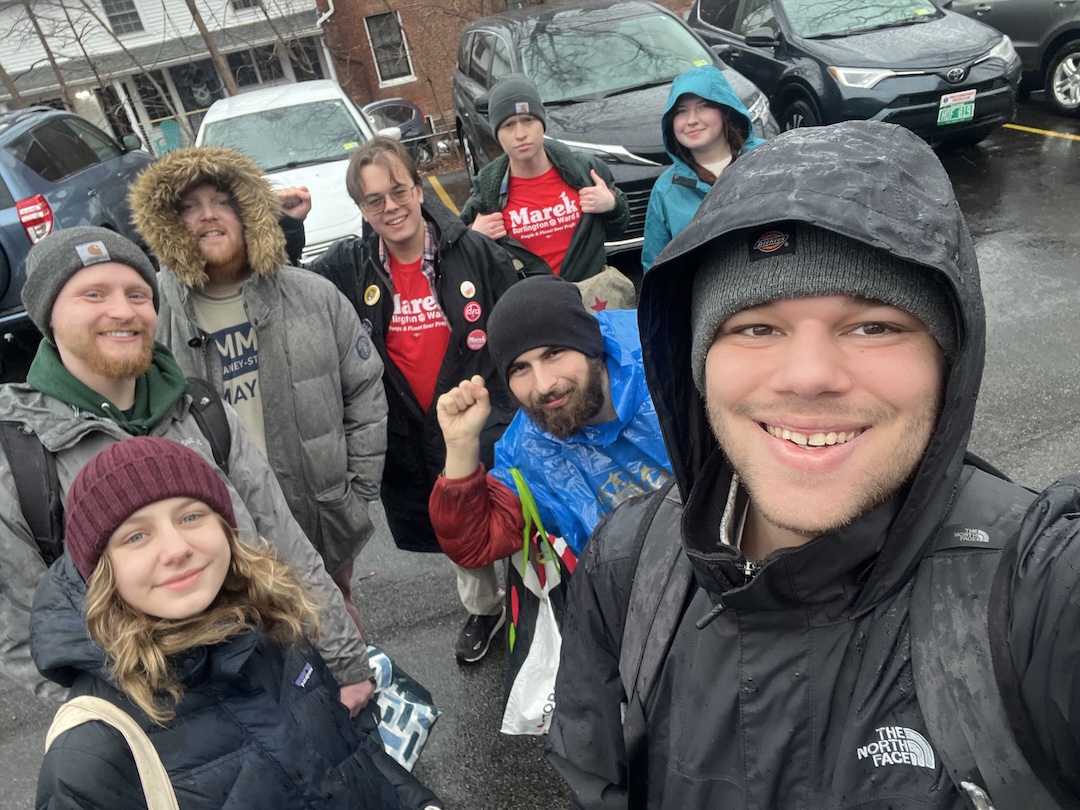
University of Vermont student and socialist Marek Broderick (right) didn't run for Burlington City Council to be a career politician. He’s using his office as a megaphone for tenant unions and labor pickets. (Office of Marek Broderick)
It’s been nearly two years since Marek Broderick, then a soft-spoken junior at the University of Vermont (UVM), was first elected to the Burlington City Council as member of the Vermont Progressive Party. Now he is preparing to graduate with a degree in biology while running for reelection tomorrow.
The district Broderick represents, Ward Eight, was initially drawn as a “student gerrymander” that contained up to 75 percent of Burlington’s student population, though it now only contains a plurality of on-campus students, around 46 percent, encompassing the largest of UVM’s dorms and the entirety of Champlain College. Befitting its large student population, Ward Eight has typically produced councilors who were either recent graduates of UVM or current students, trading hands between the Progressives and the Democrats.
Councilors have also shuffled in and out regularly. Before Broderick took office, one of his predecessors had been forced to resign over concerns that she no longer lived in the district after graduating. This resignation triggered a special election, which saw Hannah King defeat Rhone Allison, a member of UVM’s Young Democratic Socialists of America (YDSA) chapter and a classmate of Broderick’s, in a close, low-turnout race. He never imagined that he would be running against King the next year.
The birthplace of Bernie Sanders’s political career, up until recently, Burlington was the place most familiar with democratic socialist politics in the United States. Broderick, however, came to UVM without political experience. Observing politics from a distance as a teenager, he described his introduction to UVM’s YDSA chapter as a matter of one day deciding to get involved in a specifically socialist organization and typing keywords into the campus club search tool. “I’d never heard of DSA before then,” he tells me. Broderick joined UVM YDSA in the spring of 2022, a semester after it was founded, eventually becoming cochair and lead organizer.

This seemingly offhand decision to join YDSA launched Broderick into a wide world of political organizing. Beginning by traveling to Boston to protest for the opening of COVID-19 vaccine patents at the height of the pandemic, he stood on picket lines and organized for improved housing conditions and sustainable climate policy and, after October 7, in solidarity with Palestine. By his own estimation, US complicity in the genocide in Gaza served as the catalyst for increased demand for left-wing candidates across the country and influenced his decision to run against the sitting incumbent of Ward Eight in 2024.
Allison’s loss to Hannah King the year prior had dampened the enthusiasm of the local DSA chapter to run another campaign. Broderick wasn’t sure another campaign was viable, but after some convincing from fellow DSA members and the failure of Progressive attempts to recruit a candidate, he entered the Progressive Party caucuses two weeks before the nominating caucus. Many party members were skeptical of his candidacy, distrustful of backing another student after one resignation and another loss to the Democrats. Broderick, however, was eventually able to win the nomination without opposition.
His first campaign tried to bridge the gap between campus politics and a broader working-class politics. “Students don’t think of themselves as residents, and that’s a huge issue,” his campaign manager, Trey Cook, said in 2024. By speaking to their interests as renters and part-time workers, the campaign successfully bridged divides between students and other Burlingtonians.
Broderick, for his part, emphasized that while his first campaign was primarily focused on policy and delivering material change, seemingly more abstract matters of political principle played an important part in establishing his credibility and differentiating himself from his opponent. Aside from a few speeches and speaking at public comment, he said he had “zero name recognition, either on campus or in the rest of Burlington.” In attempting to close the recognition gap, Broderick’s and DSA’s particular style of politics shone through. In contrast to the last DSA campaign in the ward, which focused only on the campus-voting bloc, Broderick and his core volunteers made it a point to spread their messaging and campaigning evenly across the demographics. While making it no secret that he was a student and spoke from a student perspective, Broderick ran on what he called “a winning platform” focused on appealing across the working class: advocating for the interests of low-wage workers, affordable rents, investments in sustainability, and robust public transit.
His 15 point victory over Hannah King, who by Broderick’s estimation had “shifted right while in office” and proudly boasted that she was “more than comfortable to vote against the desire of [her] constituents,” was delivered by a group of a dozen volunteers who ran the campaign and knocked on every door in the ward three times. Facing a candidate with political connections and the support of local business, having enough people to knock on the same door multiple times and consistently turn out for the campaign was “our triumph,” Broderick said.
Navigating Public Office
Two years on, how has Broderick fared? “Burlington doesn’t have a lot of power,” Broderick said. Some of the bigger demands Broderick campaigned on, like rent stabilization, required revisions in the city charter, passed only by votes of the city council, residents, and both houses of the Vermont state legislature. And within Burlington, as the council’s only organized socialist, he wasn’t exactly teeming with power either.
Broderick’s age was also an issue in forming relationships on the council, particularly across the aisle. When he took office in April of 2024, Broderick was twenty-two years old and both the youngest-serving councilor and the youngest Burlington councilor ever. “I wasn’t patronized by the voters, but by some of my colleagues. I’m the kid, or because I’m a student I don’t know shit, or I just haven’t lived there long enough.”

Broderick said he had “tried to stay above the polarization, keep his head down, and use his principles to identify key issues.” He used his position to be a figurative “signal booster for the movement,” sticking with the “inside-outside strategy” of acting as a bridge between popular demands and material victories. With “the housing crisis as bad in Burlington as it is anywhere,” Broderick tried to advocate for funding affordable public housing at scale with significant protections for tenants. “I don’t want to leave Burlington, but it is a reality today that young people with skills have to leave Burlington. I don’t want that to happen to myself or anyone else.”
Broderick faced difficulty getting his housing priorities heard on the Burlington City Council, even among the Progressive caucus of councilors. His biggest success so far has been the adoption of an ordinance mandating city investigation of UVM and Champlain College dorms, a demand Broderick advanced through his relationship with Burlington’s Student Tenant Union after the group was stonewalled by university administration. Otherwise Broderick used his office to help student and nonstudent renters alike navigate tenant law and their leases.
Beyond housing, Broderick staked out a consistent position of putting the weight of municipal government behind popular movements and working people. In the absence of dramatic legislative success, Broderick was often a lone or minority vote against the criminalization of homelessness and privatization of city services, speaking out against the Progressive mayor’s proposal to outsource city recycling services. Broderick was often the only councilor to walk the picket lines of downtown service workers, and he continued to push for the Apartheid-Free Communities measures in solidarity with Palestine despite repeated failures.

“We Needed a Socialist Candidate”
Heading into the election tomorrow, which is Burlington’s only contested municipal race this cycle, Broderick projected confidence. He built connections across the Left, and he looked to Zohran Mamdani’s historic victory in New York City this past November for inspiration. “Zohran showed that our message is a winning message on the biggest scale, and he’s been translating the DSA campaign’s organizational difference into office. As a campaigner and candidate, he’s incredible.”

Broderick was already thinking of how to build out the bench of socialist electeds across Vermont. While he wouldn’t necessarily recommend running for office to others — “There’s no glory in it,” Broderick says — he sees having the perspective of organized socialists in government as invaluable. Electoral politics was only one part of the broader movement Broderick views as necessary to win socialism in the United States. Ultimately, for Broderick, elected socialists could serve as a boost for organizing workers and cohering a larger left-wing movement to confront Donald Trump’s second term and the existential crises facing working people.
“I never, especially going into college, liked politicians or wanted to be one,” Broderick said, but he was running for a second term “because we needed a socialist candidate, and people thought I’ve done a good job. Being a city councilor has given me a purpose school never did and a role within the movement inside and out.”