The Left Could Learn Something From Trump’s Tariff Gambit
Donald Trump enacted his trade policy at the stroke of a pen for a whole year by acting quickly and assertively while the courts debated his tariffs’ constitutionality. It’s an approach the Left can use to much better ends.
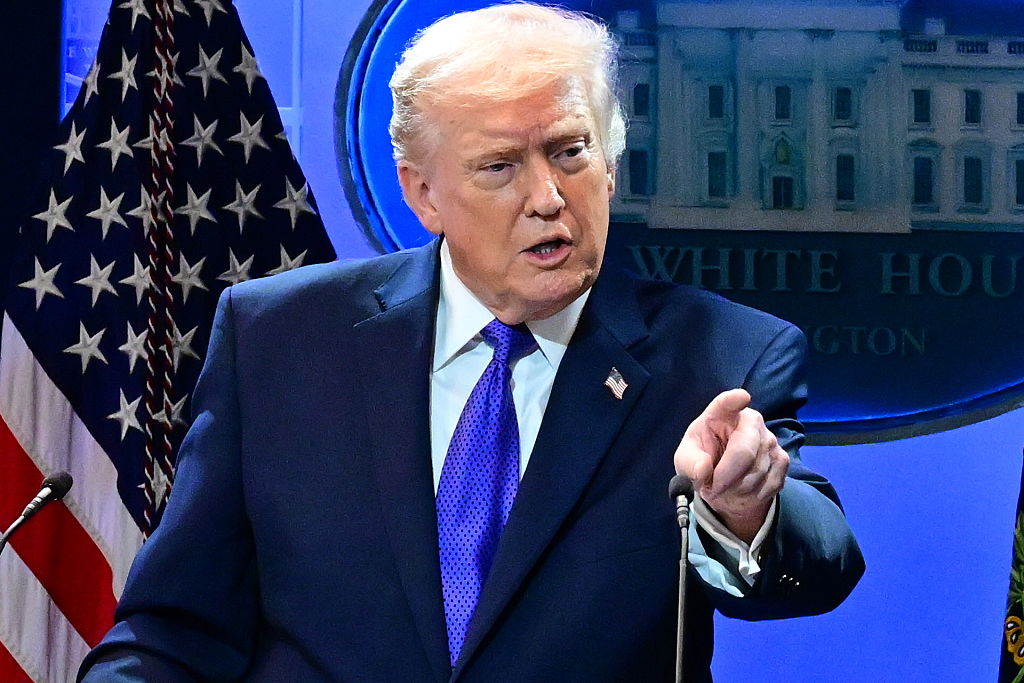
Trump’s tariff policy, and his presidency as a whole, have been a real-world experiment in using the power of the office to affect change even without Congress on its side. The Left should actually learn from this. (Kyle Mazza / Anadolu via Getty Images)
By conventional thinking, Donald Trump’s tariff strategy is a failure: he sidestepped Congress, chose a dubious legal rationale to do it, and now the tariffs have been struck down by the Supreme Court, putting his entire trade agenda at risk. But that’s only one way to look at it.
Looked at another way, Trump’s tariffs were a bold and creative way to kick-start his agenda in an ongoing era of congressional gridlock. Because of the arcane workings of the US legal system, it has taken an entire year for the Supreme Court to get around to striking them down. In that year, as they wound through court after appeal after oral argument, the tariffs have been in place, and they have been arguably one of the most transformational policies of Trump’s entire presidency.
To be clear, they have not been transformational in anything approaching the way that Trump actually intended them to be. The tariffs have not revived US manufacturing; in fact, all evidence suggests they have been the latest major blow to that ailing sector, which has shed thousands of jobs every month for nearly the entire past year.
Likewise, they may have reshaped the global economic order, but not in ways that have benefited the United States. Outrage over the tariffs — their confusing and arbitrary nature, their indiscriminate punishment of both allies and foes, their use as a tool of political meddling, and their igniting of a trade war with China that Trump had to swiftly and embarrassingly back down from — has, in no particular order: weakened US global standing and pushed key security partners away; hastened efforts at de-dollarization; frayed the global alliances that have helped underwrite US power; and generally made leading rival China look like a more reliable and attractive bet than the United States to much of the world.
Why, then, would progressive elected officials ever emulate what Trump has done here, given how counterproductive it has been to both his domestic agenda and his foreign policy? Let us count the ways.
For one, these drawbacks are almost wholly a result of the specific way that tariffs were implemented by Trump. You can imagine an alternate reality where the administration rolled out a much more strategic and nuanced tariff policy — one that targeted specific sectors and products and the countries exporting them, rather than the trade equivalent of firing a sawed-off shotgun in a bingo hall — and maybe paired it with subsidies and other government support for the domestic industries the administration hoped to revive.
In that reality, the tariffs still get struck down after a year, but maybe they actually have a positive impact on US manufacturing, and without turning the entire globe against the United States while doing it. Maybe they even have enough of a positive effect that, after they’re struck down, Trump is able to get bipartisan buy-in on a package of tariffs in Congress that the Supreme Court can’t touch, the same way that Joe Biden did in early 2022 for his CHIPS Act, despite a GOP militantly arrayed against giving him any domestic policy win.
In any case, Trump’s presidency, for both better and worse, has been a real-world experiment in, and live demonstration of, the power of the presidency and its ability to affect change even when it doesn’t have Congress’s slow, grinding legislative work on its side. Tariffs are not the first time Trump has done this, acting quickly in total disregard for the legal niceties or future opinions of judges. Liberals, progressives, and socialists don’t like the purposes he’s put this strategy to, but there’s no doubt that it has worked for him.
A future president certainly shouldn’t go as far as Trump, who has repeatedly walked right up to the edge of constitutional crisis by finding too-cute-by-half ways of defying the courts. Nor should they do it for the nakedly authoritarian and reactionary ends that he has put this strategy to. But given the tangle of crises they’ll inherit, there is no reason a future president should be constrained by institutional norms that Trump and members of his party couldn’t care less about.
The president already has the statutory authority to expand Medicare to parts of the country suffering under public health emergencies, a power Joe Biden could theoretically have used during the early days of the pandemic to go as far as unilaterally implementing Medicare for All, but never bothered to use for an even minimally ambitious expansion of the program. Even if the hard-right Supreme Court ended up striking that measure down, imagine the transformational effect it would have had for the time it was in place, both for people’s health and for their political imaginations.
It should be used sparingly and strategically, but there are clear political benefits to following Trump’s example and simply doing what you want and letting the courts sort out the constitutionality later. With enough imagination and creative use of statutory authority and legal reasoning, there are a variety of options for a future progressive president looking to take bold action via executive orders, even if it’s later struck down. And if they do it in the service of coming to the aid of Americans’ economic security — instead of, as Trump has done, for the purpose of trampling their rights and gutting the government services they rely on — they are not likely to face the same level of political fallout, even if they will be criticized by the press.
Trump’s predecessor was too much of an institutionalist to embark on this kind of strategy. But Trump’s extensive use of it this term should open the door to future presidents to do the same. No one can reasonably pretend anymore that the presidency is a powerless office as a way to excuse sitting on their hands.