Trump Is in Way Over His Head in Iran

Donald Trump’s war on Iran is barely half a week old, and with each day, it has become a bigger and bigger debacle.
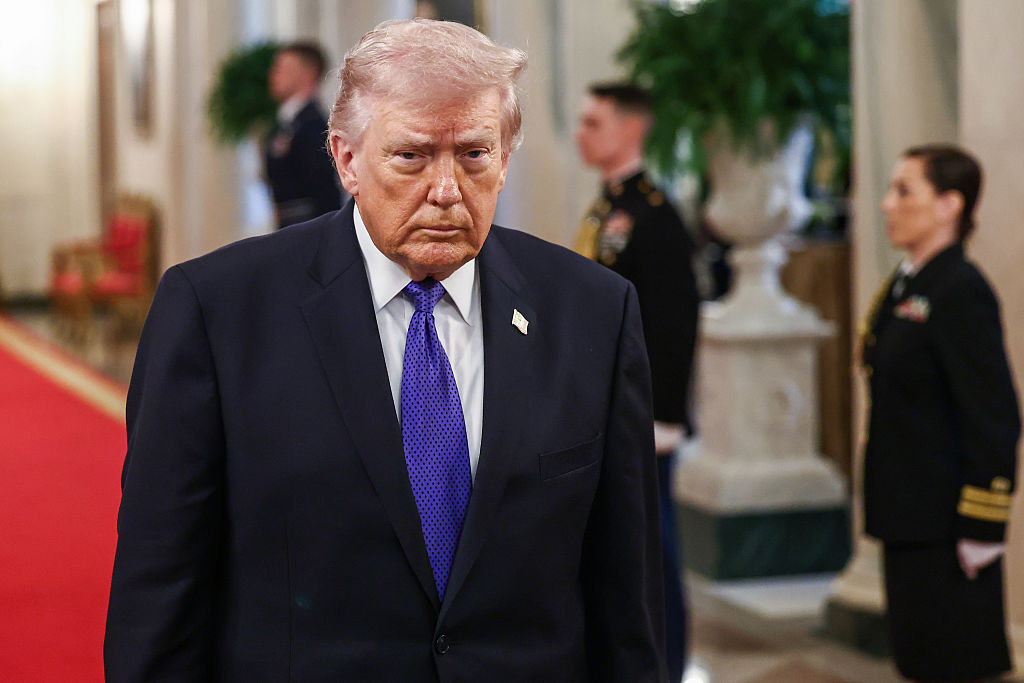
Donald Trump is struggling to settle on a single consistent rationale for his war on Iran. (Jim Lo Scalzo / EPA / Bloomberg via Getty Images)

Going into this past weekend, many, many people warned that the war with Iran that Donald Trump is now embroiled in could go horribly wrong. But there are few, if any, who predicted it would go this wrong, this fast.

Only three days in, the war is already emerging as an even bigger political liability for Donald Trump than when he launched it with only 27 percent support. The Pentagon has admitted that, officially, four US service members are dead, a number many observers suspect is a vast undercount, which both Trump and the Pentagon seem to be hinting is true. The de facto closure of the Strait of Hormuz is already sending oil prices skyward, threatening to worsen the affordability crisis that gave Republicans an electoral black eye five months ago.

The US military is burning through its already depleted stockpiles of interceptors and other munitions, and even hawkish military experts doubt it has enough for a war lasting more than a week. US bases and hotels housing American service members have been hit in four different Gulf states. On top of that, three US fighter jets were shot down yesterday in what the Pentagon says was an incident of friendly fire from one of its own security partners, Kuwait.

Officials within the administration appear to be leaking against the White House and contradicting its pro-war talking points, as if eager to make sure blame for the war is correctly assigned to Trump. The latest polling has nearly two-thirds of Americans opposing the war, reflected in the fact that even Trump sycophants like Matt Walsh are openly criticizing it. Trump officials are now publicly trying to pawn the responsibility for the war off on Israel, a fact that, while objectively true, suggests the White House is no longer eager to take credit for the decision.

Trump and his team, it is painfully clear, are in way over their heads with no plan. This was already obvious in the lead-up, when Trump couldn’t settle on a single consistent rationale for the war and reportedly asked the military brass to explain the strategy of his own decision to launch it. It is only getting worse now that the war has started.

In the course of a single interview with the New York Times this weekend, Trump said his goal was to let ordinary Iranians rise up and take control of the country (which they would do by murderous security forces simply surrendering and giving them their weapons), and in the next weeks, that he wanted to make a Venezuela-like deal with the remaining Iranian elite — two diametrically opposite versions of regime change.

Meanwhile, in a separate interview, he told ABC News that the potential future leaders he had hoped to make that deal with had been killed in the decapitation strike he has been boasting about for two days straight. Then yesterday, Secretary of War Pete Hegseth denied that regime change was ever the goal and name-checked several new aims neither Trump nor anyone else had ever mentioned before, including destroying Iran’s navy.

Not surprisingly, we’ve seen not so much mission creep as a mission landslide. At least one report, from the Israeli outlet Ynet Global, has it that the Iranians rejected an offer of an immediate ceasefire made by Trump a day after he started the war, and Iran’s leaders have repeated this refusal in public since. When he launched the war on Saturday, Trump talked about ending it in “two or three days.” By Sunday, he said “it’ll take four weeks — or less.” Twenty-four hours later, he suggested it could “go far longer than that.” Both he and Hegseth now say that they are open to sending in ground troops, a dramatic escalation in US involvement that would cause further upset among the war-weary segment of Trump’s base.

As the war continues to ramp up and human and military costs mount, Trump will face ever-heightening pressure to either take the potentially embarrassing option of turning tail and getting out as he did with the Houthis in Yemen last year, or of trying to save face by digging in and further escalating. For a president who is already not inclined to caution, and views military force as the last vestige of American greatness and an extension of his own personal virility, the temptation to go the second route will be strong.

Things aren’t exactly rosy for Iran, either. Its strikes on neighboring Gulf states and now European military infrastructure are a huge gamble that could lead US allies and partners to more directly enter the war against the already outmatched country. And Israel and the United States are already inflicting the kind of destruction on its cities and infrastructure that calls to mind Gaza, which serves as a perpetual reminder that both countries’ leaders are more than willing to carry out unspeakable crimes if it means being able to claim victory.

But the Iranian elite feel they have nothing to lose anymore, and thanks to their authoritarian system and repressive power structure, they can operate regardless of public opinion and suffering. What’s more, they have a clear goal — to inflict as much pain on the United States and Israel as possible in order to ward off any future attacks — and they are committed to it.

Trump, who in spite of his obvious desire to rule the United States the same way the now-dead Ayatollah Khamenei ruled Iran, does not have either of these luxuries. He still has to answer to public opinion, and he appears to have no idea what he’s trying to achieve, making it hard to convince voters who are already exhausted by war to go along with this latest US adventure. And with every day that passes, this war that is barely half a week old becomes a bigger and bigger debacle.