The Dutch Revolt Was Europe’s First Bourgeois Revolution
In the late sixteenth century, the Netherlands revolted against Spanish rule in a decades-long struggle that gave birth to the Dutch Republic. Although the initial spark for the revolt was religious, it helped pave the way for the rise of capitalism.
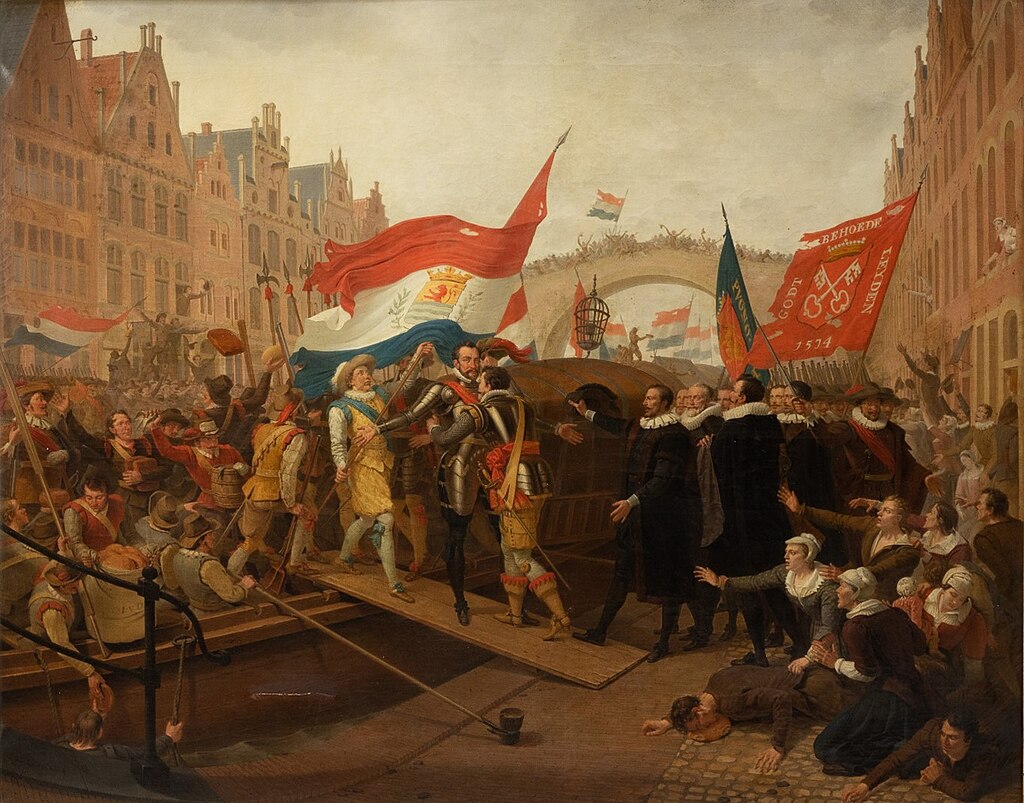
Antonis Aloisius Emanuël van Bedaff (1787–1829), The welcome of William of Orange and the Sea Beggars by Mayor Van der Werf and the Leiden city council, after the Siege of Leiden in 1574.
- Interview by
- Daniel Finn
The Dutch Revolt of the sixteenth century defeated the Spanish monarchy, the great European superpower of its day. While it may not be as well remembered as the English Civil War or the French Revolution, it was a watershed moment in the history of modern Europe.
It created the Dutch Republic, Europe’s most aggressively commercial state during the seventeenth century, and helped shape the development of European capitalism. But there were also different currents at play in the struggle against Spanish rule, as the popular classes mobilized and drove the revolt forward, playing a crucial role in its success.
Pepijn Brandon, a professor of global economic and social history at the Vrije Universiteit in Amsterdam and the author of War, Capital, and the Dutch State (1588-1795) sat down with Jacobin to discusss the Dutch Revolt.
This is an edited transcript of an interview from the Long Reads podcast. You can listen to the two-part interview here and here.
What was the social context and the system of political rule in the Netherlands during the period leading up to the Dutch Revolt?
We’re talking about a revolt that took place in the second half of the sixteenth century. It covered an area that was called the Low Countries, consisting of seventeen different provinces, all with their own social systems and systems of political rule. It was roughly divided into two territories: the Northern Netherlands, more or less coinciding with what is today the Netherlands, and the Southern Netherlands, more or less coinciding with modern Belgium.
This revolt evolved over a period of several decades. It started out as a classical revolt and ended more in the form of regular warfare, which led to the formation of an independent state in the northern provinces that became the Dutch Republic, while the revolt in the Southern Netherlands was defeated and this area remained part of the Habsburg Empire.
These seventeen provinces had only been united under Habsburg rule in the 1540s. They were in many ways an essential part of the Habsburg monarchy’s imperial ambitions, even though the core of the empire was the Iberian peninsula. This was the most urbanized area of sixteenth-century Europe. These provinces, or at least the seaborn ones, were extremely trade-oriented and very wealthy.
For an absolutist state like the Habsburg monarchy that had massive imperial ambitions and was engaged in continuous warfare across Europe, tax income from these commercial provinces was key. The Habsburgs experimented with various ways in which to gain firmer political control over the provinces, which would make it easier to levy taxes. They also wanted to avoid the kind of turmoil that was then spreading across Europe, partly religious and partly political, with local rebellions that were seeking to establish new states, often intersecting with the Reformation.
Antwerp, the most important trading city of the Southern Netherlands, had a hundred thousand inhabitants, which made it a very large city for the sixteenth century. It was a center for European trade as well as important parts of the trade reaching outside Europe, especially in the Atlantic. To give just one example, Antwerp became the main center for the sixteenth-century European sugar trade, distributing sugar that was produced in Portugal’s Brazilian plantations.
That economic role gave these provinces enormous importance, but it also gave them a sense of self-worth that led to the emergence of various opposition movements seeking to enhance the local autonomy of the Dutch elites. This created an explosive brew, especially when it intersected with the rise of oppositional religious movements.
This brew came to a head in the 1560s. First there were extensive fissures within the state apparatus, with oppositions forming among both the higher and the lower nobility, often with substantial support from wealthy urban merchant elites. These fissures then developed into complete ruptures when people from the lower classes took the opportunity to push for their own demands — especially the end of religious persecution.
Is it fair to say that the revolt was primarily motivated by religion, at least in its opening stages?
In a certain sense, yes, and in a certain sense, no. This has been a point of contention from the time of the revolt itself: whether it was a revolt primarily for religion or one for political independence. There have been sharp debates over this question right up to the present.
Mainstream Dutch historiography has classically been divided into two currents, which were connected to two main stories that the nation has told about itself since the nineteenth century. One conservative version of historiography claimed that this was a revolt for religion. That was the point of view of Protestant historians.
On the other hand, there were historians who were often equally conservative and nationalist but who said, “no, the prime mover was liberty.” “Liberty” in this sense has a complicated, Janus-faced aspect to it. When sixteenth-century people referred to liberty, they meant autonomy or something very particularist. They were referring to “our ancient freedoms” — the privileges of a city that granted it certain freedoms against the nobility or against a monarch. That was certainly an important element in the revolt.
However, liberty can also mean the liberty of the nation against a foreign power — in this case, Spain. This became a very important perspective for nineteenth-century nationalists who said, “here is a revolt fought for freedom that is the basis of our nation.” But at the start of the revolt, no one expected an independent nation to be the outcome, and no one would have defined freedom in that sense. When you interpret the term “liberty” as referring to national independence, that is anachronistic.
There have only been a handful of radical historians of the Dutch Revolt who, in the fashion of much twentieth-century Marxist historiography, claimed that the prime mover was economic. They argued that it broke out as a lower-class revolt driven by high grain prices and acute hunger. That was the thesis of Erich Kuttner, a German Jewish refugee in the Netherlands who wrote a book called Hunger Year 1566 while in hiding from the Nazis.
The book was published posthumously because Kuttner was caught by the Nazis and murdered in the Mauthausen concentration camp. He put up a firm argument that economic reasons, primarily urban poverty, were what led to the outbreak of the revolt. That interpretation has prompted a lot of discussion, including vicious attacks on Kuttner. While marginal, it has remained an influence on thinking about the revolt.
My own view is that the outbreak of the revolt cannot be seen in isolation from the intervention of the lower classes in political life, and that religion was very important as a motive for that intervention, as well as material circumstances. There is still a lot of value in Kuttner’s thesis, but he represented a rather mechanistic-materialist approach to the politics of rebellion that was prevalent among Marxist historians in the 1930s.
The mechanistic approach posed a stark opposition between the ideal motivations, which were religious, and the real motivations, which were economic and had to do with grain prices and hunger. That kind of analysis tends to dematerialize the role of the church in sixteenth-century politics. An attack on the church was not a purely theoretical or idealistic motive that was up in the air, so to speak — it was an attack on one of the main power structures behind the sixteenth-century state.
In many ways, the church was the power structure that people encountered most immediately within their daily lives. They had to kneel for a priest every Sunday. That was a material fact, something that impinged on how people lived their lives. The Catholic Church was an incredibly wealthy institution, and much of the anger expressed in popular pamphlets and in the utterances of people who took part in the rebellion and were brought to trial was directed against the wealth of the church and its crass materialism.
That is the point at which an outburst against inequality can become linked to starkly felt religious motives. We’re talking about a revolt that went through various stages. The first stage was a wave of iconoclastic fury that broke out in 1566 and continued into 1567. Catholic churches were adorned with statues of saints, images of Christ, etc. The Protestant religion turned against that, and people who were mostly from the lower classes would start breaking into churches and smashing the images to pieces.
This rebellion had been growing in the form of small-scale, everyday resistance long before this iconoclastic fury broke out. I did a lot of research myself on the immediate stages before the revolt in the textile city of Leiden in the Northern Netherlands. One of the most fascinating discoveries that I made was the widespread phenomenon of people standing up in churches, walking up to the front, taking the host from the priest, throwing it on the ground, and stamping on it, shouting, “If this is your God, then why doesn’t he intervene?”
The criticism of the Catholic practice of the host was part of the onslaught against the idea of a materialist church that assumed God was present in objects and in earthly wealth. This was in a context where the Catholic Church was everywhere and people were burned at the stake for resisting it. Against that backdrop, it was an incredibly brave form of direct action, one that was happening on a mass scale.
To conclude, I do think that religion was crucial to the outbreak of the revolt. However, religion in a deeply religious society where the church is part of the state is not a purely theoretical issue. It is part of a structure that shapes people’s lives and against which they rebel.
What political and military character did the revolt assume?
It’s useful to summarize the main stages of this revolt. It started with the wave of iconoclasm in which tens of thousands of people participated. The Spanish state then responded to the revolt, although the higher nobility in much of the Low Countries had already turned against the rebels and tried to suppress them.
For the extremely devout Catholic monarch, Philip II, that was not enough. He sent an army headed by a strongman figure, the Duke of Alba, one of the hard-line traditionalists among the Spanish nobility. Much of the higher Dutch nobility thought they could compromise with Alba, especially because they had already shown that they were not on the side of this rebellion.
But one leading nobleman, William of Orange, fled from the Southern Netherlands to Germany. From there, at various points, he tried to restart the revolt by military means. Those attempts failed until there was a lucky strike by the smaller, sea-based guerrilla bands known as the Sea Beggars in 1572, which sparked off urban uprisings in the Northern Netherlands, especially in the provinces of Holland and Zealand.
Those rebellions gave the revolt a military foothold that led to years of struggle pitting William’s small ragtag bands, plus most of the main towns of Holland and Zealand, against the armies of Philip II. There was a long period of warfare until a new wave of rebellions in the southern provinces in 1576 led to the unification of most of the Netherlands on the side of the revolt.
Throughout this period, there was a very complex relationship between the military side of the revolt and local political factors, often varying from city to city. Most of the main northern cities joined the revolt, but the two wealthiest cities of Holland and Zealand, Middelburg and Amsterdam, refused to join it until the late 1570s, because their elites were very dependent on trade within the Spanish empire.
After the unification of 1576, you had what was perhaps the most radical phase of the revolt, with a series of uprisings and takeovers by urban artisans and the middle classes in important cities in the Southern Netherlands, notably Ghent. Those cities faced a massive counterattack by the Spanish army and defecting members of the southern nobility who thought things had gone too far. The ultimate outcome was the defeat of the revolt in the south combined with its military consolidation in the north.
This led to the formation of a federal state in the Northern Netherlands, with a great deal of local particularism, but with a united army and navy. William of Orange played a major role in countering the earlier, more spontaneous way of fighting. The way that the army had been organized, with the influence of lower-rank soldiers and the participation of urban civil guards in the fighting, had combined with demands for political influence from the urban middle classes.
William replaced that with a general push for what was seen as military professionalization. By the 1580s, you had a situation where the independence of the northern provinces was consolidated, but the struggle became less of a political or religious revolt against the central authorities and more of a purely military struggle between a newly independent Dutch state and the Habsburg Empire.
What was the attitude of European powers such as France and England that were rivals of the Spanish crown?
Throughout the course of this struggle, for all the different parties involved, the revolt was enmeshed in European politics. As it progressed and the independent Dutch state got off the ground, it also became enmeshed in world politics and colonial politics. The revolt represented a shift within the balance of power in Europe — a balance that was already tenuous to begin with.
For the adversaries of the Habsburgs, this seemed to represent a golden opportunity that they wanted to grasp, but without sharing any of the republican zeal that developed as part of the revolt. There was a similar ambivalence when it came to the leaders of the revolt as well. William partly fought for his own dynastic ambitions, and his commitment to the revolt also rested on the idea of restoring the House of Orange, which was an important house within the European feudal power structure.
For a long time, William was ambivalent about whether these ambitions could be fulfilled within the framework of a return to Habsburg rule with a clear agreement on the autonomy and local rights of urban magistrates and the higher nobility. When that proved impossible, he considered the best option for the revolt to be aligning itself closely with a foreign house that could bring another state into the war against the Habsburgs.
There were two main episodes on this front. The first, when Wiliam was still alive, was an attempt to align the Dutch revolt with a French noble house that was closely related to the crown, the House of Anjou. The Duke of Anjou was brought in as a replacement sovereign for the Low Countries. Later, there was a similar attempt to align the Dutch provinces that were then still independent with the English crown by inviting the Duke of Leicester to act as the head of the Dutch armies and the central figure within the Dutch states.
But at this point you see some of the developments in the revolt’s social content as well. It would be wrong to say that anyone planned this as an urban, bourgeois revolution with the aim of independence for a merchant-dominated state. No one would have thought of the aims of the revolt in those terms during the 1560s. By the late 1570s and early 1580s, however, that objective had clearly been put on the table.
The power of cities was central to the success of the revolt — city wealth was crucial in funding the professionalization of the army. Those urban merchant elites were quite willing to accept a figurehead ruler from outside if that helped them fight the war against Spain and its armies. But they were very reluctant to give up the independence and political sway that they had gained by that point.
The ambitious high nobles from France or England who were invited to the Netherlands expected that they would play the role of a substitute king within the Dutch provinces, on a level footing with other kings and princes in the rest of Europe. They didn’t expect to be treated like officials who had to carry out the decisions made by urban upstarts. That created enormous social and political tensions, which led to the rapid failure of the two attempts involving the Duke of Anjou and the Duke of Leicester.
After the second failure, which resulted in an episode of major political turmoil, the estates-general in the northern provinces decided they could go it alone: “We don’t need that kind of alliance, and if we do make alliances, we’ll do it as an independent state or republic.” That was when the Dutch Republic was founded, at a moment of great confidence that they could wage war at the level of a major European state.
Were there any movements among the popular classes during the revolt that were similar to those which later emerged during the English and French revolutions — the Levellers, the sans-culottes, the enragés?
This is a very important question, especially because the standard answer in the historiography of the Dutch Revolt is a blunt no. In a certain sense, that is correct, because you did not have sustained and unified political movements of the lower classes at the level that you later saw in the English Civil War or the French Revolution. Nor did you have the development of proto-communist programs like those of the Diggers or the conspiracy of Gracchus Babeuf.
On the other hand, lower-class rebellion was absolutely fundamental in elevating the various oppositional movements that existed in the Low Countries during the early 1560s to the level of outright revolt. It was also instrumental in creating the new phase of the revolt in 1572 when the attempts by William to relaunch the revolt from above as a purely military, princely-led affair had failed. The capture of a small town in southern Holland by guerrilla bands turned into a province-wide revolt because ordinary people went into the streets in town after town and forced their magistrates to proclaim that they were with William.
These were crucial episodes, and the pattern was repeated several times in the 1570s and ’80s, with popular rebellion proving to be decisive in the continuation of the revolt. The military struggle in the first phase took the form of Spanish efforts to recapture the rebellious cities. It was not regular warfare that defended the cities against the professional, well-trained Spanish armies — it was the total mobilization of the population, often including women.
There was also the element of religiously infused expectations that the rebellion would result in the creation of a new Jerusalem, a society in which people could have a say. The revolt was connected to what has often been called the Popular Reformation. The Reformation was a complex, multi-class phenomenon. There was a princely Reformation that was quite conservative in its outlook, but there was also, especially in the first half of the sixteenth century, the so-called Anabaptist movements that have often been described as proto-communists.
The Anabaptists believed that the return of Christ was around the corner and that it would lead to a society that was more equal and more just for the lower classes. Those millenarian sects also told lower-class people that they could play a role in interpreting scripture and preaching the word to their fellow artisans. That left a deep imprint. In my studies of Leiden, even in the 1560s, I found that the majority of people who were being persecuted as religious dissenters were not Calvinists, but were in fact associated with Anabaptism in some shape or form.
At the same time, we should remember that Anabaptism had gone through a radical, confrontational phase in the 1530s that reached a high point with the capture of a German city called Münster, largely by Dutch Anabaptists who had gone there to establish the new Jerusalem. That religious rebellion was crushed mercilessly. Even today, if you go to Münster, the church still has the cages hanging in which the bodies of the revolt’s leaders were displayed after they were executed.
Anabaptism in the Low Countries went through a series of crises after that defeat. The result was a turn away from the world toward spiritualism and pacifism. As an organized force, it hardly played any role in the revolt because revolts were no longer encouraged in that line of thinking. But the chiliastic ideas encouraged by Anabaptism were still present during the early stages of the revolt.
Overall, you had two elements. You had the importance of lower-class rebellion, which was very much concentrated in particular towns rather than assuming the form of a national movement. There was no Dutch equivalent of Paris where lower-class rebellion could become the focal point of the nation because of its sheer weight and size. Then you had the remnants of radical ideas rather than the formation of a new ideology that could bind together these forms of lower-class rebellion.
During the fourteenth century, Flanders had experienced the most sustained wave of popular rebellion anywhere in Europe. Did that leave behind any legacy for the revolt of the sixteenth century?
It certainly did. In some ways, it had a decisive influence when it came to the unfolding of the revolt in the south. After the reunification of the provinces on the side of the revolt in 1576, there was a phase of radicalization that ran in opposite directions in the Southern Netherlands.
On the one hand, you had a radicalization of the Counter-Reformation and of counterrevolution. The Southern Netherlands were an area where feudalism had much deeper social roots than in the north. Much of the nobility thought that the power of the cities and the influence of merchants on politics had gone too far and that it was better to align with the Habsburg monarchy and with the most conservative variants of Catholicism.
On the other hand, there was a wave of urban uprisings leading to the formation of revolutionary dictatorships in the classical sense of that word. Militant artisans and their craft guilds took control over city governments, beginning in Ghent. There were complex alignments with members of the lower nobility and with people from the lower classes. But the tradition of the urban middle class taking control of the city in defense of their autonomy is one that goes back to the fourteenth century.
My dear colleague from Belgium, Jan Dumolyn, has written very convincingly about this long-running sequence of battles for urban autonomy against the nobility. You could describe those battles as the rumblings of a newly confident bourgeoisie or premonitions of shifting social relations in Europe. This phenomenon was not sealed off from the Dutch Revolt.
The last outburst of that tradition before the revolt came in 1540, when Ghent went through a major uprising. The Hapsburg king Charles V laid siege to the city and severely punished its population after defeating the revolt. Resentment was still lingering, and the tradition was still very much alive when the revolt broke out two decades later.
In many ways, we can see the militant phase of the revolt in the south during the late 1570s and early 1580s as a continuation of that tradition. The irony is that this inheritance created a form of radicalism that far surpassed what existed in the northern provinces while, at the same time, it also carried with it medieval legacies that hindered the success of these revolts on a larger territorial scale. One of those legacies was an intense urban particularism.
The rulers of Ghent fought for the city and for its control over the countryside and the provincial states. Several large cities that underwent similar uprisings also had a strong focus on their own interests, so there was very little possibility of creating a united front against the forces of the noble counterrevolution. The strength of the urban revolts in some ways inhibited the rise of state structures that could counter the might of the Spanish armies and thus left these towns to be defeated one by one.
In contrast, while there was also a lot of urban particularism in the Northern Netherlands, especially in Holland, the fact that those towns were all relatively small and weak gave them a much stronger impetus to work together than was the case for the proud and powerful ancient cities of Flanders and Brabant. It was the combination of individual weakness and collective strength on the part of the towns in Holland that compelled them to form a coherent, provincial whole opposing the encroachment of Spanish troops.
What kind of state and society was the Dutch Republic that emerged from the revolt?
That question brings us right to the heart of the old debates about whether or not we can speak of “bourgeois revolutions.” I have been influenced a lot by my late friend, Neil Davidson. As many people have rightly said, if you imagine a bourgeois or capitalist revolution as a moment when the rich and wealthy go into the streets and make a revolution to establish their state, there has never been such a phenomenon in history. But then the argument from Neil and others is that the bourgeois nature of these revolts lies in their outcomes.
The Dutch Revolt in many ways illustrates that point very well. I don’t think anyone doubts that the Dutch state emerging from the revolt was Europe’s most commercially oriented state at the time. Merchant capitalists had an overbearing influence within the state and made arrangements to organize many of its tasks, including aspects of warfare and colonial conquest, as public–private ventures for which they expected to see a return in the form of profits. This was a state that self-consciously identified the interests of the state with the interests of trade.
Now, whether that alone is enough to define this as a capitalist state is a matter for further discussion. But the revolt created merchant power within the state and urban power on an unprecedented scale. The independent power of those social groups would never have been possible within the confines of an absolutist, monarchical, feudal state. In that sense, the revolt broke new terrain.
We’re often trained to see these moments in terms of purely national trajectories. First we look at the basic social and economic structure within the confines of a particular national territory, identifying the elements of capitalist development, then we try to connect the revolt with those elements, before finally asking whether the outcome matches our criteria of a capitalist state and a capitalist society.
I think that is a limiting perspective. We need to have a longer-term approach to this question, where you see the development of important political, social, and economic fissures within feudal society over the course of centuries, which creates the space for experiments in new forms of statehood and social organization that might initially be tried out on a local scale. By the late sixteenth and early seventeenth century, that can translate into the politics of an entire state like the Dutch Republic.
At the same time, it’s not a complete break with earlier practices. The urban particularism of the previous age is largely retained but combined with new elements, especially an orientation toward world trade and empire that is entirely novel. I would see what have been described as the classical bourgeois revolutions, from the English Civil War to the American and French revolutions and up to the American Civil War, as a long, drawn-out struggle for different forms of social organization, which in the end culminates in international capitalism.
Looking at Dutch history in particular against that wider European and North American backdrop, what role would you say the revolt played in the development of Dutch capitalism?
I don’t think anyone would see these events as harbingers of capitalist development in their own right. It’s in the very nature of capitalism as a privatized market relationship that it develops largely outside of the state. In many parts of the world, it developed at the point where the role of money and commerce no longer merely consisted of regulating trade between disparate areas but also became connected to localized systems of production that were fully commercialized. People’s labor and the buying and selling of land were now mediated through the market.
The telling of that story is often exclusively attached to England, but I don’t believe that is correct. Relations of that kind developed in many places, including the late medieval Low Countries, but they were enmeshed within a political structure that still only favored the protection of trade and commerce up to a certain point, subject to the political motivations of the nobility and the monarchical state.
The importance of the Dutch Revolt is that in an already highly commercialized area, it created a state that had the accumulation of wealth through trade and competition inscribed in its very being. That was an enormously accelerating factor, as can be seen in two outgrowths of the revolt that both occurred at the moment when it changed from being a revolution shaped by spontaneous uprisings from below to become a struggle waged by a state with a regular army funded through urban taxation and loans by wealthy merchants.
First of all, the ongoing warfare became a major factor in the dispossession of independent commercial peasants in the peripheral provinces. They were being driven off the land because they could not sustain themselves as peasant households when their crops were being destroyed and they could not go to the towns to sell anything. One of the major weapons of war was inundation, where part of the land was flooded, and it took years for it to be suitable for agriculture again.
Those independent peasants went bankrupt on a massive scale, and their land was bought up by the same urban elites that were funding the Dutch armies. I would say this was a classical form of original accumulation, although it’s not one that Karl Marx discusses in Capital. Dutch agriculture was already commercial, but it now became organized on a much grander scale, with local tenant farmers who paid rent to urban elites.
The second outgrowth is that this newly confident state with its own army and navy began to challenge Habsburg power. It needed approximately a decade to secure the outer borders of the new state. But once it had done that, it started to bring the war to where it really counted and where it could really hurt the Iberian powers, namely their colonial empires. The war of independence rapidly developed into a war for empire as well, first in Asia and then in the Atlantic world, making the Dutch Republic the major world power of the seventeenth century.
I see parallels here with the Irish campaigns of Oliver Cromwell and William of Orange. Again, a process of bourgeois consolidation immediately turned into empire-building at the same time that the elements of the revolts that came from below were either incorporated or smashed. I also see similar patterns in the French revolution with Napoleon’s Egyptian campaigns. This turn to military expansion is a crucial but understudied dimension of bourgeois revolutions.
Following on from that last point, how did the Dutch colonial empire take shape during and after the revolts? How important were the colonies for the future economic development of the Netherlands?
The colonial ventures took shape relatively early. By 1588, the Dutch had renounced all the attempts to find a foreign ruler to act as the head of state. The Spanish Crown launched a major attempt to crush the revolt for good by sending a giant fleet to reconquer the Netherlands and wage war against England. For various reasons, the armada proved to be a miserable failure, which opened the way for the newly established Dutch navy to bring the war to the seas and the major trade routes of the Iberians.
By the 1590s, there were various private initiatives to gain a foothold in the Asian trade and to capture several islands along the West African coast, including slave-trading and sugar-producing islands. The state swung behind these initiatives because it recognized that this was a major opportunity to fund their own state through colonial ventures and to undermine the funding of the Spanish state, which relied heavily on silver imports and other forms of trade with the Atlantic world.
The Dutch forces launched a concerted attack on the Iberian strongholds outside Europe. The Dutch East India Company was established in 1602, with the Dutch West India company emerging at a later stage in 1621. Both companies became important contenders for power in the Indian Ocean and in the Atlantic, and both started to acquire important colonies, often by genocidal means and intersecting with the slave trade in which the Dutch became a major participant.
That brought an important injection of wealth, which contributed further to the wealth of the big urban merchants. They often funneled the money back into new colonial enterprises, or into European trade, or into local commercial agriculture. While the Dutch were conquering colonies abroad, there was also a craze for land reclamation within the Low Countries, which added substantially to the stock of arable land. To an important extent, this was also funded by the spoils of colonial ventures.
The circulation of capital from colonial initiatives back into the home economy and vice versa became an essential aspect of the surge in capitalism in and around the Low Countries during the seventeenth century. It was a new phenomenon that was greatly assisted by the creation of an independent state through the revolt.
How would you situate the revolt in relation to what later happened in England, France, or the American colonies, and what implications does it have for the wider concept of bourgeois revolution?
The concept of bourgeois revolution is a difficult one with all sorts of problematic connotations, but I would still want to rescue it — I think there is something valuable there. There were various crises within Europe’s old order during the sixteenth, seventeenth and eighteenth centuries. But those crises did not turn in a capitalist direction in and of themselves.
The fact that a number of states emerged with capitalist interests at their heart became an important factor in bringing about this transition. Those states all came out of major convulsions, wars, and revolutions. But the question is, how did they evolve out of these events? On this point, I would take a somewhat unorthodox approach. Although I mentioned Neil Davidson in particular, there are many others who have taken an unorthodox approach to this question as well.
What we have to think about is the relationship between forces operating from below and from above in these revolutions: the role of popular risings on the one hand, war and empire on the other. There is a strong tradition of historiography from the left that distinguishes between the first phase of classical bourgeois revolutions, ranging all the way from the German Peasants’ War to the French revolution, and later developments such as the Italian risorgimento, the Meiji restoration in Japan, and the Bismarckian transformation of the German state.
This tradition presents the first set of bourgeois revolutions as revolutions from below and the second set as revolutions from above. There is also a strong association between the bourgeois revolution and the democratic revolution. I find this to be anachronistic in so many ways, and it grants the bourgeoisie too much historically.
There was no case where the outcome of these events was a democratic state in any meaningful sense of the term. They were ruling-class states, created from the top down, with at best a limited element of democracy. There was a democratic urge that could be seen in the uprisings from below, but it’s hard to see democracy as the defining program (except in a very general sense that the people should have a say in how they’re governed, which is important in its own right).
But the immense fissures within the feudal order, the divisions within these states, and the conditions of permanent warfare created openings in which mass rebellions could erupt from below — partly driven by the desire to achieve a say in the field of politics, partly by religion, partly by socioeconomic motives — and have a major impact on political life. You can see these revolts littered through European history in many different moments.
At certain moments, they coalesced into rebellions that were national, semi-national, or region-wide. In what are usually described as the classical bourgeois revolutions, these rebellions developed into major challenges to the existing state. Very often, the bourgeois element was not part of the rebellion or revolution itself, but rather involved partly riding that wave and partly suppressing it. The moment where you could identify a real bourgeois turn was the moment when a new state was consolidated, which meant shutting down the influence from below on this process of rebellion.
To some extent, the bourgeois element is the counterrevolution within the revolution. It preserves the shell of the revolution but transforms it into something qualitatively different, and the defeat of popular mobilization is a crucial part of that transformation. Very often, the emergency that allows for the curtailment or smashing of popular rebellion takes the form of external war, at which point the state comes into its own.
We can see this pattern in the Dutch Revolt, the English Civil War, the American War of Independence, and the French Revolution. To be provocative, one could even say that there is an element of this in the Haitian Revolution as well, which goes from a very radical stage to a period of internal and external consolidation.
If we want to see the Dutch Revolt as a bourgeois revolution, it must be in this sense. It starts as a disparate series of revolts and opposition movements from different social classes, but it later coalesces into a state controlled by merchant elites with a very ambitious agenda for reshaping the world, both internally within the Low Countries and externally in terms of empire-building.
What was the general significance of the Dutch Revolt and the Dutch Republic that came out of it for the history of capitalism and the international state system leading up to the present day?
In the period that followed the revolt, there was a very strong Dutch presence in European politics and the European economy that had an enduring impact on the world. This was in combination with developments elsewhere — it’s not that everything emanated from this small region of Europe.
It became a stepping stone for the consolidation of bourgeois rule in England in the most direct sense, since the monarch who was brought in to carry out this task was William of Orange, the great-grandson of the Dutch Revolt’s main leader. But more broadly, the Dutch Republic provided a model of how a commercial state could be organized, one to which people in the seventeenth century referred.
It showed that a commercial state of that kind could be militarily strong and successful. It introduced new forms of colonization, in the sense that colonization became an enterprise for profit rather than the aggrandizement of a monarchal state. By the 1650s, you have tracts arguing for the creation of slave-based plantation colonies, based on calculations about the rate of return on investment. This had a big influence on the thinking of other statesmen in the rest of Europe and changed the rules of the game, both for colonizers and for the colonized.
We cannot go here into the major debates between figures like Robert Brenner, Immanuel Wallerstein, and Giovanni Arrighi about the prime mover of capitalist development. But what is created in the Dutch Republic is a new dynamic in which colonial revenue is funneled back into agrarian capitalism and vice versa. That creates new patterns of accumulation, bringing the Dutch Republic enormous wealth, and making it a financial center within Europe.
Even when it lost its elevated position among European states, it was still the home of major colonial companies and financial firms that bankrolled ventures outside the Dutch Republic, including Britain’s efforts at industrialization as well as its colonization schemes in the Caribbean. There were some important tipping points in world history to which the Dutch Republic made a significant contribution, for better or worse — I would say for worse.
There is also the suppressed and forgotten part of the Dutch Revolt, which is the aspect of popular rebellion reshaping European politics. Progressives have historically tended to celebrate these events by observing that the present-day order was not created through a history of peaceful progressions: in fact, popular rebellion redrew the map of the world. That aspect remains important, but it needs to be tethered to a precise understanding about the relationship between popular rebellion and the states that emerged out of these events.
There is a powerful radical tradition of thinking about these revolutions that deserves to be recuperated. I referred earlier to the work of Erich Kuttner, who was very astute in seeing independent lower-class rebellion as a major driver in these events, despite some of the problems with his thesis. Kuttner’s work fits into a small tradition of works that emerged in the 1930s, somewhat detached from the mainstream of Marxist writing at the time, which was very much indebted to the idea of the bourgeois revolution as a democratic revolution.
Against that notion, there was a minor undercurrent of historical works that are still very important. Those works emphasized the fact that lower-class rebellion drove these revolts forward and that the role of the bourgeoisie consisted of riding this wave and suppressing it at the same time. As well as Kuttner, we could also mention Daniel Guérin’s book on the French Revolution and of course The Black Jacobins by C. L. R. James. For James, it was the masses in Saint-Domingue and Paris who were the main actors against both the forces of feudal reaction and the bourgeoisie with its newly forming state.
Works like that, which came from more critical and marginal areas of Marxist historiography, contain some crucial insights into the radicalism of these moments of revolt. They help us to dissociate that radicalism from the repressive nature of the states that emerged from the rebellions.
This is currently a major debate when looking at the American War of Independence in the eighteenth century, where some writers have argued that we should see these events as having been purely reactionary. I think that argument latches onto the moment of counterrevolution within a revolution. What it leaves out is the fact that the revolution itself was not made by the people who went on to consolidate their power over the state.
The initial outbursts were moments of true radicalism with very different visions of what the future could potentially hold. Recapturing those moments of radicalism is one of the important tasks that historians of the Left have always tried to carry out.