The Proper Way to Welcome the People Destroying the World
The heads of mining and fossil-fuel companies are meeting this month in Melbourne to exchange tips on how to best extract wealth from the planet. We must greet them with mass protest.
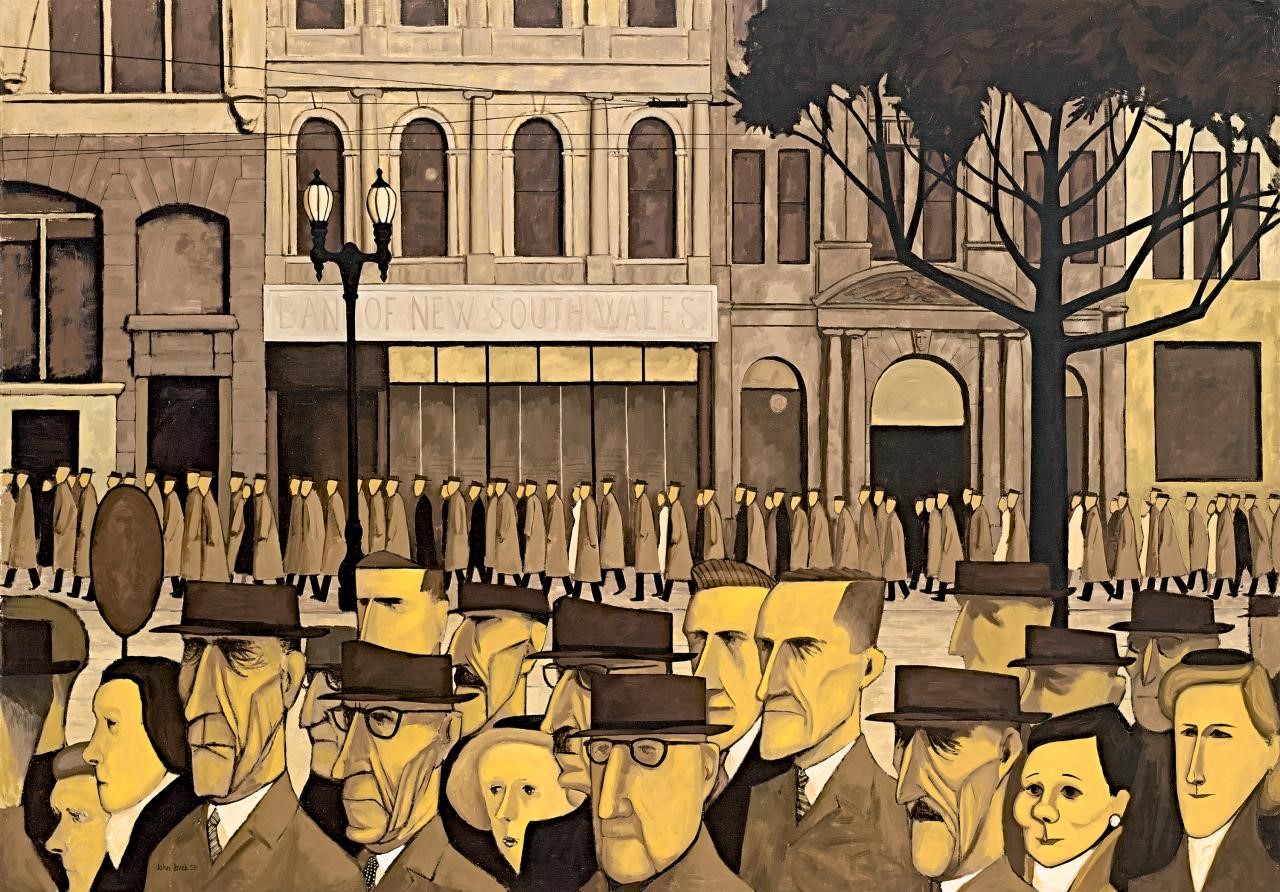
“Collins St, 5 pm” by John Brack, 1955.National Gallery of Victoria
It’s easy to forget that Melbourne, now regarded as a laid-back refuge for artists, intellectuals, and activists, was once considered the commercial and financial capital of the southern hemisphere. Australia’s first mining millionaires were Melbourne-based. Their history remains sewn into its urban fabric. The city’s broad boulevards, impressive banks, fine suburbs, and colonial mansions were all built with wealth generated first by the gold rush of the 1850s, and later by base metal mining, from the 1880s onward. “The actual production does not take place in Victoria,” wrote visiting English author Richard Twopeny in 1883, “but it is in Melbourne that the money resulting from the productions of other [pre-Federation] colonies as well as of Victoria is turned over.”
At the same time, Melbourne was also scene to grave poverty. For a labor movement recovering from the worst of the 1890s depression, the lavish clubs and ornate buildings of Melbourne’s Collins Street — depicted in John Brack’s famous painting, “Collins St., 5pm” — stood in stark contrast to the slums of now-gentrified Collingwood or the primitive conditions of mining towns like Broken Hill. There, locals lived in dusty corrugated shacks and makeshift tents, and struggled with horrific diseases like typhoid. “How fitting then,” observes historian Erik Eklund, “that the only words in John Brack’s iconic painting of Melbourne were ‘Bank of New South Wales’, for indeed much of the wealth of late nineteenth century Collins Street came from the far western NSW town of Broken Hill.”
While Collins Street may have changed since the turn of the twentieth century, it remains home to some of Australia’s most notorious mining giants, many of whom will be front and center at this year’s annual International Mining and Resources Conference (IMARC). IMARC is Australia’s largest mining event; it is slated to bring together around seven thousand industry heavyweights from over a hundred countries.