In Amsterdam, the Left Might Bicycle to Power
After years of organizing outside electoral politics, a new left formation in Amsterdam is running for city council. Its leaders argue that movements don’t need protest alone — they also need power.
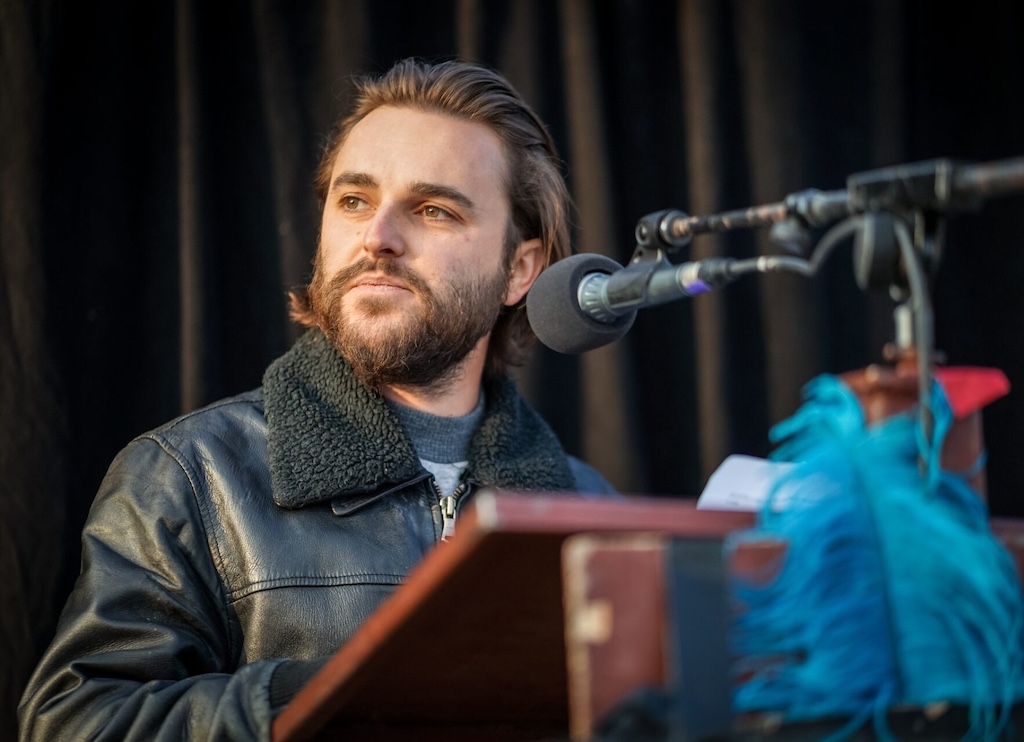
Chris Kaspar de Ploeg at Indigenous Liberation Day at the 1492 People’s Tribunal in Amsterdam on October 12, 2022. (Courtesy of Oscar Brak)
Amsterdam once stood as one of the world’s great capitals, the place from which large ships left to go as far off as the Americas and the islands of Indonesia to trade and conquer. There are reminders all over the city of that history, residues of its imperial past. But what grandeur exists now looks slightly shabby, the city marked by a decline in investments in its public services and widespread disappointment with its political leaders.
There is graffiti across Amsterdam that also calls to mind last year’s massive demonstration of 250,000 people against the Dutch government’s support for Israel’s genocide against the Palestinians and then of the hooliganism of Maccabi Tel Aviv supporters who rampaged the city chanting for the death of Arabs.
These marks — painted on walls or indicated by fraying posters — tell the story of a city that is anxious about its place in the world. There are still large ships in the harbor, but they are not controlled by the Netherlands; these are ships that are driven by the winds of trade blown from other places — eastern Asia certainly, but also North America. Amsterdam is still a port city, but now it is mostly a tourist city: a municipality of less than one million people that draws in over twenty million tourists each year.
Chris Kaspar de Ploeg was born here in 1994, a few years after the Soviet Union had collapsed and after the ships in the harbor loaded with manufactured goods had begun making more trips to Asia than to European consumers. He was so impatient to enter the world that it took his mother only a few minutes of labor to give birth to him in a tall apartment building beside one of Amsterdam’s many canals.
We are in this building three decades later, and he runs about in an apartment that had once been the home of a close friend, talking energetically about his childhood. It was a happy one, surrounded by migrants from the old Dutch colonies of Indonesia and Suriname as well as migrant laborers from Morocco and Turkey. On Sundays, he attended the Armenian school run by his mother. Raised by parents who gave him a strong sense of justice, it helps that he comes from a mixed family of Armenians and Sephardic Jews — the memory of genocide in his own family history is fresh in his consciousness.
In his old building, Chris tells me about the Amsterdam he wants to build, one that would be “genocide-free.” “We will get rid of companies that are complicit in genocide, such as Booking.com,” he says. “As well as the investment funds that are buying up our houses, such as Blackstone.” The “we” here is De Vonk (The Spark), a new left formation in the Netherlands that will run candidates in the 2026 city elections in Amsterdam. De Ploeg heads the party’s list in those elections.
Students Have the Right to Dream
In the second decade of the twenty-first century, when Chris entered the University of Amsterdam, the contradictions of war and globalization hit Europe hard. Having yoked themselves to a new “global NATO” during the “war on terror,” European states found themselves drawn deeper into ghastly wars provoked largely by the United States. It felt to young people like Chris that they were living in a civilization of war, with NATO refashioned in the post–Cold War world as an imperial army.
Ordinary people in Europe paid the bill for these wars and for the escalation of military spending, as well as for the allowance given to corporations to operate largely without any tax burden. In the Dutch case, Amsterdam’s Zuidas in particular is a center for letterbox companies evading taxes all over the world and a major investor in Israel. For young people, this meant pressure to pay more for college and take on precarious jobs despite earning degrees.
In 2015, the problems created by war and globalization erupted into one of the most significant uprisings in recent Dutch history. The University of Amsterdam’s administration announced Profiel 2016, a project to direct resources toward majors that would lead to careers, thereby heavily cutting humanities. Students organized themselves and took over the Bungehuis, the building of the humanities faculty. After an eleven-day occupation of the building, they also took over the Maagdenhuis, the administrative heart of the university. The students and sympathetic faculty formed themselves into phalanxes called De Nieuwe Universiteit (the New University), RethinkUvA, and eventually, during the Maagdenhuis occupation, University of Colour.
The sign outside Maagdenhuis read “No democratization without decolonisation.” Chris and his brother Max were deeply involved in the occupations. For nearly two months, the administrative building was transformed into a self-organized experiment, with students running assemblies and teach-ins, living in sleeping bags surrounded by discussions and music. Here, the students debated their future and the future of the planet. Everything was on the table. Universities, Chris said at that time, are “ruled by corporate managers” and had become “factories of inequality.”
The ideas that germinated in the university resonated across the country. The Netherlands had been gripped by budget cuts and an ethos of hierarchical managerialism. During the Maagdenhuis occupation, for example, home care workers were inspired to occupy Oss City Hall, drawing lessons from the students.
The students had a deep sense of the class attack on the university. This was accompanied by a growing sense of disquiet about how the government had begun to weaponize knowledge against the downtrodden. The University of Colour demanded a more progressive curriculum and also called for adherence to the principles of the Boycott, Divestment, and Sanctions movement (BDS) against Israel. “Solidarity ceased to be an idea,” Chris says of that period, “and became a practice — something that feeds you, exhausts you, transforms you.”
Student leaders such as Chris learn how to write in struggle. It begins with notes scribbled on cardboard signs that evolve into slogans and speeches and then morph into essays and investigations. A look at Chris’s early writings after 2015 shows a mind that is captivated by stories that the powerful conceal and by the ways the wealthy disguise their authorship of the world’s violence.
He began to present his ideas in a variety of forms: sometimes, with a guitar or drum, he would recite poetry; at other times — late at night, megaphone in hand — he would defend the right of students to dream with a moving speech. That is how his peers remember him: an analytical and emotional poet of the moment.
Building Democratic Intimacy
Dutch politics are deeply frustrating, with the parties that have older left and center-left traditions (such as the GreenLeft and the Labour Party) now serving as neoliberal apologists for NATO, while the old right has migrated rightward to become openly racist and imperialistic. For a student leader of a major upsurge, there was simply no home in the mainstream of Dutch politics. So, Chris, with his brother and others, formed Aralez, a grassroots anti-colonial network for political education and movement building. They had in mind the project of shaping a new kind of political force in a country that desperately needed one.
Long before the genocide in Palestine awakened a new generation, they were uniting various movements, groups, and communities, grounding them in practices of international solidarity. “In the spirit of Bandung,” Chris says, ‘we started organizing a yearly conference to ensure that decolonization means opposing war, imperialism, and exploitation — more than simply diversity and inclusion.” Aralez, de Ploeg says, must “renew the culture of resistance” in the Netherlands, one that goes back to the days of anti-colonial and working-class struggles to sustain a democratic country, in solidarity with the downtrodden across the globe. This was not merely a project of critique but one of building political power, as they set up training programs for activists of various movements to hone their skills and strategic thinking.
“Everywhere,” Chris says, “people are creating cracks in the system. And those cracks tell a story.” To listen to these cracks, Chris and his brother politicized the student-run café and cinema Studio/K, connecting with dozens of grassroots organizations in the city and beyond, ranging from those focusing on local housing struggles to those supporting solidarity with the Congo. At these Studio/K nights, the entire palimpsest of Amsterdam’s movement struggles showed itself through documentaries, poetry, and music as well as extended conversations late into the night.
Chris continued this work for years after leaving Studio/K, under the umbrella of Arts of Resistance, which used the arts as a means of mass politicization. The group invited the participation of artists such as the British Iraqi rapper and activist Lowkey or Kiala Nzavotunga, the guitarist of the late-great Nigerian musician and activist Fela Kuti.
Arts of Resistance, Studio/K, and Aralez had the purpose of bringing people together from different organizations and movements and building a democratic intimacy between them. Trust is key to any political project. And it is this intimacy of equals that helps to build trust and maintain connections even if small political differences might arise. There are larger struggles than small differences, and this process of the reconstruction of a society of the Left helped immeasurably to prepare Amsterdam for the emergence of first BIJ1 and then De Vonk.
The Origins of De Vonk
BIJ1 was formed in 2017 by TV and radio host Sylvana Simons to contest elections on the basis of an anti-racist program (the name of the party was first Artikel 1, referring to the first article of the Dutch Constitution, which prohibits racial discrimination). The early form of the party was rooted in the Afro-Dutch communities that had links to the former colonies of Holland and, to a lesser extent, in the Muslim immigrant communities that felt the rough edge of the war on terror. Simons had earlier been a member of Denk, a political party formed in 2015 by two members of the House of Representatives, Tunahan Kuzu and Selçuk Öztürk, both of Turkish Dutch origin.
The name BIJ1 refers to the earlier name of the party, but it is pronounced as bijeen, which is the Dutch word for “together.” BIJ1 was broadly left-wing but had no clear ideological position on the world and on Holland’s position in the world. This lack of ideological unity led to constant infighting, with seven out of eight councillors throughout the country dropping out or splitting off, including one that left early in 2025 for ChristenUnie, a strongly Zionist Christian party.
In 2024, De Vonk emerged from a split-off with BIJ1, largely driven by the desire among those who formed the new group to pursue a mass line and build a mass party on the Left. They brought together various small left-wing parties in the city, including the Activistenpartij UvA (Activist Party), the largest student party at the University of Amsterdam, and the Revolutionaire Socialistische Partij (Revolutionary Socialist Party), which itself emerged from dissatisfaction with the old-guard Socialistische Partij (Socialist Party). The latter expelled their entire youth wing in 2021 for veering too far to the left and governed the city of Amsterdam between 2018 and 2022 with the right-wing People’s Party for Freedom and Democracy, or VVD, the party of the current secretary-general of NATO, Mark Rutte.
The Left in the Netherlands, even broadly defined, is at its lowest point in Dutch history, commanding no more than 20 percent of seats in parliament. With no credible home in the parliamentary left, De Vonk has begun to draw in people that have never placed their faith in political parties at all, some of whom are becoming card-carrying members for the first time in their lives, as is the case for Chris. The group builds on years of organizing outside of electoral politics with local movements and adopts their platforms as central to its demands (such as the Housing Manifesto, Move Manifesto, Rider’s Constitution, Reparations Manifesto, Manifesto Against Islamophobia, Black Manifesto, and BDS Demands).
De Vonk proposes sweeping reforms in the city that would enable free public transport, large-scale construction of social housing, affordable green energy and food production, and the greening of the city while eliminating poverty. They want to pay for these programs by raising tourism and property taxes, but they also argue that going beyond reform will be necessary.
In a city with more empty houses than homeless people, expropriation of the rich and powerful seems unavoidable. Achieving such goals requires organization, and this is exactly how they aim to use their platform in the city council: as a means of strengthening the city’s movements. The general attitude of De Vonk is well articulated in their election program:
That is why we as a party must stick to a revolutionary line. We listen to the street, not to The Hague [the capital of Netherlands] or the Stopera [city hall]. Instead, our loyalty goes to the movements that fight day in, day out for a just world. Our loyalty goes to all the neighborhood initiatives and Amsterdammers who are simply doing their best. We are an organic part of those same movements, not a political machine that only craves seats.
A World of Wounds
In mid-2026, Monthly Review Press will publish de Ploeg’s book The Exterminating Empire: Capitalism’s War on Life from Palestine to the Burning Planet, with a foreword by Jason Hickel. Like De Vonk itself, the book aims to ground the burgeoning Palestine movement in the longer struggle against imperialism and exploitation, and to strategize how to move from critique to directly challenging power.
Chris is shaping up to become an incredibly productive writer, publishing two more titles in 2025 and 2026 with Starfish Books in Amsterdam, as part of a book trilogy called De Grote Koloniale Oorlog (The Great Colonial War). De Grote Koloniale Oorlog is a trilogy against amnesia, making the claim that places such as the Netherlands have actively sought to forget their colonial history and that the tentacles of neocolonialism hardened after the colonies won their independence.
Today, with the rising militarization of European society, Chris is well positioned to resist the ongoing transformation of the Dutch welfare state into a war state. Years before most Europeans awoke to the reality of war in the wake of the Russian invasion of Ukraine in February 2022, he had written his debut book, Ukraine in the Crossfire, the first deep, left-wing analysis of the conflict to appear in print, edited by the Ukrainian Marxist Volodymyr Ishchenko.
One of the most engaging parts of Chris’s character is his insistence on the future. The world, he argues, should not be divided between the rich and the poor, or the powerful and the powerless, but between those who believe that change is possible and those who do not — and who often seek to prevent it. Inequality of wealth and power is central to his thinking, but more important still is the desire to transform the world away from hierarchy and toward egalitarianism. “We inherit a world full of wounds,” Chris says. “But wounds are also openings. Through these openings we breathe, we see, and we move.”