No, It’s Not the US’s Hemisphere
Donald Trump speaks of an expanded Monroe Doctrine that asserts US domination across the Americas. Chilean ex-diplomat Jorge Heine told Jacobin about the need for a new nonaligned movement that can resist imperialist claims.
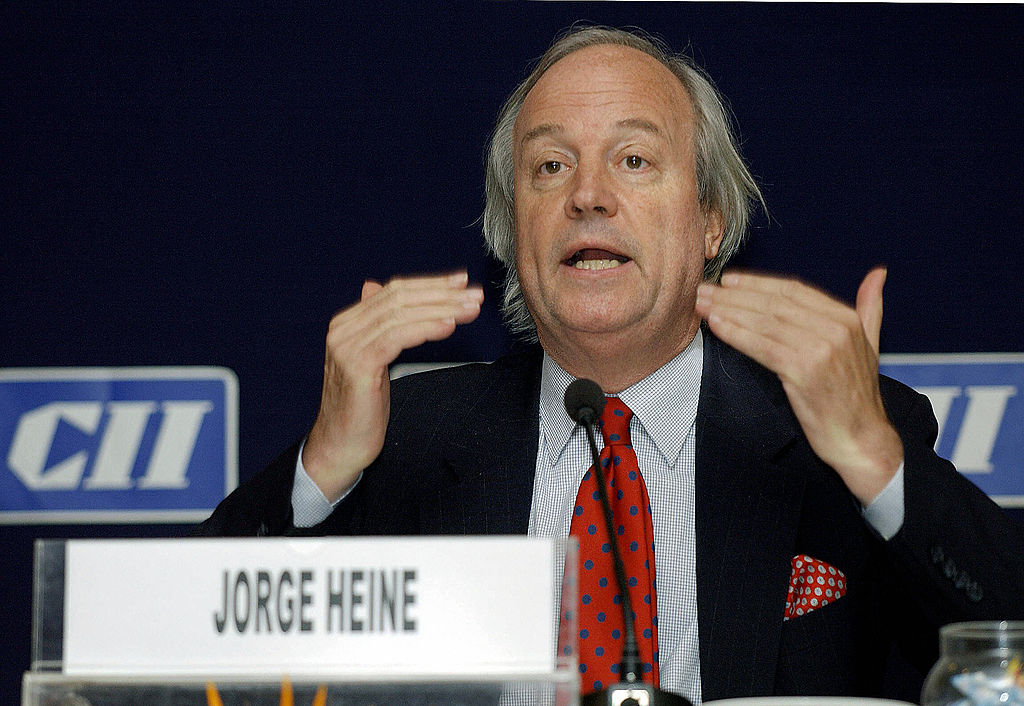
According to Jorge Heine, Chile is not alone in charting a path between China and the United States without necessarily picking sides. (Rob Elliott / AFP via Getty Images)
In October 2023, Chile’s President Gabriel Boric made his first visit to China. During his three days in Beijing, he attended the third Belt and Road Forum for International Cooperation, met with Chinese president Xi Jinping, and signed bilateral trade deals. Two weeks later, Boric was at the White House. There, he participated in the Americas Partnership for Economic Prosperity (APEP) conference and met with then-president Joe Biden. By the end of his term, Chile has refused to fully follow either of the great powers in what’s seen as a twenty-first-century Cold War. It is today doing about 40 percent of its trade with China and 15 percent with the United States.
“Not very many leaders from developing countries can say that they have visited the Great Hall of the People and have been received by President Xi, and ten days later visited the White House and been received by the US president,” Jorge Heine, a former Chilean ambassador, tells me from the capital, Santiago. “In many ways, the way we see it, this is what active nonalignment looks like in practice.”
Heine is author, together with former minister of state Carlos Ominami and political scientist Carlos Fortin, of The Non-Aligned World: Striking Out in an Era of Great Power Competition. In it, they define active nonalignment as “a foreign policy that is in constant search of new opportunities, evaluating each of them on their own terms.” The stance is nonpartisan, Heine cautions: “Active nonalignment is not a foreign policy of the Left or the center or the Right. It is nonideological. It provides a guide to action.”
Chile, according to Heine, is not alone in charting a path between China and the United States (and to a lesser extent Russia) without necessarily picking sides. Yet it has been leading this rising trend internationally. The authors cast this concept as a new twist on the Non-Aligned Movement (NAM), first developed in the 1950s and ’60s: “Faced with the reappearance of a confrontation between the Great Powers, an emerging Global South is picking up the traditions of the post-World War II, post-colonial movement and adapting it to the challenges of the new century.”
With Chilean right-winger José Antonio Kast’s election adding wind to the sails of Latin America’s reactionary right, and US president Donald Trump’s illegal kidnapping of Venezuelan president Nicolás Maduro, the strategy faces a major test.
In 2026, Trump has already made good on his corollary to the Monroe Doctrine, which calls for increased US control over trade and military actions across the continent. Heine and his coauthors believe that it’s particularly important for Latin American nations to be nimble on statecraft.
“If anything, the attack on Venezuela only reinforces the notion of active nonalignment,” Heine told Jacobin. “The alternative, which is to subordinate yourself fully to the US, is obviously untenable. The current situation, especially in Latin America, is very difficult, and this is also true elsewhere (Iran comes to mind). But that does not mean there are not ways of dealing with it.”
Based on the conceptions of the original NAM, which emerged as a third way between the capitalist and Communist-led worlds during the Cold War, the strategy of active nonalignment has gained a new lease of life with the COVID-19 pandemic, Trump’s reelection, and the wars in Ukraine and Palestine. Far from universally siding with the West in these conflicts, many leaders in developing countries have weighed their interests carefully: in some cases, they’ve refused to take sides, while in others they’ve aligned themselves in opposition to the United States.
Recent major crises prompted Heine, Ominami, and Fortin to update and revise an earlier book that had laid out some of these concepts. That book, Latin American Foreign Policies in the New World Order, was initially published in Spanish in November 2021, just months before Russia invaded Ukraine. At the time, hearkening back to the NAM was seen by some colleagues as “anachronistic,” Heine said. But after the war broke out, “suddenly nonalignment was back with a vengeance, with positions taken by India, South Africa, Brazil, Pakistan, by other countries [that didn’t follow the West]. Rather than being an anachronistic concept, it turned out to be prophetic.”
Latin America at the Forefront
In many ways, active nonalignment first started in Latin America, and this is also where it has thrived.
On November 9 and 10, when Colombia hosted the EU-CELAC Forum in Santa Marta, the philosophy once again reared its head. On stage in concluding remarks, President Gustavo Petro called for Latin America to return to the “center of the world,” rather than remain at the periphery. While inking deals with China and Europe, Petro also criticized the US bombing campaign of small boats, claimed to be carrying drugs in waters off the coast of Venezuela — a prelude to this weekend’s kidnapping of Maduro.
There are several reasons, the authors explain, why a region Washington sees as its “backyard” has become the cradle of active nonalignment. Heine — a nonresident fellow at the Quincy Institute for Responsible Statecraft, and recently retired professor of international affairs at Boston University — tells Jacobin of a “triple whammy” of factors.
The COVID-19 pandemic, which hit Latin American countries particularly hard; the global economic crisis that followed; and Trump’s reelection all supercharged the need for Latin American leaders to look beyond the United States for assistance and trade. This economic diversification has, in turn, allowed them to pursue a more active foreign policy, which has included among the world’s strongest and most wide-ranging condemnations of Israel’s genocide in Gaza.
For Latin America, opening up to China first and foremost makes economic sense. Despite a wealth of natural resources, growth in Latin America has lagged behind that of the rest of the Global South, in part due to its traditional dependence on the United States. This underdevelopment has led regional leaders to seek additional investments — and not only in infrastructure — elsewhere. They’ve found a willing partner in China. Between 2000 and 2023, the authors note, trade between Latin America and China increased fortyfold.
China, Heine explained, is a different sort of superpower than the Soviet Union was during the Cold War. Unlike the USSR, at the center of a largely self-contained bloc (only about 4 percent of Soviet GNP was imports and exports), China “offers economic opportunities to countries in Africa, Asia, and Latin America in terms of trade, investment, and financial cooperation.” This, he said, “opens the possibility of what we call playing the field.” “Countries in the Global South can play Beijing against Washington and vice versa, in a way that it wasn’t possible in the past,” Heine told Jacobin.
Latin American countries have not necessarily fallen completely into China’s orbit either. Brazil, for example, has increased trade with China while never straying too far from the United States. When the United States has struck out at Brazil — such as through imposing high tariffs or attempted intrusions into their domestic matters — Brazil has felt emboldened to push back in a way it might not have before, quite possibly because of its diversification away from the United States. “Brazil has stood up to Trump; it has not let itself be pressured into doing what Washington wants,” Heine said. “At the same time, it continues to talk with Washington and with the Trump administration.”
This has played out in foreign policy terms. In February 2023, for example, the one-year anniversary of Russia’s invasion of Ukraine, Brazil proposed that a group of Global South countries — including India, China, Indonesia, and Turkey — band together to propose a peace plan for Ukraine, as opposed to relying on the United States, which has tried to impose a unipolar approach. Shortly thereafter, Brazil’s chief of foreign policy, Celso Amorim, was sent to Moscow where he met with Vladimir Putin. Brazilian president Luiz Inácio Lula da Silva later took his peace plan to China’s Xi during a bilateral meeting. Brazil’s multiplication of approaches, Heine said, was a “leading example of the application of active nonalignment.”
“You can stand up for what your country needs and wants, and at the same time you can continue talking and looking for ways to resolve these differences,” Heine said of Brazil’s foreign policy.
Active Nonalignment Beyond Latin America
Angola, on the western coast of southern Africa, offers one of the more interesting examples of active nonalignment. Angola is the largest recipient of Chinese loans on the entire African continent — to the tune of US $24 billion in 2024.
But in recent years, it’s been the United States that Angola has turned to for assistance with an ambitious infrastructure project. Called the Lobito Corridor, the proposed railroad would run from the mineral-rich Democratic Republic of the Congo (DRC) and Zambia to the coast of Angola for shipment abroad. The project has already received over $4 billion in investment from the United States, with more funds on the way. The partnership, the authors write, “reflects the refusal by African countries to align themselves with one or the other of the Great Powers, as well as their willingness to hedge their bets and play both sides against the middle.”
This is well-illustrated by the refusal of many African states to rally behind Western military support for Ukraine and sanctions on Russia. Seventeen African countries, including South Africa, abstained from a UN General Assembly vote on condemning the invasion. Some Asian countries have followed suit.
India, notably, drastically increased its imports of Russian oil in the years after 2022. “Paradoxically, the war in Ukraine has diminished trust in Western powers and concentrated people’s minds on how to hedge bets,” Indian political scientist Pratap Bhanu Mehta wrote in a column for the Indian Express.
This approach has continued during the second Trump administration. Though some observers have suggested that developing countries might quickly fall in line with Trump’s whims, this has largely not been the case. “The notion of active nonalignment came up during the first Trump administration, and I would argue very strongly that if anything, it has received a greater impetus during the second Trump administration,” Heine said.
As Steve Ellner writes in Jacobin, Trump’s domestic policies might be leading to greater Latin American unity in the face of the US deportation apparatus — and something similar could be said for his attacks on Venezuela. Whatever their view of Maduro’s rule, Latin American leaders seem to almost universally agree that US military campaigns in the Caribbean are illegal under international law and risk escalating further.
Even if Latin America continues shifting rightward, Heine cautioned, active nonalignment remains a valuable proposition. He pointed to examples in Ecuador and Uruguay, both led by traditional right-wing parties, but which have engaged with both the United States and China on trade and financial cooperation.
“One view that has become quite widespread is that in the end, Latin America will have to take sides, and it will have to side with Washington,” Heine said. “I totally disagree with that notion. In today’s world, what are you going to do? The structure of the world economy today is such that you cannot simply say, ‘We will not do business with China, we will not interact with China.’”
To Heine, the answer to the current geopolitical challenges is obvious: keep playing the field.