After Venezuela, Greenland Is Next in Trump’s Firing Line

European leaders’ muted response to the illegal attack on Venezuela showed how afraid they are of antagonizing Washington. Now they fear Donald Trump’s plans to seize Greenland, but they have no clear plan to stop him.
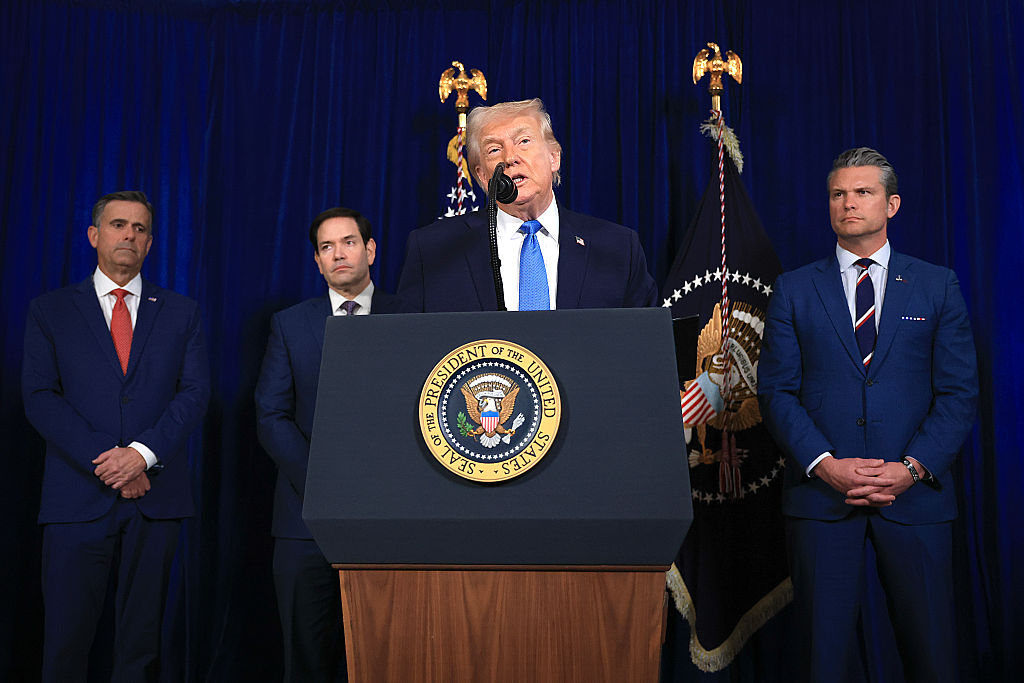
One year into Donald Trump’s second term, Europe’s utter dependence on American hegemony is more obvious than ever before. (Joe Raedle / Getty Images)

The bombing of Caracas and subsequent abduction of Nicolás Maduro and his wife this past weekend seems to have taken everybody outside of a small circle around the US president by surprise. Not even most lawmakers aligned with him in Congress seem to have been in on the plan, informed of it only after the operation had begun and not long before the rest of the world found out about it from their news source of choice.

Sending American troops onto foreign soil on dubious pretexts and without legislative approval is surely something of a tradition for US presidents. None other than Barack Obama — who received his ill-deserved Nobel Peace Prize less than a year after his presidency began, a fact that surely grinds Donald Trump’s gears — was notorious for bombing other countries without receiving authorization from Congress, a practice one Democratic colleague justified by explaining that doing so would “just become a circus.” In that sense, Trump’s brazen and illegal aggression against a sovereign country was par for the course for American imperial power.

New, however, is the utter lack of effort the United States has put into convincing its NATO and EU allies of the aggression’s justification. Instead, it is leveraging the attack to exert renewed pressure on Europe to do its foreign policy bidding — meaning settle the war in Ukraine on Trump’s terms and maybe even cede Greenland, an autonomous territory of Denmark, to US occupation.

Astonishingly, the Europeans seem to be taking it. One year into Trump’s second term, Europe’s utter dependence on American hegemony is more obvious than ever before. The EU’s muted response to Trump’s latest flagrant violation of international law certainly evinces a moral failing, but more importantly, it underlines just how few options it really has in an increasingly multipolar world.

A Hollow Response

Much has already been said about the European response to Saturday’s attack, which only a minority of heads of state clearly denounced as a violation of international law. Most, such as Germany’s Friedrich Merz or France’s Emmanuel Macron, opted for equivocation, describing the legality of the operation as “complex” while emphasizing that no tears would be shed for the abducted Venezuelan leader and urging all sides to respect human rights. A few, like Hungary’s prime minister, Viktor Orbán, one of Trump’s few real allies in the EU, openly welcomed the attack, while Ukrainian president Volodymyr Zelensky jokingly suggested that Trump “knows what to do next.”

Given the muted response of most European states to the genocide in Gaza and the already frigid relations between Caracas and Brussels, it comes as little surprise that some violations of international law would matter more than others in the eyes of European lawmakers. Nevertheless, what happened last Saturday seems to indicate a qualitative shift.

Whereas previous US violations were often couched in a rhetoric of righteousness and American legal scholars sought to devise their own interpretations of international law that excused US actions, this time around, the White House has dispensed with such niceties entirely. Trump and his cronies make no bones about their intentions to restructure the entire Western hemisphere to their liking — national sovereignty and international law be damned.

This has immediate implications for the EU because of Trump’s regularly expressed desire to see Greenland — still a Danish autonomous territory, despite moves toward independence — incorporated into the United States in some way or another. Trump’s vision for Greenland, which some European leaders first interpreted as a joke when he first brought it up in 2019, appears increasingly menacing.

The day after the operation in Caracas, Trump told reporters: “Let’s talk about Greenland in twenty days,” while his press secretary, Karoline Leavitt, backed it up two days later by saying that the “US military is always an option.” Trump’s deputy chief of staff, Stephen Miller, has been the most brazen, bluntly stating that no EU member would dare intervene should the United States invade.

If aggression against Venezuela got a pass, one would at least expect European leaders to stand up against such an unprecedented threat to long-standing US allies. Yet other than Danish prime minister Mette Frederiksen, who stated that NATO would be “over” should the US invade, the European response has been remarkably subdued. Lawmakers like French foreign minister Jean-Noël Barrot continue to beseech Washington to tone down its rhetoric and play fair, all the while emphasizing their willingness to bend to Trump’s will and do whatever Washington demands in return for a continued seat at the table. No amount of public thrashing, it seems, is too much for them to take.

Europe’s Double Bind

We could be forgiven for thinking that some European leaders simply lust for humiliation. But the real reason for their subservience is geopolitical. The European Union, having tied its security and standing in the world to the United States for the better part of a century, is simply in no position to stand up to Washington’s bullying.

This is particularly the case since the Russian invasion of Ukraine, which has seen the EU collectively dedicate nearly €200 billion to Ukraine’s defense through a mixture of grants and loans. Though the total US expenditure on Ukraine has been lower, approaching something like €130 billion (significantly less than Trump’s claim of 300 billion), American support remains vital, particularly to ensure the flow of high-tech weapons that allow Ukraine’s armed forces to hold out against Russia’s vastly larger military.

The United States also remains crucial to any possible cease-fire deal, as Russian president Vladimir Putin has repeatedly emphasized his preference to negotiate not with Kyiv or Brussels but directly with Washington — a preference Trump is only too happy to indulge.

Under Joe Biden’s presidency, European leaders felt confident that American support would be indefinite, and repeatedly vowed to stand by Ukraine until victory, repeatedly predicting that total Ukrainian victory was within reach. Four years later, such a scenario seems near-impossible, with Russia advancing slowly but steadily along the battlefield and Ukrainian society showing growing signs of exhaustion.

Yet having cut off practically all channels of communication with Moscow since the invasion began, EU member states have little diplomatic room to maneuver, and Moscow, believing victory to be near, has little reason to negotiate with them. The most recent proposals for creating postwar security guarantees for Ukraine, agreed this week in Paris, also foresee the United States taking a central role in monitoring any cease-fire.

Europe thus seemingly has no way out of its current predicament. It cannot confront the United States as long as a war with Russia rages on its eastern flank, and it cannot end that war without US cooperation — if at all. Rapprochement with China — a necessity if Europe is ever to emerge from Washington’s shadow — is also impossible with Atlanticist hawks like EU foreign policy chief Kaja Kallas and European Commission president Ursula von der Leyen at the helm.

Sooner or later, the European political class will have to think long and hard about whether tying its fortunes to a declining and increasingly volatile superpower in the name of defending “our values” was really such a good idea. For now, it can only hope that Trump’s saber-rattling over Greenland does not escalate into the kinds of actions we saw him take last week in Venezuela. If it does, Brussels is in for three very long years indeed.