Aijaz Ahmad’s Marxism Challenged India’s Hindutva Regression
Aijaz Ahmad belonged to a generation of South Asian left intellectuals who came of age in the heyday of anti-colonial revolution. He was an uncompromising opponent of the Hindutva right that betrayed the heritage of India’s struggle against colonialism.
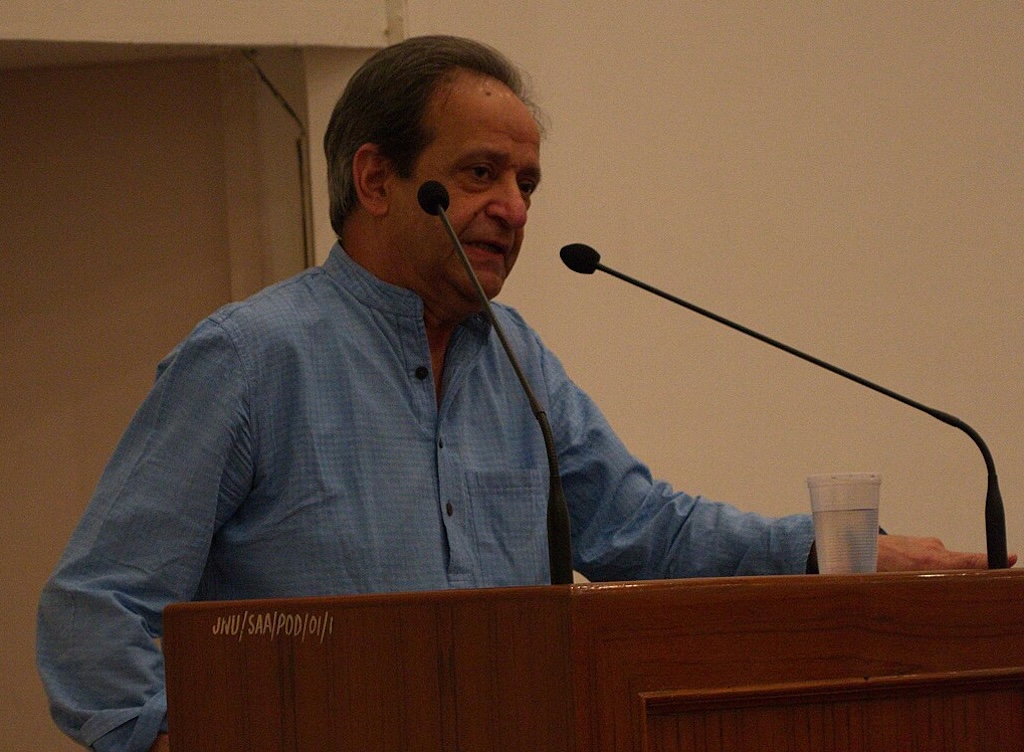
Aijaz Ahmad’s brilliant analysis of India’s Hindutva far right contains vital lessons for the Left today in South Asia and beyond. It offers one of the most creative readings of Antonio Gramsci’s work for a postcolonial context. (Subin Dennis, used under CC BY-SA 3.0 / Cropped)
The late Aijaz Ahmad was a voice that could not be ignored. He was a literary critic, poet, and translator, a representative of the last truly Indo-Pak generation of revolutionary intellectuals, and a figure steeped in the revolutionary and aesthetic traditions of Marxism (both “Eastern” and “Western”). He was also one of the great political essayists of our time.
Ahmad’s interventions spanned the great faultlines of our epoch: liberalism and fascism, imperialism and nationalism, Hindutva and Islamism, postcolonialism and poststructuralism, “world” literature and Urdu literature, and down to Indo-Pak and US politics. His restless intellect and unmatched erudition made Ahmad an essential cornerstone for the great theoretico-political debates of our time.
A Sui Generis Marxism
Coming of age in the immediate aftermath of independence in India and Pakistan and inspired by the great prestige of anticolonial revolutions in China, Cuba, Vietnam, and beyond, Aijaz Ahmad was one of a group of subcontinental intellectuals who took their public and political vocations very seriously. These intellectuals, including figures such as Eqbal Ahmad, Feroz Ahmed, and Romila Thapar, were eminently conscious of their role in shaping the nebulous entity-in-making called “the nation.”
It is this political and public responsibility that powered Ahmad’s restless energy in shaping, as he put in an autobiographical interview, “ideological struggles in the upper reaches of High Culture [i.e., the academe],” while also taking “very seriously the more important task of helping sustain a broader culture of progressive ideas.” This attunement to the multilevel organization of modern life shaped Ahmad’s prolific range of publications. He composed at least five books in Urdu as well as numerous translations of classical Marxist texts, not to mention dozens of interviews, essays, and articles in every conceivable venue (avant-garde journals, popular magazines, newspapers, and, toward the end of his life, podcasts and online platforms).
Ahmad’s Marxism had a “sui generis character”: one that refused to divorce culture, politics, economics, and history, and opposed simple determinative schemes focused narrowly on a single factor (e.g., the “economic”). “Class,” for him, was not an Invisible Hand asserting its primacy directly in every phenomenon, an (ahistorical) master key determining every twist and turn of history. Instead, as Prabhat Patnaik has perceptively put it, Ahmad’s Marxism was distinguished by its attention to “historical depth”: “a total unwillingness to lump together phenomena that are only broadly similar; an insistence upon distinctions being drawn between them; and a tracing back of each phenomenon to its complex historical roots.”
In this framework, particular phenomena are analyzed in their specificity, in their distinctive origins and evolution, with class revealing itself only through its effects in a historical force field of medium- and long-term duration. This attention to “the utter historicity of multiple, interpenetrating determinations” shaped some of Ahmad’s most famous contributions: from the iconoclastic critique of Fredric Jameson on Third World literature to vitally important reflections on nationalism, populism, and fascism.
Contra Jameson
In 1986, Fredric Jameson, the preeminent Marxist theoretician of his epoch, published a rousing essay titled “Third-World Literature in the Era of Multinational Capitalism,” first delivered as a lecture to a West Coast audience in the United States. Jameson aimed to puncture the universalist pretensions of reigning definitions of “world literature.” Breaking with Euro-American-centered criteria for the literary “canon,” he sought to understand the specificity of literature from the formerly colonized regions.
Works under the heading of “Third World Literature,” Jameson suggested, should be read as “national allegories” and “distinguished radically from analogous cultural forms in the first world.” Such works internalize “a radically different and objective relationship of politics to libidinal dynamics,” whereby “the story of the private individual destiny is always an allegory of the embattled situation of the public Third-World culture and society.”
In this light, Jameson would reflect on the double dilemma of the (post)colonial intellectual. The first was a dilemma of social incapacity — in other words, the inability of national ruling and popular classes to escape the strictures of (neo)imperialism. The second was one of aesthetic representation, searching for the particular forms and languages in which to illuminate this disarticulated dialectic, the poisoned chalice of formal independence.
Appearing barely a year later, Ahmad’s riposte to Jameson was swift and severe. Ahmad declared the “epistemological impossibility of a ‘third world literature’” — a category so capacious that it reduced the large majority of the world and its cultural productions to the singular experience of colonialism. Crucial issues of periodization, social and linguistic formations, their specific histories and ideological-political struggles, could not possibly be comprehended at such a generalized level of abstraction.
To be clear, Ahmad was not arguing against the socially representative function of literature and in favor of a textual involution or complete indeterminacy. The fundamental question was that of “the epistemological status of the Dialectic.” Here, Jameson’s singularization of form under “national allegory” fell into a model of “unitary determination [which] in its origins is a pre-Marxist idea.” The Marxist dialectic, conversely, is based on “a tension, a mutually transformative relation, between the problematic of a final determination (of the ideational content by the life-processes of material labour, for example) and the utter historicity of multiple, interpenetrating determinations.”
Drawing upon his deep familiarity with Urdu literary history, Ahmad demonstrated how even literature produced under colonialism dealt with the latter in conjunction with myriad other impulses. Such impulses included the patriarchal hypocrisies of local (petty) bourgeoisies, progressive intimations of social contradictions, and later on “a nationalism of mourning” that reserved no place of innocence for “our own.” Literary texts, therefore, “are produced in highly differentiated, usually overdetermined contexts of competing ideological and cultural clusters, so that any particular text of any complexity will always have to be placed within the cluster that gives it energy and form, before it is totalized into a universal category.”
The critique of Jameson thus gave intimation of Ahmad’s powerful Marxist method. This was a method attuned to historical specificity and close reading, with an attention to particularity and the deep ruts of history, while keeping the horizon of (complex) determination and representation intact.
With Jameson
A point of convergence between Ahmad and Jameson might be detected in this injunction to close reading. For just as Ahmad instructs that any text should “be placed within the cluster that gives it energy and form,” Jameson’s own ruminations emerged from a specific context.
Two years earlier, Jameson had published an influential essay on the aesthetic of “postmodernism” as “the cultural logic of late capitalism.” Here, Jameson traced the increasing dominance of hyper-mobile, neo-globalized capital, especially in core Western countries.
The penetration of commodity cultures even into the recesses of the unconscious heralded an advanced form of reification: an assault on the senses, foreclosing properly historical forms of thinking, and confining everyday experience (and political practice) to immediacy. In contrast, Jameson argued, drawing upon Hegel, Marx, and Lukács, the subordinate position of the Third World lent it an “epistemological priority,” a “kind of situational consciousness” with the potential to grasp and upend the whole rotten structure.
Here, it is the uneven development of capitalism that produced “the national” as an inescapable terrain of practice and appropriation, especially in postcolonial contexts — including, in Jameson’s argument, for cultural production. Indeed, this is an argument that Aijaz himself made throughout his lifelong engagement with nationalism and populism. In contrast to approaches that saw “the nation” as an inevitably oppressive form of collectivity, one condemned to nativism and xenophobia, Ahmad was attuned to the objective coordinates of “the national” form and its profound ambiguity.
To put it succinctly, while Ahmad was correct in pinpointing the reductionist content of Jameson’s singularization of “national allegory,” he missed the context of Jameson’s formulation, with its attention to late capitalism, uneven development, and the importance of the national terrain. It was a context he would have profoundly agreed with.
The National Form
In his reflections on the national form, we again see Ahmad’s ecumenical Marxism and its attention to historical specificity. The institutionalization of market relations at multiple levels, associated infrastructures of communication, transport, and finance, and capitalism’s constitutive unevenness and period crises, provide the social and spatial coordinates for the nation-form.
Ahmad elaborated on how the nation-form is rendered concrete through multiple processes acting in different combinations: via colonial conquest through emergent state apparatuses, as a defensive container against the global market and for projects of developmentalism, and/or in the process of anti-colonial struggle itself.
This attunement to the varied historical rhythms that go into the formation of “the national” led to Ahmad’s refusal to assign nationalism any essential character:
Nationalism is not in itself a class ideology . . . [it] is not some singular ideology with an identifiable essence. It always exists in articulation, in combination. . . . [and] the actual content of any given nationalism is given by the power bloc that takes hold of it and the political project in which it gets embedded.
Nations and nationalism are thus always in process and are objects of struggle. In his historical genealogy of nationalism, Ahmad focuses on anti-colonial struggles where — due to specific trajectories of surplus extraction and class formation — it was “the peasantry that transformed nationalism from a minority current into a mass movement.”
This led to Ahmad’s formulation, drawing upon Lenin, that “the national question is essentially a peasant question.” The fate of the nation-in-making hinged upon the choice between fulfilling the demands of the peasantry through agrarian revolution on one hand and reconciliation with imperialism on the other.
Indeed, if the national question was not resolved in favor of the masses in general and against imperialism in total (including its political-economic forms), it would return “in an irrationalist form,” with narrow and elite forms of nationalism veering toward “fascist majoritarianism.” Fascism, as Clara Zetkin reminded us, is just reward for the failure to make revolution.
National Culture
Ahmad was therefore deeply attuned to varied conceptions of “the nation” and “national culture.” The “nation” and national culture could be articulated in different ways: through the search for an essence around language, ethnicity and/or religion; or in the form of a more active and materialist conception rooted in everyday struggle.
The former conception of culture often legitimates hierarchical and majoritarian practices. Instead of seeing culture as a terrain of conflict and struggle, the search for stable essences from the past often ends up validating elite-centered values and practices. In contrast, a “materialist conception of culture” sees the latter as “sets of material practices by different strata in society” and is allied to Antonio Gramsci’s conception of the “national-popular.”
The “nation” is here identified with popular classes, “so that a national culture can only arise out of the practices as well as aspirations of those classes.” This is an inclusivist and universalist culture, not opposed to but emerging through the particularity of the national, i.e., through the struggles of diverse popular classes: “the nation not as patrimony but as project, not as primordiality but as an orientation towards the future.”
Indeed, Ahmad saw the contestation between these two forms of collectivity — (narrowly) spiritualist and culturalist versus more expansive and active — as a thread running through modernity. Thus, instead of taking for granted binaries of “high” vs. “low” culture, Ahmad urged us to understand the particularities of culture, class, and nation in relation to ongoing struggles for emancipation. It is essential to engage with the deep ruts of history and geography, the particular forms and idioms in which social and economic relations are lived and contested.
Conversely, Ahmad situated binary classifications of “high” or “low” culture within historical projects of domination, consent, and differentiation, i.e., what Gramsci called “hegemony.” Indeed, it is in his mobilization of Gramsci that Ahmad’s most pertinent lessons for contemporary left debates may be discerned.
Hindutva
In 1992, a few weeks after the spectacular destruction of the historic Babri mosque and just as India was entering a period of economic liberalization, Ahmad delivered the first in a series of lectures on Hindutva fascism. Through some of the most creative readings of Gramsci in a postcolonial context, Ahmad established a series of parallels between the unevenly developed Italian and Indian social formations.
Here, longue durée histories of clerical “classicism” (High Christianity and Brahminism, respectively) had culminated in a “cosmopolitanism” embedded in upper caste/class cultures. Combined with vast socioeconomic and regional inequalities, this produced “blockages” in the creation of a “national-popular” project during colonial and postcolonial eras. These social formations were marked by “a paradox of great civilizational depth with endemic national fragmentation,” as subordinate groups were weakly integrated into hegemonic projects.
In India, as Nehruvian developmentalism and nonalignment faltered through the 1970s and ’80s, the field was open for the realignment of dominant classes, along with emergent petit-bourgeois groups. It is here that the century-long Hindu nationalist project of the National Volunteer Union (Rashtriya Swayamsevak Sangh, or RSS), “a spectacular missionary organization” that had been organizing with “Olympian patience” in every pore of India’s diverse civil and political society, came into its own.
Throughout the late 1980s and beyond, Hindutva forces staged a strategic offensive. They combined wars of position and maneuver, spectacular violence against minorities and legal machinations, street and electoral politics to forge arguably the most dangerous and deep-rooted fascism in the world today. This was all lubricated through an alliance with monopoly capital and a thoroughgoing commitment to economic liberalization, while preying upon vast layers of those experiencing lumpenization and social decomposition.
Ahmad thus avoided presenting Hindutva as a purely instrumental handmaiden of the big bourgeoisie, while situating the “victory of fascism . . . in an overlap between social history and economic structure.” It is this overlap of the longue durée of Brahminical cosmopolitanism, cultural conservatism, and authoritarian religiosity on one hand, with the more proximate crisis of the Indian ruling bloc on the other, that created conditions for Hindutva’s war of maneuver. The “pathological nationalism” of the RSS–Bharatiya Janata Party (BJP) combine recast long-term historical rhythms to paper over structural crises of the post-Independence ruling bloc, and thus served to lubricate the transition to market reforms.
In Ahmad’s parallel Gramscian analysis of neighboring Pakistan, one ought to distinguish the flirtation with Zulfikar Ali Bhutto’s left populism followed by military dictatorship in the 1980s from the experience of fascism, precisely due to the dictatorship’s inability to forge a coherent mass base. This pattern is being repeated today in Pakistan in a different conjuncture, with the removal of Imran Khan’s right-populist government and further radicalization of the praetorian stranglehold.
On Populism and Fascism
The specificity of populism and fascism, for Ahmad, lies not simply in their manipulation of social crisis and political paralysis. A crisis is an explosion of clashing times.
The strength of populist and fascist regimes is precisely in their drawing together of varied historical processes to resolve crisis through mass mobilization and militarization, even while buttressing existing ruling classes. Such movements and regimes draw upon the disjunctures of class, culture, nationalism, and long-standing nodes of popular common sense, while instituting “cultures of cruelty” in everyday life against various Others (religious and ethnic minorities, immigrants, etc.).
There are two further points to note in Ahmad’s Gramscian analysis. First, he situates the “hysterical unitarianism” of Hindu nationalism in the weakness of reigning hegemonic projects in India. Ideological hypertrophy and cultural chauvinism, therefore, can be as much an index of socioeconomic strength and confidence (as in imperialist countries) as of underdevelopment and its compensation (as in peripheral formations). The imperative is always to trace the specific and historical connections between ideological and political-economic practices, rather than to deduce one mechanically from the other.
Second, by understanding fascism as a revolutionary movement of the Right, Ahmad cut through often formalistic debates around interwar fascisms and their contemporary far-right cousins. Beyond their parallels, Ahmad focused on the “imitative originality” of today’s fascisms (such as Hindutva). He traced the specific historical and social disjunctures they intervene in, and the particular institutions, nodes of common sense, and practices of everyday life through which their hegemonic projects take shape.
As Ahmad perceptively commented:
Every country gets the fascism it deserves, in accordance with the “physiognomy” of its history, society and politics and . . . the historical phase that the country is going through. What we have to grasp about every successful movement of the fascist type is not its replication of something else in the past, but its originality in response to the conditions in which it arises.
No Shortcuts to Hegemony
The lessons Ahmad’s analysis offers for the Left today, especially in South Asia and peripheral formations, are imperative. Contemporary populist and fascist projects forge social bases through the unevenness of region, class, and the world-system, and in the “objective necessity for the definition of a national project, in the form of an identity and its future projection.”
Conversely, the Left can neither abandon “the terrain of nationalism,” nor can it occupy that terrain “empty-handed.” Therefore, no anti-fascist project in India (and beyond) can remain confined to a (plural) secularism in opposition to religious communalism. A reformulated secularism had to be articulated to a coherent economic project and a mass base: in short, “a superior national project capable of organizing what Gramsci once called the ‘national-popular’ will.”
Ahmad crucially distinguished such a project of national-popular hegemony from (left) populism. Unlike populism, building a national-popular will is not simply a matter of (often top-down) rearticulation of economic crises in class-oriented, as opposed to ethnic or racial, directions. The culture of fascism is “a condensation of the structure in its historical aspect . . . connecting the links between structure and superstructure.”
The anti-fascist project, therefore, will have to work through popular common sense, and through the deep ruts of history, the social and spatial unevenness that provides fascisms with their distinctiveness. In short, looking beyond the timeframe of electoral cycles, the “national-popular” has to be a total project of transformation across structures and superstructures: rooted in the multiple arenas of everyday life and in the struggles of diverse working classes.
Such then are the imperatives of building dual power today. There are no shortcuts to hegemony.