Claire Valdez Is a Socialist and Union Organizer Running for Congress

Claire Valdez

Socialist state assembly member and former UAW organizer Claire Valdez is running for Congress in New York’s 7th district. We spoke to her about the race, the right and wrong ways to fight Donald Trump, and how the labor movement changed her life.
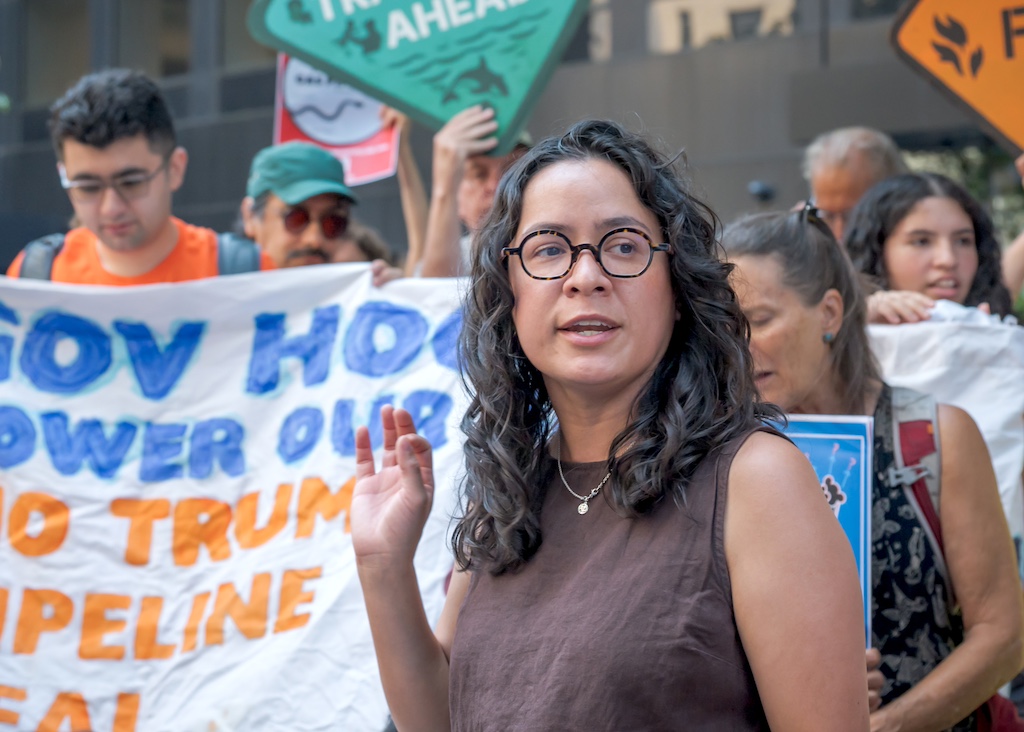
Claire Valdez is running for New York’s 7th Congressional District. (Erik McGregor / LightRocket via Getty Images)

Interview by
Micah Uetricht

The New York City left is on the electoral ascent right now. New York City Democratic Socialists of America (NYC-DSA) member Zohran Mamdani entered the mayor’s office on January 1, the culmination of nearly a decade’s worth of socialist organizing and institution-building in the city. New socialist candidates are regularly announcing campaigns to challenge incumbent members of the state legislature, aiming to join the seven already there. (A potential eighth, Diana Moreno, will be immediately joining them if she wins a special election to replace Mamdani’s district in the state assembly next month.)

And NYC-DSA has its sights set even higher: in the case of Claire Valdez, to Congress.

Valdez, thirty-six, has just announced her campaign for New York’s 7th Congressional District, a seat that includes parts of Brooklyn and Queens and that will soon be vacant upon longtime representative Nydia Velázquez’s retirement. She will be running against Brooklyn Borough President Antonio Reynoso. Valdez was a rank-and-file organizer in the United Auto Workers (UAW) Local 2110 in New York City and an active member of NYC-DSA. With the organization’s endorsement, she won a state assembly seat in Queens in 2024; on January 14, NYC-DSA will hold an endorsement forum weighing whether to endorse her campaign — part of what the organization characterizes as its “thorough, democratic, and lengthy” endorsement process. That endorsement would bring Valdez a major degree of grassroots campaign firepower, the kind that Mamdani’s top campaigners credit with delivering him the mayoralty.

If Valdez prevails in the race, she will join Rep. Alexandria Ocasio-Cortez as another New York socialist in the House. Given her background as a union organizer, she would likely serve as a strong advocate for organized labor in Congress and would be one of the few representatives from a working-class background. Her first campaign ad, launched this morning, declares, “Workers deserve it all.”

Jacobin’s Micah Uetricht spoke with Valdez about her time in the labor movement, what she sees as being at stake in the campaign, the role of socialist leadership in a deep-blue district, and the sense of political “seriousness” she learned from the late labor organizer Jane McAlevey. The transcript has been edited for length and clarity.


Micah Uetricht

Tell me about your background.

Claire Valdez

I’m a union organizer. I’m an artist. I’m a proud democratic socialist. I’m a Latina and a Native American, a dual citizen of the Ysleta del Sur Pueblo Nation and the United States. I grew up in Lubbock, Texas, which is a very conservative part of an even more conservative state. I grew up in a liberal household. I wanted very much to be a political person, but I had no political home to call my own.

I was radicalized by the invasion of Iraq. But I think my politics come from being a worker. I’ve worked many low-wage customer service jobs, at Taco Bell, Pizza Hut, Trader Joe’s. My sense of who I am came from the idea that I was an hourly worker with very little control over how much I was paid or what my working conditions would be like.

Micah Uetricht

What was your journey into the labor movement?

Claire Valdez

I came to New York to be an artist, which is an incredibly hard thing to do anywhere, but especially in New York, where space and time are the most expensive things that exist. I eventually got a job at Columbia University. I didn’t know my job at Columbia was union until I got the job. I remember my first union meeting at Columbia, UAW Local 2110. We were finalizing the most recent contract. Walking into a room full of two or three hundred workers I’d never seen before, who came from all over the university, did all kinds of different jobs, and were trying to figure out what it is that we deserved and could demand — that was a very powerful experience. I knew then that I wanted to be involved in my union.

Micah Uetricht

Unions aren’t just vehicles for higher wages and benefits; they’re also vehicles to increase democratic engagement, both on the job and in the rest of society, by working-class people. Unions, at their best, can transform the lives of workers. Have you had such experiences, of feeling like you have had your life transformed by the labor movement?

Claire Valdez

Absolutely. My union changed my life. When I became a union member, it was the first time in my working life that I didn’t feel alone.

Being able to sit at the bargaining table with your boss as an equal is a transformative experience. So much of what my coworkers and I were trying to do at Columbia was to not just bargain for a better contract but also to bring as many members in as we could to that process, so that they understood their rights. That was happening on the heels of the onemember, onevote referendum in the UAW, and the Members United slate was campaigning for the international executive board. I saw the opportunity to bargain for more as very much part of the opportunity to democratize the UAW and elect people like [UAW president] Shawn Fain and [UAW Region 9A regional director] Brandon Mancilla to lead our work.

Micah Uetricht

There are not very many working-class people in elected office in the United States, especially in Congress. Why is it important to change that?

Claire Valdez

It’s incredibly important that our representatives reflect what most people’s lives actually look like. The concentration of wealth in the hands of very few in the United States has destroyed our democracy. If the people that we elect to go to Congress are also millionaires and billionaires and beholden to corporate interests, we’re going to see the same attacks on our fundamental rights as working people.

Building a strong, militant, and vibrant labor movement in the United States is one of the most important things that we can be doing to defend our democracy against fascism, in addition to making people’s lives better.

Micah Uetricht

If you win this race, you’ll be on the front lines of the fight against Donald Trump at the federal level. What do you think effective resistance to the Trump agenda looks like?

Claire Valdez

I have been inspired by people, including elected officials, putting their bodies on the line. It’s a moment when procedural reforms and the status quo aren’t going to make anyone in the United States feel more powerful. Having representatives who go to El Salvador to fight for their constituents directly, who are going to ICE detention facilities to fight for their constituents directly — that empowers people to feel that there’s something we can actually do.

We’ve seen a lot of the Democratic Party establishment point to decorum or the way that things are meant to be done. That’s so insufficient to meet the moment and the real scale of the crises that we’re facing. ICE is now murdering people in the United States, many of our neighbors are being disappeared, and outright fascism and white supremacy are on the rise because of this administration. People are ready to fight back, and they want to see our representatives do the exact same.

Micah Uetricht

If you were elected, would you engage in these kinds of confrontational actions?

Claire Valdez

Yes, absolutely. My colleagues and I earlier this year were arrested at 26 Federal Plaza [New York’s immigration court] for seeking to inspect the conditions many of our neighbors had been held in. I would absolutely be committed to doing the exact same kind of work in Congress.

Micah Uetricht

What will be on your agenda as far as union and working-class issues, if you win this seat?

Claire Valdez

The PRO Act still needs to be passed. But we can go beyond it. I’m very interested in a federal jobs guarantee and making and realizing the Green New Deal, which would provide many, many union jobs to build up new infrastructure. I have another policy I’ll be pushing to provide resources for new union organizing in the United States, focused on how the federal government can make unionizing more possible.

Micah Uetricht

The labor movement is in extremely dire shape right now. How would you use this office to help rebuild the labor movement, at a time when legislative advance for unions may be blocked for the moment?

Claire Valdez

The only way that we’re going to end this new Gilded Age we find ourselves in is by ushering in a golden age of organized labor.

Public support for unions is at an all-time high right now. We need a federal government that’s actually going to support it and make it easier to organize, to take on concentrated power, to fight for social democracy. Standing arm in arm with organized labor across the United States and in individual legislative fights, we can protect the National Labor Relations Board and the National Labor Relations Act.

We’re coming up soon on the 2028 general strike called by UAW president Shawn Fain. This is an incredible short-term organizing project to bring much of the labor movement together in a shared goal. I hope to be a federal partner to the UAW and to Fain in the work to organize around that.

Micah Uetricht

New York District 7 is the heart of the “Commie Corridor,” as Michael Lange calls it, which went overwhelmingly for Zohran Mamdani in the recent mayoral race. What’s the role of a member of Congress from such a deep-blue district within the larger body?

Claire Valdez

The fight we’re going to have in this particular district is not going to be about whether we’re winning the Democratic majority in Congress. It’s going to be about what that majority is actually doing.

Again, we can offer procedural complaints and return to a status quo that’s not serving working people. Or we can chart a path toward taking on the oligarchy, toward fighting fascism, and advance a program that works for working people. This district can lead in that effort on advancing an affordability agenda — an economic populist agenda around health care for all, housing for all, unions for all.

Micah Uetricht

Would this be part of your argument for why you should be the Congress member from this district rather than Brooklyn Borough President Antonio Reynoso, who you would be up against in this race? Reynoso is a progressive who endorsed Mamdani in the mayoral race.

Claire Valdez

There’s a real appetite in New York 7 for democratic socialism. The district is represented in almost every place by a democratic socialist in the state senate or state assembly. There’s a demonstrated hunger for the political program that we have on offer and can keep building on.

Micah Uetricht

Talk about this district. In addition to being deep blue, it has a huge percentage of renters. It’s also rapidly gentrifying, and the demographics of the district are shifting. How would you aim to represent this district in Congress?

Claire Valdez

New York 7 has a long history of organized struggle. Newtown Creek, in the eighteenth and nineteenth century, was an industrial center. There’s immense environmental pollution because of that, and people have been organizing against that for a long time. It is 77 percent renters. Tenants have been displaced by financial speculation, venture capital, and private equity all over the district. There has been organized resistance against that kind of displacement as well.

It’s a district that has a long history of fighting corporate and billionaire interests that have wanted to kick us out of the neighborhoods that we call home. That spirit continues today. It is a very creatively vibrant community, too. There is a huge number of artists and performing artists who are trying to eke out an existence in a city that is profoundly expensive to live in. It’s a population of people who desperately need stable housing and health care. And those are the things I want to fight for in Congress.

I’m a tenant and once was an aspiring artist. So many people in this district are living paycheck to paycheck, and it’s something I’ve experienced myself. We deserve real stability in our homes.

Micah Uetricht

Nydia Velázquez was a longtime progressive member of Congress. How do you feel about stepping into her seat?

Claire Valdez

Congresswoman Velázquez has spent her entire life fighting for self-determination in Puerto Rico and in anti-colonial struggle all over the world. She was one of the first Congress members to call for a ceasefire in Gaza in 2023, and that action came directly out of that lifelong work. She has demonstrated courage in places and at times when it has been incredibly hard to stand on the right side of history. I want to continue that legacy.

Claire Valdez at a protest against Israel’s war on Gaza in 2024. (Claire Valdez campaign)
Micah Uetricht

You have been a part of the socialist movement in New York City. NYC-DSA played a central role in electing Zohran Mamdani as mayor, but it has also built a much larger operation that got you and seven other socialists elected to the state legislature, as well as all its work beyond the electoral realm. Talk to me about what your time in DSA has looked like.

Claire Valdez

I joined DSA in 2019 and got really involved when Bernie Sanders started running again, so my path was similar to a lot of DSA members. And I was energized by seeing Alexandria Ocasio-Cortez and Julia Salazar win their elections in 2018, then reenergized by Bernie’s 2020 campaign. A lot of my work within DSA was around electoral projects, including Salazar’s reelection campaign in 2020 and Samy Olivares’s state assembly campaign in 2022. I served as the new member coordinator for the chapter as well, so I had a direct hand in building the way we onboard new members.

When I think about my time in DSA, it exemplifies what DSA work is supposed to be about. It’s supposed to be about a canvasser coming in and not knowing what they’re doing, and being developed into a field lead, then into a field coordinator. And then being developed into something else — in this case a politician.

The power of the socialist organization is that they identify leaders and train them and give them the resources they need. And the socialist project sees the political promise in everyday people. I’ve spent almost seven years now in DSA and have had a lot of different roles in a lot of different campaigns. What I love very deeply about the organization is that we see political potential in all our members and develop them into leaders and organizers.

Micah Uetricht

You were sworn into the state assembly with your hand on a copy of the late legendary union organizer Jane McAlevey’s book No Shortcuts. You spoke alongside me at a memorial service for Jane last year. What impact did Jane’s work have on you and your work in elected office?

Claire Valdez

The thing that I always took away from her work is the seriousness of it, the methodical and intentional way that one has to go about organizing. It requires an immense amount of discipline.

She writes about building or developing capable organizers, which is something DSA does. And she influenced the attitude that I brought to Albany and to legislating: you make your list, then you go down your list, you talk to people, you talk to them again, you try to find the places where you have common concerns and interests, and you try to move them. And in every single conversation, you’re trying to map out again the situation you’re in. In Albany, the terrain changes all the time depending on what we’re debating, what the governor is doing, what primary elections are happening. Assessing and reassessing those conditions requires you to be very attentive and very thoughtful.

Jane’s work made me want to commit to a lifetime of doing this kind of organizing and being within the struggle. The book is called No Shortcuts, and that phrase is the anthem of so many different organizers I’ve met. This isn’t something that’s going to be done anytime soon — it requires all of us to be committed to it for all our lives.

Micah Uetricht

Your campaign is using particularly bold language: “Workers deserve it all.” What does that phrase mean to you?

Claire Valdez

I’ve held bad jobs, and they form so much of the way that I think. Workers deserve not just stable housing, health care, and good benefits. They deserve time off. They deserve to be able to live the good life. We deserve to be able to spend time with friends and family and go on vacation and feel powerful in our daily lives, and we deserve a say in our working conditions.

I bargained against Columbia University and sat across the table from management — that was powerful. Everyone deserves to feel that way at work. Everyone deserves to feel equal to their boss and feel that they aren’t alone.