Capitalists Want You to Stop Worrying About Climate Change
In The Long Heat, Andreas Malm and Wim Carton take aim at what they call rationalist-optimists — people who naively believe that market solutions can fix the climate crisis. But their sweeping critique runs the risk of abandoning all hope in the future.
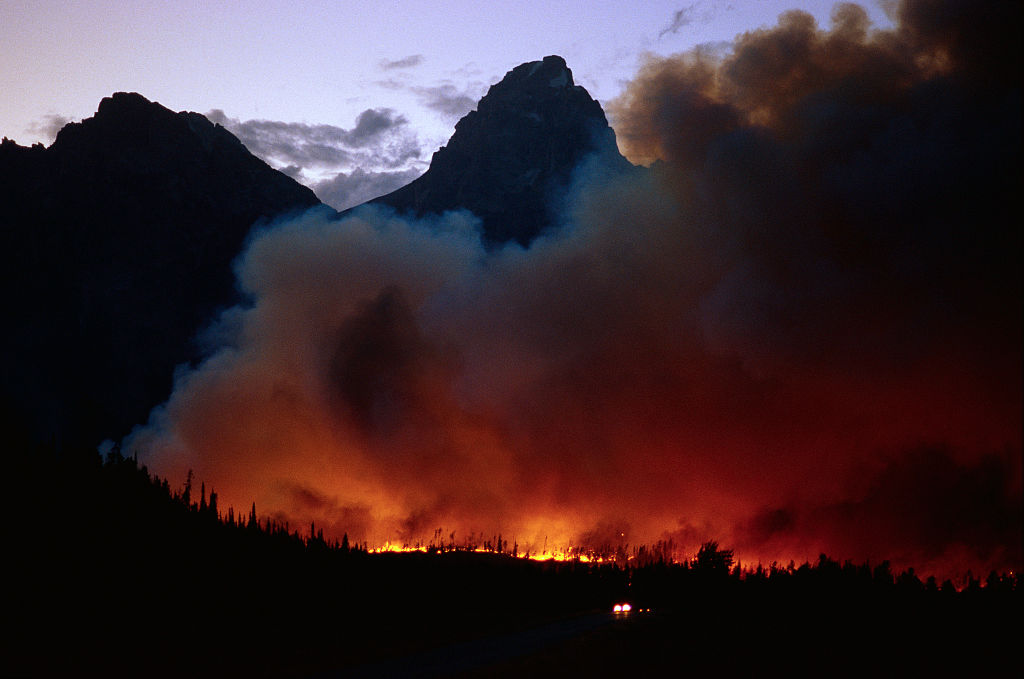
At a time when fossil fuel consumption is still rising and rationalized optimism about the future is commonplace, Andreas Malm and Wim Carton’s arguments seem especially pressing. (James L. Amos / Corbis via Getty Images)
Andreas Malm and Wim Carton have an enemy, and it’s not “climate deniers.” These authors acknowledge that the original Big Oil brand of climate denialism — which rejected the scientific fact that through the burning of fossil fuels humans emit carbon dioxide, which in turn warms the planet — is now less prevalent than a newer denialist argument, asserting that “climate change exists but it is not much of a problem.”
Nor is their enemy as broad or systemic as “capitalism,” although the authors have half-jokingly described their book as a sort of “readable IPCC report of a Marxist nature” and advocate goals like the “infliction of serious material costs on fossil capital.”
For these professors at Lund University in Sweden, the authors of the new book The Long Heat: Climate Politics When It’s Too Late, the enemies du jour are the “rationalist-optimists.”
These people — we’ll name names later — are optimistic in that they callously maintain that, as Malm writes in his 2024 book, Overshoot, “everything will turn out well,” despite the fact that global heating is set to speed past 1.5 degrees Celsius and potentially hit 3 degrees Celsius, with devastating consequences for humanity. For this “ideology of anti-revolution,” overshoot of 1.5 or 2 degrees Celsius of warming and the sustained use of fossil fuels is “unavoidable.” Rationalist-optimists believe the climate can be stabilized or global warming “reversed” through the deployment of technological solutions, like pulling carbon out of the atmosphere via carbon dioxide removal (CDR) technologies or using “solar geoengineering” to dim the sun and temporarily cool the planet.
The rationalist half of the moniker refers to these people’s presumption that technologies like solar geoengineering or CDR — should it become affordable and thus feasible at scale — would be deployed in an optimal fashion, rather than misused by subjects who remain “short-sighted, self-serving, beholden to private pecuniary interests,” like the US military or some rogue Silicon Valley start-up.
Written with anger, and conviction, the book is a gripping read. At a time when fossil fuel consumption is still rising and rationalized optimism about the future is commonplace, Malm and Carton’s arguments seem especially pressing.
The influence of rationalist-optimists can be seen everywhere. Take the MAGA figures who have traded old-school denialism for declarations that climate change is just “not incredibly important,” as US secretary Chris Wright puts it. Or the “centrist” writers at organizations like the Council on Foreign Relations or the Tony Blair Institute, which argue that it’s time to accept that the world will warm by 3 degrees Celsius, push responsibility onto developing countries, and center CDR and other technofixes as the central climate solution. Even the most progressive Democrats are foregrounding messages around affordability instead of the word “climate,” if only for tactical reasons. To put it simply: the necessary frontal assault on fossil capital is not on the menu — not yet anyway.
The Earth Is Not a Closed-Loop System
Malm and Carton devote the first section of the book to setting the record straight on climate science. Too often, they argue, we have a tendency to oversimplify the Earth system, relying on the fictitious idea that the Earth is some sort of closed loop, or that the globe’s temperature can simply be turned up or down with the perfect technology or human ingenuity. Rationalist-optimists lack humility in the face of a planetary system. The Earth’s climate, Malm and Carton point out, is not like the thermostat in your home, which we operate like a machine with a full understanding of its inputs and outputs — and which we could not even feasibly control entirely.
In this section, the authors reference classic scholarship, and particularly that of Charles Darwin. They confront Darwin’s flawed contention that “nature makes no leaps,” i.e., that evolution only occurs through small, gradual changes. Instead, drawing on G. W. F. Hegel and Friedrich Engels — who abhorred “gradualism” — the authors walk through the phase shifts that can turn gradual increases of concentrations of carbon dioxide into rapid, dramatic, and even irreversible shifts in physical systems.
Once an ice sheet begins melting or the Amazon rainforest begins dying, the process will not simply stop when emissions fall. We cannot hold blind faith that future emissions reductions or reversals can or will reverse avalanche-like changes to the natural world — and these pages are a convincing scolding of the policymakers for whom “conservatism or fatalism about society flips into extreme adventurism about nature.”
A Carbon Removal Time Machine?
If the first section of the book is a thorough beatdown of techno-optimist thinking on climate science, then the following two sections are the heart of the text, focusing on CDR and geoengineering. It’s worth reviewing where CDR stands today and what the climate policy world is expecting — no, demanding — of it in the years to come.
Humans emit 37.4 billion tons of carbon dioxide from burning fossil fuels each year, and remove just two billion with today’s CDR technologies. But 99.9 percent of those existing removals come through traditional methods like planting trees, where there is only limited potential for expansion. “Where on Earth is this land going to come from?” our authors ask, noting a European study from 2020 that assumed sizable swathes of the Global South, including the sixteen-million-strong city of Kinshasa, could be turned into emission reduction plantations. There’s also the irony that the very warming these trees are meant to mitigate is setting forests ablaze.
It is on novel negative emissions technologies, accounting for 0.01 percent of reductions today, that rationalist-optimists are really relying. The Long Heat has the reader examine the menu of options that this approach has to offer without using the rose-tinted glasses of mainstream politicians. Humans could try bioenergy with carbon capture and storage (BiCRS), growing plants, burning them for energy, and capturing and storing the resultant CO2 — although this might require as much land as is currently used globally for growing crops.
Humans could scatter rocks to accelerate the natural process by which silicates or carbonates eventually become limestone and lock away carbon on the ocean floor (enhanced rock weathering). But they’d likely need to “extract as much material as the entire global cement industry in the world today” and scale up faster than China’s cement sector did during its unprecedented boom in the 2000s.
The essence of “overshoot ideology” is that with the right mix of technologies, deployed rationally, we can save some semblance of business as usual, with continued fossil extraction and profit accumulation in the face of climate change.
Even if one is more optimistic than Malm and Carton about the technological potential of CDR, none of these technologies could benefit from the same market forces that have caused solar power and electric vehicles to scale up at unprecedented, unexpected speed in the last decade. In the absence of the profit motive, “removal would have to be the public good par excellence.”
The problem is that the state is not forcing polluters to pay for this public good. What novel CDR exists today, particularly in the United States, relies on dubious voluntary carbon markets that — in the absence of requisite public investment and policy — sell emissions offsets. The authors are especially critical of developments in the direct air capture industry, where the fossil fuel industry has made significant moves to leverage air capture for enhanced oil recovery, pumping captured carbon underground to remove hard-to-reach oil and gas.
Malm and Carton also call out 1PointFive, a subsidiary of Occidental Petroleum, and its CEO, Vicki Hollub’s now-infamous quote declaring that direct air capture is a lifeline for the oil and gas industry’s continued social and political license to operate. Rational plans for saving the climate have no room for slightly less carbon-intensive oil.
Overshoot Ideology Embraces Solar Geoengineering
The third and final section of the book opens with a question: If the dominant classes experienced an imminent loss of control over society due to political unrest and an uprising driven by cascading climate disasters, how would they try to retain it? The obvious answer, at least according to Malm and Carton, is solar geoengineering, often described via the anodyne abbreviation of SRM, or solar radiation management. No CDR technology — even at its very best — can reduce temperatures quickly, certainly not within a few months in response to a deadly heat wave. But spreading sulfate aerosols in the stratosphere via SRM to reflect incoming sunlight could do this, in the same way the soot from volcanic eruptions have cooled the planet in the past.
But SRM opens a Pandora’s box of potential technical side effects. Some may be more familiar to casual climate-watchers, like how SRM could weaken the Indian monsoon, a yearly weather event, and threaten the main source of water for over a billion people. Others, like the dramatic and potentially devastating differential cooling of the tropic poles, are only familiar to those who engage deeply with scientific journals, as these authors have. Nature, we are told, is apparently “all a Marxist needs these days.” Technology that sets out to affect the climate systems of regions will likely create geopolitical tensions between nations. Indian farmers may complain that American geoengineering could harm their crop yields.
Where Malm and Carton truly stand out is in their analysis of perhaps the gravest problem with SRM: the humans in charge of it. “Characteristic of overshoot ideology,” they write, “is the insertion of a rationalist-optimist article of faith: any dangers of side effects [of SRM] can be avoided by the agents in charge of perfecting the tech.” But, if the world was indeed rational, they contend, “geoengineering would be nowhere on the agenda.” They savage the scholars at Anglosphere universities who believe that this technology could be controlled properly. David Keith of the University of Chicago receives special criticism, as does Bill Gates, who has funded Keith’s SRM work and is now setting up false dichotomies between limiting temperature rise and eradicating malaria.
These Swedes are among the first to map how MAGA’s position on these sun-dimming technologies is likely to evolve. The current Republican Party abhors the idea, conflating the real dangers of SRM with the imagined threat of “contrails.” Three Republican-led states have banned the practice and at least twenty more are considering bills to do so. Yet despite Trumpian and Republican bluster, “a regime that embraces climate breakdown as the flipside of fossil fuels is preparing to treat it with something like sulfate planes,” especially if doing so would help reduce climate-caused migration from south to north.
In other words, a future energy secretary may well disagree with Wright that global heating is “no big deal” but agree that American oil must keep flowing and burning, and share the current administration’s xenophobia and penchant for mass deportations and illegal arrests in service of white nationalism. Such a global hegemon could dim the sun to square the circle.
All in all, The Long Heat’s section on SRM is clear, almost game-theory-like analysis, written in prose that sweeps the reader from page to page, even if the section’s extended metaphor of SRM as a form of repression in the psychoanalytical sense — we are treated to a chapter titled “Towards a Freudo-Marxist Theory of Geoengineering” — can become somewhat tiresome.
It’s only after finishing the book that the reader has time to pause and wonder what didn’t make it in. Yes, it’s primarily a 426-page polemic and need not contain think tank–style recommendations, but it is quite thin on the question of what should be done in the face of overshoot and the rise of techno-optimism. (Kim Stanley Robinson, a reviewer of the manuscript, has made the same point.)
In the conclusion, one reads that “uncompromising, Luddite resistance” — what the historian Eric Hobsbawm called “collective bargaining by riot” — can be the only response to SRM. But this is qualified by the admission that, if the sulphate planes are already up in the air when Malm and Carton’s fellow travelers take power, it might be that SRM would be “if only for a fleeting moment, the lesser evil” if the Earth is on the precipice of catastrophic tipping points. Perhaps these questions have no good answers.
The book’s most noticeable shortcoming, however, is the limited discussion of China, by far the most important global actor in the climate struggle. China appears as a foil to the United States — how might Beijing react to the Pentagon building an “Iron Dome for the planet”? This is surprising given the differences between China’s state capitalism and the capitalism practiced by the North American and European bourgeois who are the targets of the book’s main critique. Why so little analysis of the Communist Party of China from an author (Malm) who has called in these pages for an “ecological Leninism” and praised how Geoff Mann and Joel Wainwright explore the idea of an authoritarian, state-centered response to the crisis — a “Climate Mao” — in their 2019 book, Climate Leviathan?
Resisting Rational-Optimism
What rationalist-optimists misunderstand, according to Malm and Carton, is that technological progress alone cannot surmount the political and social obstacles to drive emissions to net-zero at sufficient speed. When renewable energy becomes cheaper than fossil fuels, the owners of oil rigs and the banks behind them do not voluntarily shut down assets before they are depreciated. If and when novel CDR technologies become deployable at scale, CDR companies will not automatically prioritize negative emissions over offsets, and so emissions could stagnate rather than rapidly decline. In other words, fossil capital — the title of Malm’s first English-language book — will not go quietly into the night.
There is no path to net-zero emissions without discomfort, without the stranding of assets, without people and corporations losing money. While there’s certainly a role for CDR, and perhaps maybe even SRM one day, we must cut emissions above all else. With decarbonization at the fore, we can then — as a report from researchers at American University puts it — focus on how much CDR we can do well.
Doing CDR well means building CDR as a public good, marshaling massive public investment and policy — perhaps via a federal carbon authority — to deliver removals outside some make-believe free market. We need to ensure removals are publicly monitored and verified, set removal targets that complement but don’t replace emissions cuts, and sharply curb the use of CDR for enhanced oil recovery.
We have yet to overcome the obstacles to decarbonization, but as the authors point out, “No one knows how quickly the business of fossil fuels could . . . come undone.” Confronting fossil capital is in fact the only rational path forward amid overshoot. Malm and Carton have done the global community a real service by sharply describing the dangers facing humanity and smashing the illusion that there is an easy way out.