The Lies Behind the US’s Next Forever War

Donald Trump is leaning heavily on drug-trafficking accusations to justify his recent kidnapping of Nicolás Maduro. But a new congressional report has found that the vast majority of illegal drugs come to the US via Mexico and China, not Venezuela.
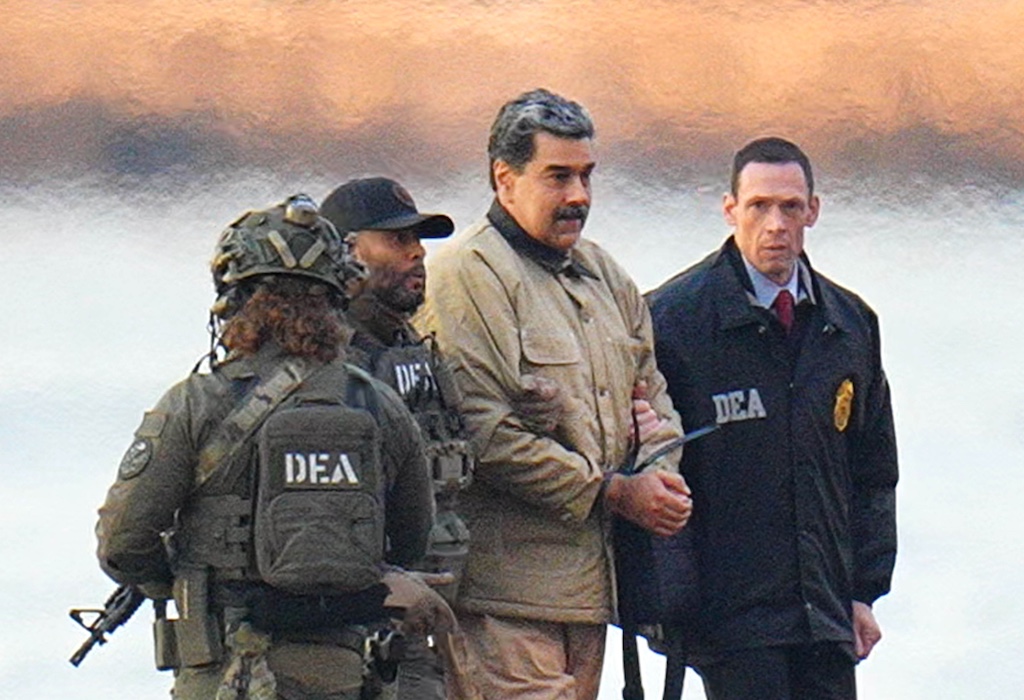
Donald Trump has accused the Venezuelan government and its president, Nicolás Maduro, of facilitating “narco-terrorism.” (XNY / Star Max / GC Images via Getty Images)

A new congressional research report has found that the vast majority of illegal synthetic drugs, like fentanyl and methamphetamine, come to the United States via Mexico and China, not Venezuela. The finding comes as the Trump administration continues to claim that Venezuela is a narcotics hotbed to help justify its military assault on the country.

While designating illegal fentanyl as a weapon of mass destruction in December, the Trump administration has accused the Venezuelan government and its president, Nicolás Maduro, of facilitating “narco-terrorism,” including the trafficking of fentanyl and cocaine into the United States.

Such claims were reiterated by Vice President J. D. Vance on January 4, following the US military operation in Venezuela to capture Maduro.

“First off, fentanyl isn’t the only drug in the world and there is still fentanyl coming from Venezuela (or at least there was),” wrote Vance. “Second, cocaine, which is the main drug trafficked out of Venezuela, is a profit center for all of the Latin America cartels.”

However, a December report issued by the Government Accountability Office (GAO), Congress’s independent, nonpartisan research arm, found that Mexican cartels “dictate the flow of nearly all illicit drugs, including synthetic drugs, into the U.S.”

The only mention of Venezuela in the report is of a “high-ranking member of Tren de Aragua, a Venezuelan [cartel] designated as a foreign terrorist organization . . . charged with conspiring to provide and providing material support to a designated terrorist group.”

In particular, there is little evidence suggesting Venezuela is a source of fentanyl, an extremely potent synthetic opioid that is now the leading cause of death for people ages eighteen to forty-five in the United States. After Maduro’s capture this past weekend, the Justice Department issued a twenty-five-page indictment accusing the Venezuelan leader of drug trafficking and terrorism — but made no mention of fentanyl.

Instead, the recent GAO report found that Mexican transnational criminal organizations “are a major supplier of the top two illicit synthetic drugs involved in overdose deaths in the U.S. — fentanyl and methamphetamine.” The government investigators’ conclusions were based in part on interviews with the Trump administration’s own law enforcement officers at the Drug Enforcement Administration, FBI, Homeland Security Department, and other agencies.

The report also found that Chinese drug manufacturing companies were publicly listing, selling, and offering advice on how to evade searches for fentanyl and its chemical components on various social media sites. Undercover GAO investigators used aliases to contact these Chinese companies in an attempt to potentially purchase chemical ingredients to produce fentanyl.

The report also noted that since 2009, Mexican cartels have purchased the chemicals needed to make fentanyl and methamphetamines from China and India. At times, according to investigators, Mexican drug smugglers have exploited shipment loopholes to route these chemicals through the United States before shipping them over the border.

This fall, Donald Trump justified his administration’s deadly extrajudicial strikes on alleged Caribbean drug ships, which he claimed were “loaded up with mostly fentanyl and other illegal narcotics,” by arguing they saved thousands of lives by preventing would-be overdoses. But in closed-door hearings in November, military officials told members of Congress that no fentanyl was found on the boats in the Caribbean targeted by air strikes.

Meanwhile, Trump supporters have insisted that US intervention in Venezuela will curb the opioid crisis.

On January 3, Rep. Dusty Johnson (R-SD) celebrated Maduro’s arrest by arguing the Venezuelan president is responsible “for facilitating the trafficking of deadly drugs, such as fentanyl, across our border, killing hundreds of thousands of Americans.”

The son of real estate magnate and Trump Middle East special envoy Steve Witkoff also praised US intervention in Venezuela, arguing that Maduro’s “drug networks have helped poison an entire generation of Americans” like his brother, who passed away in 2011 after overdosing on OxyContin, a highly addictive painkiller manufactured by US drugmaker Purdue Pharma.

In his first administration, Trump’s Justice Department settled with Purdue Pharma and its owners, the billionaire Sackler family, for practically pennies over their liabilities for the prescription opioid crisis.