What Brazil’s January 8 Can Teach Us About January 6
In 2021, the January 6 Capitol attack exposed deep connections between the US state and far-right groups. When something similar happened in Brazil in 2023, it prompted a national attempt to reform the government. The US has failed to do the same.
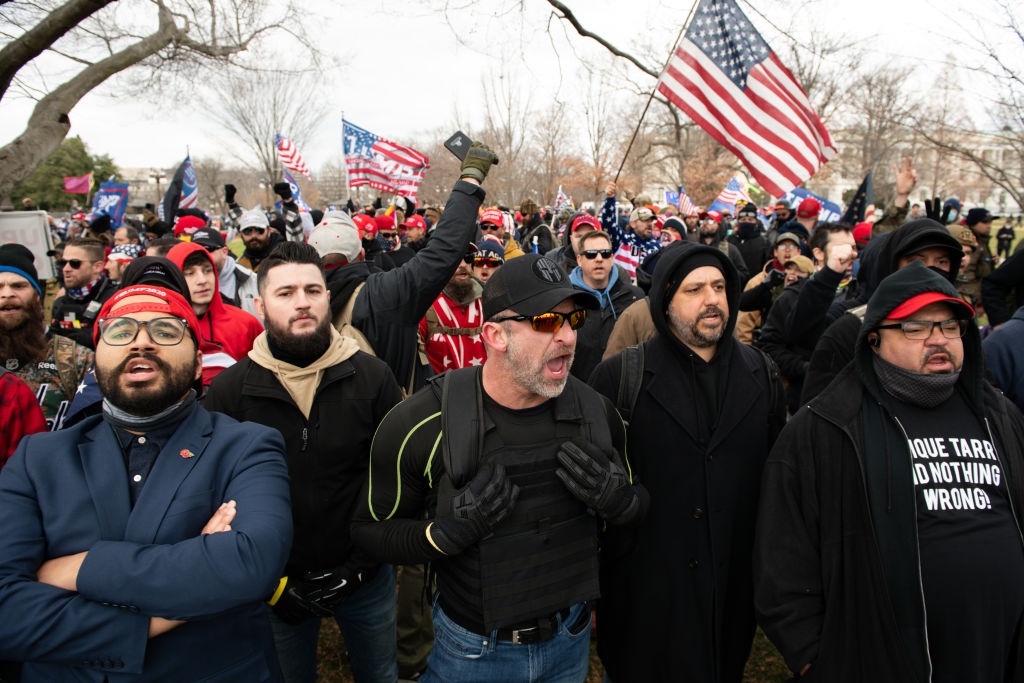
With Donald Trump’s return to office, the machinery of the state has turned not against those who attacked democratic institutions but against those who defended them. (Graeme Sloan / Bloomberg via Getty Images)
On January 6, I watched from my living room as a crowd of angry Americans stormed the Capitol. I did not know then that one of them was someone I knew.
Footage released by the FBI confirmed that the young man who sat across from me in a class called Democracy and Education had ditched his signature suit and bowtie for a black hooded puffer and Trump hat and led a mob of Donald Trump supporters in a heave-ho effort to raid the US Capitol, cheering as an officer was pepper sprayed and brutally beaten in front of him.
After pleading guilty to a felony, he would be sentenced to two months in prison, of which he served only seven weeks. In one of the first acts of the Trump administration last February, he was pardoned alongside some 1,500 other rioters.
More important than the clemency granted to those who smashed windows, beat police officers, and wandered the halls taking selfies was what the government’s response left untouched: Trump and the political elites who summoned the crowd, fed it lies about a stolen election, delayed intervention as violence unfolded, and then rebranded the assault as overheated protest or political theater.
Those who could have stopped January 6 have not only escaped punishment; many were rewarded with renewed political power. And with Trump’s return to office, the machinery of the state has turned not against those who attacked democratic institutions but against those who defended them, as career prosecutors who brought cases were harassed, fired, demoted, or placed under internal investigation, their work reframed as partisan abuse. Trump — who did more than anyone to ignite the violence — is today arguably stronger than ever.
Brazil’s Alternative
In retrospect, the American response would prove to be only one of several possible paths. Another democracy confronted with a comparable test chose a different one. About four thousand miles south, Brazil’s former president Jair Bolsonaro, one of Trump’s allies, sits in a ten-by-ten-meter concrete prison cell, serving a twenty-seven-year sentence for attempting to overturn and then subvert an election he lost.
On January 8, 2023 — two days after the second anniversary of the US Capitol attack and one week after Luiz Inácio Lula da Silva took office — thousands of Bolsonaro supporters converged on Brasília’s Praça dos Três Poderes. Many had traveled for days; others had spent weeks camped outside army barracks, openly demanding military intervention.
With Congress in recess and much of the federal government between administrations (and with a Bolsonarist governor), resistance was thin. By early afternoon, the crowd overwhelmed police lines and, in rapid succession, stormed the National Congress, the Supreme Federal Court (STF), and the presidential palace — smashing windows, destroying offices, vandalizing artworks, and livestreaming the assault, as their American role models had.
Like Trump, Bolsonaro spent months concocting the claim that he had been cheated, attacking the legitimacy of the election system in advance so that, if he lost, defeat could be rebranded as fraud. Though Bolsonaro did not goad the rioters on in person as Trump had (the Brazilian leader was busy eating KFC in Orlando, Florida), he continued to promote doubts about the vote count and the judicial oversight of the election, even after the Superior Electoral Court and Brazil’s armed forces found no evidence of widespread fraud.
But that is where the two stories begin to diverge. Brazil’s police and prosecutors moved with a speed and unity that the United States could never manage. On January 9, STF justice Alexandre de Moraes removed Bolsonarist Federal District governor Ibaneis Rocha from office for complicity in the attacks, ordered the dismantling of the pro-coup encampments outside military installations, and demanded a sweeping law-enforcement response to prevent a second wave.
Then came the investigation. Brazilian authorities refused to isolate January 8 as a spontaneous and feverish riot. Instead, they treated it as a conspiracy with identifiable authors. Days after the attack, police searched the home of Anderson Torres (Bolsonaro’s former justice minister and Brasília’s then–security chief) and found a draft decree to declare an emergency “state of defense” aimed at the Superior Electoral Court — a legal mechanism that, investigators said, would have opened a path to intervene in election administration and revisit the result. As the inquiry broadened, former service chiefs told federal police that Bolsonaro discussed and presented a draft emergency decree to prevent the handover of power — testimony that aligned with investigators’ recovery of similar texts from devices linked to Bolsonaro’s aide Mauro Cid.
Reports later unveiled a post-election meeting whose alleged plan was to bring specially trained troops to Brasília, provoke violence, and use the resulting chaos to justify exceptional measures and annul the election. Investigators also uncovered credible evidence of a clandestine plot to assassinate Lula, vice president–elect Geraldo Alckmin, and Supreme Court Justice Moraes, with documents about the plan even printed at the presidential palace during Bolsonaro’s final months in office.
Despite pressure from the Trump administration, including the imposition of 50 percent tariffs on Brazil, the STF, under the leadership of rapporteur Moraes, authorized extensive preventive measures to preserve evidence and prevent coordination — pretrial detentions, passport seizures, communication and social media bans, and ankle monitors — and structured the prosecutions to distinguish between foot soldiers and alleged organizers.
Hundreds of January 8 participants were tried and convicted not simply for vandalism but for attempted violent abolition of the democratic rule of law, coup d’état, criminal organization, and destruction of protected public property, while prosecutors pursued parallel cases against those accused of planning and enabling the rupture from within the state. In September of 2025, after hearing witness testimony from former service chiefs and reviewing documentary and digital evidence, the court convicted Bolsonaro and key collaborators and handed out lengthy prison sentences.
That judicial assertiveness has not gone uncontested. Critics — including prominent jurists and civil liberties advocates — argue that the STF, and especially Moraes as rapporteur, has stretched powers granted under Article 102 of Brazil’s 1988 Constitution, which gives the STF original jurisdiction over crimes against constitutional order, to justify unusually centralized and preventive action. They warn that Moraes’s reliance on monocratic orders blurs the line between investigation and adjudication and risks eroding confidence in the rule of law.
Yet the predicted backlash has largely failed to materialize. Lula’s refusal to interfere with the courts has been welcomed by Brazil’s financial and political center, where markets and the centrist block have prioritized institutional stability over the kind of polarization and judicial delegitimation that followed January 6 in the United States.
Even a recent amnesty proposal for Bolsonaro — advanced with decisive centrist support on the grounds of national reconciliation and his failing health — has provoked mass protests and is widely expected to face a presidential veto and judicial challenge. More strikingly, a recent study shows that the coup prosecutions did not weaken democratic support among Bolsonaro voters and in fact strengthened pro-democracy attitudes among non-Bolsonaro voters, despite the fact that confidence in democratic institutions has declined in Brazil in the past decade.
The Brazilian response reflects a hard-earned lesson from the comparative study of democratic collapse: early, forceful, and legally grounded intervention is often the only way to stop backsliding once elites signal a willingness to subvert electoral outcomes. A large body of political science research — from Juan Linz’s classic work on democratic breakdown to more recent scholarship by Steven Levitsky and Daniel Ziblatt, Nancy Bermeo, and Ozan Varol — shows that modern coups rarely arrive as tanks in the streets.
As we have seen in places like Hungary and El Salvador, they proceed instead through “executive aggrandizement,” legal gray zones, and coordinated pressure on courts, election administrators, and the security services. International critics who recoil at the assertiveness of Moraes often seem to forget that, in the long history of the Brazilian state, where the brutal military dictatorship was only overthrown in 1985, democracy is the exception, not the rule.
What January 8 teaches us about January 6 is that the gravest threats to democratic systems rarely come from unruly mobs breaching buildings alone. They come instead from within the state itself: from the quiet and political complicity of security and military apparatuses tasked with defending constitutional order and from the failure of the judiciary that is supposed to hold them accountable.
If — when the glass has been swept away and the trials are over — those who empowered, guided, mobilized, and legitimized people like my classmate are never held to account, then the legal process becomes theater and the conditions for repetition remain intact. Once we lose trust in the arbiters of justice, the rule of law becomes an airy appeal, not a tangible reality.