Ukraine on the Brink
Ukraine's politics are dominated by oligarchs. Its streets are more and more run by the far right.
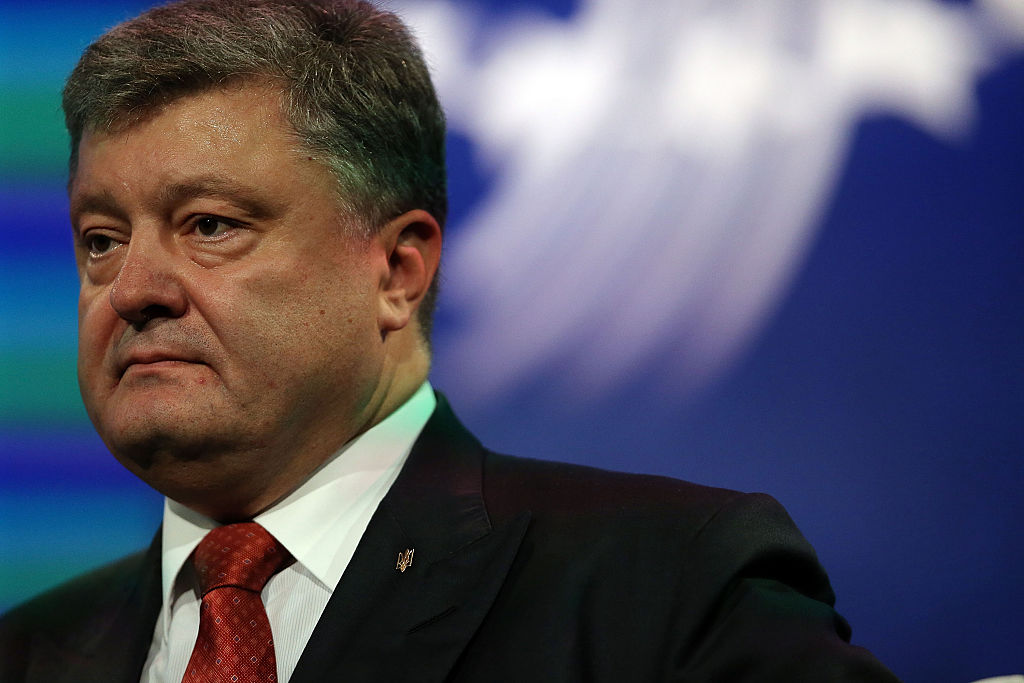
Ukrainian president Petro Poroshenko attends the the annual Clinton Global Initiative meeting on September 27, 2015 in New York City.Spencer Platt / Getty
When the Soviet Union fell apart in 1991, its former republics’ economies went into free fall. Ukraine — the most populous of the new states, after Russia — was no exception: average incomes and life expectancy declined as violent crime soared. It had been a center of heavy industry in the Soviet Union, but during the 1990s its industrial facilities were sold off at bargain prices to figures linked to its political leadership. From 1994 that leadership was dominated by President Leonid Kuchma, a former factory manager who attempted but ultimately failed to keep both Russia and the West on its side.
By the turn of the millennium, Ukraine’s economy had stabilized — but most Ukrainians were still desperately poor, and the conspicuous wealth of a small minority fueled popular conviction that the country’s resources were being stolen. Gradually, Kuchma came to be seen as emblematic of that theft. In neighboring Russia, the chaos and relative openness of the 1990s was giving way to Putin’s new authoritarian order as political freedom was traded for a measure of stability.
It gradually became clear that there would be no such consolidation in Ukraine. In December 2000, a series of recordings was leaked in which President Kuchma discussed abducting the journalist Georgi Gongadze, as well as concealing the proceeds of corruption. The resulting protests were suppressed, and Kuchma remained in place, but the groundwork had been laid for much larger demonstrations — the so-called “Orange Revolution” — that came four years later after vote-rigging by Kuchma’s would-be successor, Viktor Yanukovych, in the 2004 presidential election. A rerun of that contest handed power to Western-leaning Viktor Yushchenko, whose tenure combined some economic growth with rising inequality — and spanned the 2008 financial crisis, which further impoverished ordinary Ukrainians. In the next election, in 2010, Yushchenko lost to the opportunistic Yanukovych. Having indicated that he would sign an association agreement with the European Union, in the autumn of 2013 Yanukovych bent to pressure (and incentives) from Putin and changed his mind. Demonstrators once again gathered in Kyiv’s Maidan Nezalezhnosti (Independence Square), leading to the president’s removal from power.