Bryan Johnson Is Silicon Valley’s Sexless Vampire Future
Bryan Johnson’s sexless brand of “wellness vampirism” is the perfect metaphor for Silicon Valley. It’s a utopian promise of a limitless future disguising a brutal, extractive reality that leaves us all drained.
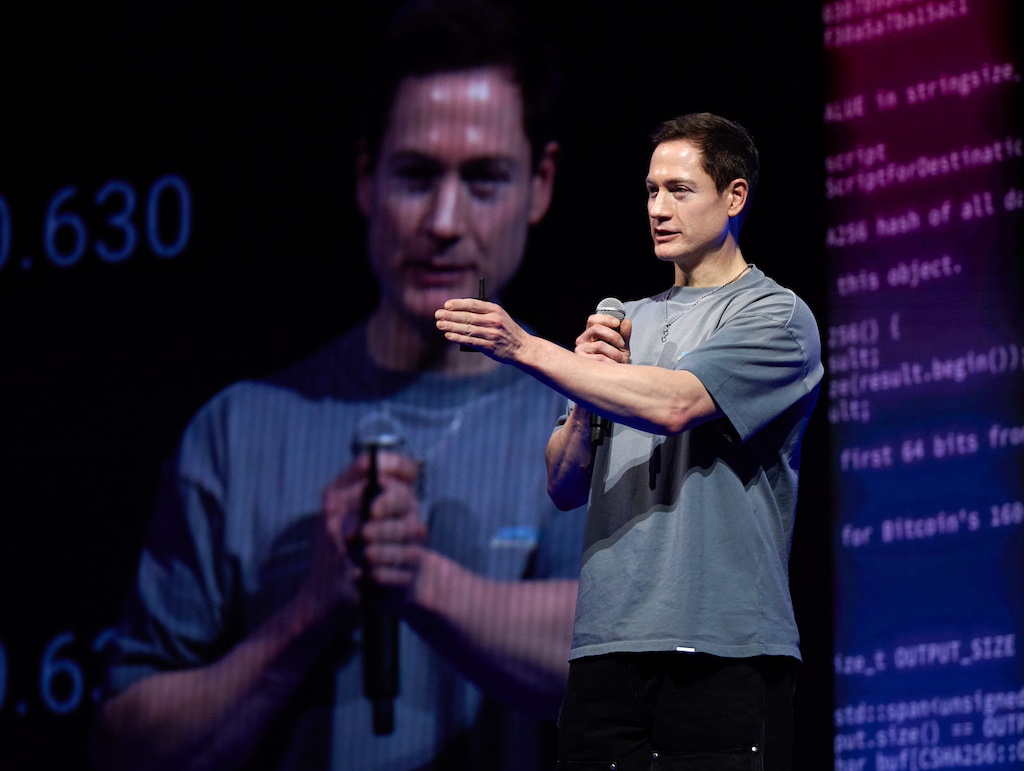
Bryan Johnson has spent millions trying to become immortal and transform his body into a temple of biological data. (Bridget Bennett / Bloomberg via Getty Images)
Fictional vampires are dark, dangerous, and, crucially, sexy. From Bela Lugosi’s hypnotic stare in the first Dracula film to the tortured emo vibe of Edward Cullen, the silver-skinned heartthrob of Twilight, the undead have often been seen as the apex predators of the dating pool. That’s because their monstrosity is balanced by a seductive, often genteel charm. “There was a deliberate voluptuousness which was both thrilling and repulsive,” describes Bram Stoker’s protagonist, Jonathan Harker, in the original novel Dracula, capturing the essential vampire paradox in a single sentence.
But in the 2020s, the ultimate “bad boys” appear to have undergone a catastrophic software update.
Enter Bryan Johnson: the centimillionaire biohacker who has turned a quest for eternal life into a grim, spreadsheet-driven slog. Johnson, the Silicon Valley founder behind the well-publicized brand Don’t Die and the subject of a 2025 Netflix documentary (Don’t Die: The Man Who Wants to Live Forever), has spent millions trying to become immortal and transform his body into a temple of biological data. He takes ninety-one pills a day, performs shock therapy on his penis, measures his erections, and once engaged in a “multigenerational plasma exchange” in which he siphoned the blood of his teenage son. He is, by any objective definition, a vampire, but one who has traded the cape for wearable sensors and the Transylvanian castle for a Wi-Fi-enabled home laboratory. What he lacks is any semblance of seduction — bloodthirsty but strangely bloodless.
you up? pic.twitter.com/6lqqdHqm2F
— Bryan Johnson (@bryan_johnson) March 10, 2025
Consider the way Johnson recently revealed his secret three-year-long romantic relationship the way one might announce a corporate merger. In a long, solemn X thread posted in early December, he announced that he had been quietly dating his girlfriend, Kate Tolo, also his business partner at his longevity startup, Blueprint, for years. “I’m a 48-year-old American, raised Mormon, with three children. She’s a 30-year-old Bosnian-Australian-American,” he posted in early December while unironically comparing himself to Founding Father John Adams and Tolo as First Lady Abigail. “It took time to bridge our worlds. In our years of knowing each other, three of them have been navigating a relationship. All while building a business and movement.”
But things took a truly dark turn for the cringe-averse when he began documenting their reunion on social media after some two weeks apart. “Without her touch, my vagus nerve’s 100,000 myelinated fibers have dropped their high frequency spectral power, squawking distress,” he wrote. Most men might just say they missed their girlfriend; Johnson prefers to imagine that “my hypothalamus begins synthesizing oxytocin, preparing to dump it upon first eye contact to ensure the reestablishment of our pair bond.” When they finally reunited, he didn’t just hug her; their “olfactory systems consume[d] each other with delight.” Or, as they begin to kiss: “Kate’s blood vessels dilate from the acetylcholine and nitric oxide release, flushing her lips, skin, and body. The cascade is nearing waterfall.” It is a vision of intimacy that is both clinical and deeply unsettling, a kind of erotica written by a cyborg with the romantic instincts of a malfunctioning Alexa.
But behind the bizarre robo-poetry about mirror neurons lies a more familiar, and far more human, pattern of warped and controlling behavior. It’s not surprising that Johnson’s pairing with his coworker has remained under wraps for three years. As the New York Times documented in March, he routinely cajoles his employees, sexual partners, vendors, and contract workers into silence with restrictive nondisclosure agreements. The article also detailed Johnson’s messy fallout with former fiancée (and employee) Taryn Southern. According to a lawsuit she filed against him, Johnson pressured her to sign an employment separation agreement with confidentiality terms and ended the relationship while she was undergoing treatment for stage 3 breast cancer.
Tolo is at least Relationship 3.0 for Johnson. He was a practicing Mormon with a wife and three children when PayPal acquired his payments company, Braintree, in 2013. Suddenly, after striking Silicon Valley gold, according to the New York Times, he got divorced, left the church, hired prostitutes, and took loads of drugs, including acid, Ibogaine, and DMT. By the 2020s, he transitioned into the immortality business with Project Blueprint, an obsessive effort to reverse his body’s aging and become his own Frankenstein experiment. The Don’t Die lifestyle is like a full-time job as a janitor of self-maintenance. Johnson has turned his body into a site of total surveillance, where every drop of blood, scalp stimulant, and urine test is logged in a desperate, expensive attempt to outrun the inevitable.
Johnson’s sexless brand of wellness vampirism is a perfect metaphor for the current state of Silicon Valley. It’s the logical, grotesque endpoint for an industry that began with the breezy, patchouli-scented promise of democratizing information and forging boundaryless human connections, pitching the internet as a digital commune where the human spirit could roam free.
But that utopian mask has slipped, and now Big Tech is almost purely extractive. Just as Johnson siphons the plasma of his own offspring to fuel his quest for immortality, the tech titans have spent the last decade siphoning our attention, our data, and our very cognitive life force to power their bottom lines.
In the end, Bryan Johnson is successful at sucking our attention. But as a boyfriend, a boss, and a poet, he exists as a cautionary tale. He is the first vampire in history who makes us look at the cold, inevitable embrace of the grave and think: Actually, that looks like a pretty good deal.