Jessica Mitford Had Every Reason to Side With Power and Refused
Jessica Mitford was born the child of aristocrats and the sister of fascists who celebrated the rise of Adolf Hitler. But she betrayed her class to become a communist, embedding herself in the life of the working class and railing against the powerful.
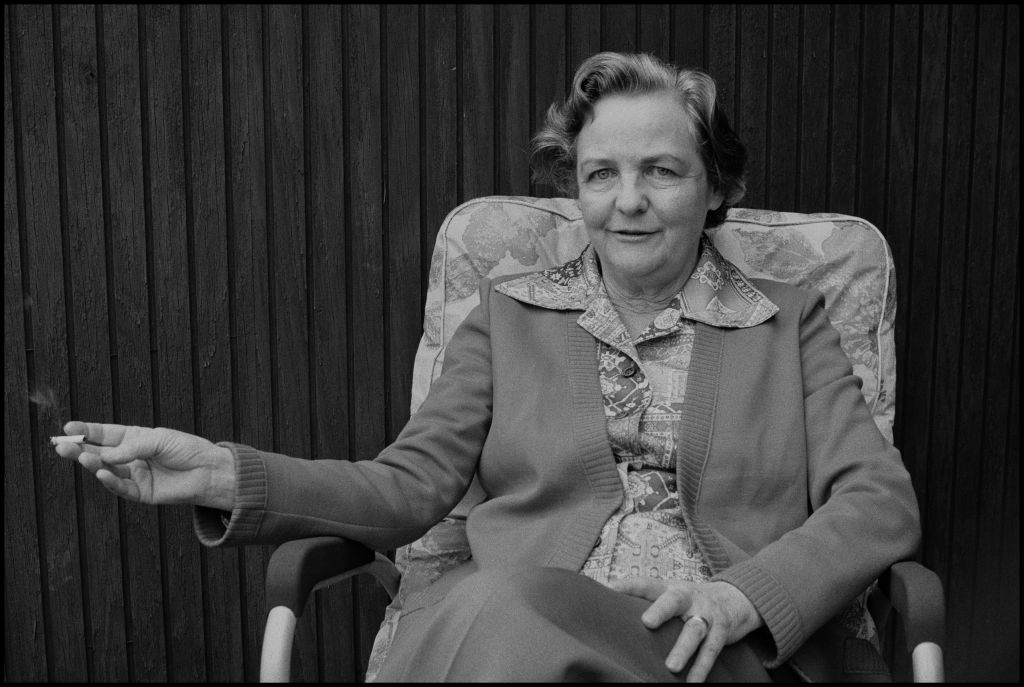
Jessica Mitford was born into Britain’s ruling class: her parents were aristocrats, her siblings were fascists, and her cousin was Winston Churchill. A new book shows how she ditched her background to become a communist and radical journalist. (Janet Fries / Getty Images)
In twentieth-century Britain, the Mitford name became entangled with the rise of European fascism. On October 6, 1936, the most beautiful of the six sisters, Diana Guinness (née Mitford), married Oswald Mosley — accomplished fencer and founder of the British Union of Fascists — at the Berlin home of Joseph Goebbels, overlooking the Tiergarten. Adolf Hitler was guest of honor. Just two days earlier, Mosley had been beaten back at the Battle of Cable Street, where tens of thousands of communists, trade unionists, and Jews used their bodies as barricades to prevent his Blackshirts marching through the East End of London, England’s most densely populated Jewish district.
Unity, Diana’s younger sister, had moved to Bavaria in 1933 in the hope of meeting Hitler and, in 1934, watched a forest of swastika flags beneath a torchlit procession during the first Nuremberg Rally with Diana. Unity succeeded in her ambition, reinventing herself as Hitler’s englisches Fräulein, indulged as no other foreigner in his inner circle. “I am so happy that I wouldn’t mind a bit dying,” Unity wrote to her mother, Lady Sydney Redesdale (or “Muv”): “I suppose I am the luckiest girl in the world.” But when Britain finally declared war on Germany in September 1939, Unity calmly walked into Munich’s English Garden and fired a bullet from her pearl-handled pistol into the back of her skull. The suicide attempt failed, leaving her with permanent neurological damage. Hitler sent roses to her hospital bedside.
The Making of a Class Traitor
Growing up, Jessica “Decca” Mitford, the fifth of six sisters, shared a bedroom with Unity. In Hons and Rebels (1960), she later recalled how they divided the space with rival insignia: on the window, Unity’s “swastikas carved into the glass with a diamond ring,” Nazi pendants, and Italian fasces; on Jessica’s side, “for every swastika a carefully delineated hammer and sickle,” along with a bust of Lenin and stacks of the Daily Worker. While Jessica would ultimately forgive Unity for her love of Hitler (“Perversely, and although I hated everything she stood for, she was easily my favourite sister,” she reflected after Unity died of meningitis at thirty-three), she felt no such charity toward Diana and her husband.
When, in 1943, Winston Churchill, her first cousin once removed, put the Mosleys under house arrest after three and a half years’ internment in Holloway Prison as enemies of the state, Jessica wrote a public letter to the prime minister to say he had erred. “Dear Cousin Winston,” she began, “the release of the Mosleys [shows a] real cleavage between the will of the people and the actions of the ruling class in England . . . and that the Government is not truly dedicated to the cause of exterminating fascism in whatever place and in whatever form it rears its head. . . . My personal feeling is that the release of the Mosleys is a slap in the face to anti-fascists in every country . . . The fact that Diana is my sister doesn’t alter my opinion on this subject.”
Any biography that treats Jessica merely as a colorful exception to her elite family’s embrace of far-right nationalism — fodder for a morality play about aristocratic bad behavior — misses why she still matters. (For this type, watch last year’s smooth but spiritless six-episode family portrait Outrageous on Britbox.) Instead, Jessica was a serious anti-fascist thinker and writer who went on to become one of the most prolific investigative journalists of the American left. A new book by Northeastern University professor Carla Kaplan, best known for her definitive biography of Zora Neale Hurston, entitled Troublemaker: The Fierce, Unruly Life of Jessica Mitford, draws on Peter Y. Sussman’s 2006 collection of Jessica’s letters, Decca.
Bringing her subject out from the long shadow of her notorious, more glamorous sisters, Kaplan restores Jessica as a major political writer whose commitments shaped both her life and her work. “I discovered that human nature was not, as I had always supposed, a fixed and unalterable entity,” Jessica later wrote, “that wars are not caused by a natural urge in men to fight, that ownership of land and factories is not necessarily the natural reward of greater wisdom and energy.”
From a fascist–communist standoff in adolescence grew a lifetime of opposition, as Jessica set herself against her sisters and her class. In 1937, she engineered a meeting with her second cousin Esmond Romilly — “Churchill’s Red Nephew” — whom she loved sight unseen for his socialist polemics and for dropping out of Wellington College. They ran away together to Civil War Spain, married in Bayonne, and Esmond fought with the International Brigades in Madrid. When the foreign secretary sent a consul to bring them home, they refused (“Impossible to persuade her to return”), relenting only after refugees were used as leverage.
Back in London, they settled briefly in working-class Rotherhithe, running a gambling parlor amid “tough journalists and advertising agents, Communist Party bosses, Bohemian pub-crawlers and a sprinkling of half-liberated girls who had once been debutantes.” Their daughter Julia died of measles, rife around this area of the docks, before her first birthday. Burdened with debt, they fled to the United States – first to Greenwich Village, then Washington, DC (where Romilly wrote of his experiences in Spain and reluctantly penned a column for the Washington Post called “Baby Bluebloods in Hobohemia,” and where the newlyweds were taken under the wing of civil rights activist Virginia Durr and New Dealer — and Soviet spy — Michael Straight), then Miami, which Jessica loathed (“a horrible, tinselly town with its maddening eternal sunshine”). After the outbreak of war, which represented what he had fought for in Spain “only on a much bigger scale, for now the survival of the whole of Europe was in the balance,” Romilly joined the Royal Canadian Air Force and disappeared, presumed dead, during a failed raid over the North Sea in 1941.
Inconsolable after Romilly’s death, one half of her “conspiracy against the world,” Jessica nevertheless found new freedom in the 1940s and ’50s to devote herself to activism and writing. She married civil rights lawyer Robert Treuhaft, settled in Oakland, and became “enchanted by the flesh-and-blood Communists” she ran with in California. She became a Party fundraiser and organizer during “a curious moment in its history: the Browder Period,” as the CPUSA shifted from revolutionary Marxism to a more “respectable” position of Americanism and class collaboration, and attracted the attention of the FBI. She often took her children — Constancia (“Dinky”), born soon after Romilly’s death, and later, with Treuhaft, Nicholas and Benjamin — on marches and leafleting campaigns with the Civil Rights Congress, protesting housing discrimination and police brutality and demanding a retrial for Willie McGee, an African American man unjustly convicted of raping a white woman. For Esquire, she travelled to Montgomery, Alabama, greeting the arrival of Freedom Riders and getting caught up in a riot when the Ku Klux Klan led a mob against the civil rights activists.
Later documenting her experiences with the CPUSA in A Fine Old Conflict (1977), Jessica left the Party a year after Nikita Khrushchev’s “Secret Speech” and the Hungarian Revolution, but she also tired of all the doctrinaire statements from officials. In “Lifeitselfmanship or How to Become a Precisely-Because Man” (1956), she satirized the shopworn language favored by her comrades in their uncompromising class war, which she categorized as “L and non-L (left and non-left) English,” a send-up of her sister Nancy’s writing on “U and non-U English,” for upper-class and non-upper-class speech. Subpoenaed in 1953 by the House Un-American Activities Committee, she refused to answer questions about her political beliefs or associations. She later portrayed the hearing in essays and memoirs with lucidity and satire, and it is now remembered as a model of principled First Amendment resistance, invoking her freedoms of speech and assembly — distinct from both cooperation and Fifth Amendment silence — and as an early indication of the sharp, skeptical voice that would later define her investigative writing. As Christopher Hitchens put it, “She had the invaluable gift of making powerful institutions look ridiculous . . . simply by describing them accurately.”
As a muckraking journalist, Jessica focused on uniquely American institutions and issues: the brutalities of profit-driven health care and the exploitations of the commercialized funeral industry, exposed with forensic clarity and polemical fury. After Nicholas was hit by a bus and killed at the age of eleven — the second child she lost, testing what Durr called Jessica’s “concrete upper lip” — she critiqued what she defined as “the American way of death,” in which the poor and bereaved were sold embalming myths, upsold caskets, and sales-driven “grief therapy.” She challenged the subtle violences of everyday life under capitalism, where profit insinuated itself into moments of maximum vulnerability, transforming illness, death, and grief into opportunities for extraction rather than occasions for care.
Kaplan depicts Jessica in her final years as a loving but often absent mother who buried herself in her writing as Treuhaft had an affair with a family friend. Much is made of Jessica’s sloppiness (she saw no point in making her bed in the morning only to get back into it at night) and her fondness for domestic shortcuts (like the new invention of ready meals), but also of someone who took both her leftist commitments and her partying seriously. Kaplan details how Jessica tore up karaoke sets with her friend Maya Angelou and led a kazoo band called Decca and the Dectones. When one friend criticized her for not having a feminist bone in her body, Jessica replied: “Perhaps true — but I do have splashes of cartilage.” Jessica Mitford’s life, as Kaplan makes clear, was not a repudiation of her origins so much as a sustained argument against them — waged with intellect and a defiant faith that history could be forced, however imperfectly, to bend left.