America’s Ties to Israel Might Lead It to War With Iran
Donald Trump is once again threatening war with Iran just six months after bombing the Islamic Republic in June. Part of the reason for his hawkishness is his closeness to Israel, whose increasingly reckless actions threaten the whole Middle East.
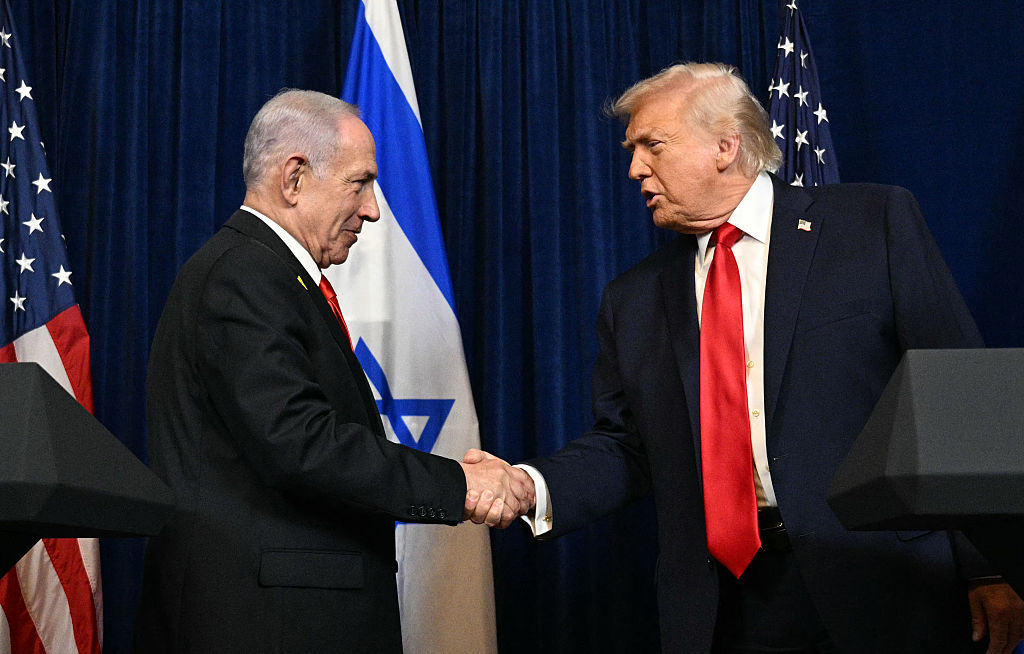
After the end of the Cold War, it was possible that the US and Iran might have normalized relations. But Israel’s commitment to dominating the region stood in the way. (Jim Watson / AFP via Getty Images)
Two new histories of US-Iran relations ask why these nations — once strategically linked by Cold War imperatives — have been hostile to one another for almost half a century. Afshin Matin-Asgari’s Axis of Resistance: A History of Iran–US Relations engages this question through the lens of imperialism, while Dalia Dassa Kaye’s Enduring Hostility: The Making of America’s Iran Policy offers an account of US-Iran relations in the language of the foreign policy establishment. While the former sheds light on the US role in undermining the Islamic Republic since the 1979 revolution, the latter refuses to interrogate the reasons for this hawkishness.
The Revolution and Its Aftermath
For Afshin Matin-Asgari, a US academic from the Iranian diaspora, the poor relations are a product of US refusal to accept Iranian autonomy. Before the Iranian Revolution in 1979, Iran was a client state whose primary purpose, from the US perspective, was as a market for arms and as a bulwark against the Soviets in the Persian Gulf.
Matin-Asgari’s focus on US imperialism frees him from idealizing US-Iran relations prior to the revolution. His focus on the revolution itself is perhaps unsurprising given that he was among the leftist students studying in the United States who returned to participate in the events of 1978–79.
After the Shah fled Iran in January 1979, he moved to the West. As the months went by, his hopes of regaining his throne diminished and his lymphatic cancer spread; he wearily drifted from Cairo to Rabat to Paradise Island in the Bahamas, and finally to Cuernavaca. With few friends left, the Shah still had his banker, David Rockefeller, who pulled the requisite strings to land him in Mexico.
The Shah also had Richard Nixon and Henry Kissinger on his side. The latter lobbied the Carter administration to admit him into the United States for medical treatment. Kissinger even played hardball with Carter, linking his support for the new iteration of arms control talks with the Soviets, which he had started, to the admission of his dying friend.
The CIA, the State Department and its US Embassy in Tehran advised Carter that such a policy would antagonize Iran. The United States knew the popular revolution was concerned — and, with hindsight, paranoid — that the Americans plotted to reimpose their client king. After all, in 1953 they had done just that: the Shah had fled to Baghdad and Rome while the CIA manufactured a coup to oust his democratizing prime minister, Mohammad Mosaddegh, who threatened US control over Iranian oil.
“If they let him in,” said William Sullivan, America’s last ambassador to Tehran, in the summer of 1979, “they will bring us out in boxes.” Late on Sunday, October 21, Carter finally admitted the Shah, sending a US Air Force jet to collect him the following morning. On hearing the news, street protests swelled to a million in Tehran. Supreme Leader Ruhollah Khomeini struck a curiously pragmatic tone: “It’s all right if he dies, but what will happen to our money?”
If one takes a strongly contingent view of history, Carter’s surprising move to admit the Shah is perhaps the most critical event in the history of US-Iran relations. Precisely a fortnight later, the American embassy was taken by a small group of university students. The group had spent weeks conducting amateur reconnaissance of the vast complex.
Khomeini, who historians tend to agree had no foreknowledge of the plan, first wavered and then publicly backed the hostage-taking, issuing his principal demand that the Shah be returned to face trial. For 444 days, nightly footage of blindfolded diplomats (and a few CIA operatives) were beamed into the television sets of millions of households across the United States.
For this humiliation, as well as his botched rescue effort, Carter, would lose the 1980 election. He responded to the crisis, which would cost him his presidency, first by freezing $12 billion in Iranian assets, imposing sanctions, and designating the Islamic Republic a “state sponsor of terrorism.” Carter covertly backed, and likely orchestrated along with Arab allies, Iraq’s invasion of Iran, which mobilized the nation for eight years against Saddam Hussein and, in its final years, the United States itself.
Matin-Asgari identifies Khomeini’s decision to back the students as a “second revolution.” Khomeini won back momentum that he had lost over the course of 1979 to leftists, Islamist leftists, and rival traditionalist clergy. A revealing indicator of his position in late 1979 is the result of the parliamentary elections in the spring of 1980. In a highly suppressed vote, Khomeini’s party, the Islamic Republican Party (IRP), still only won 85 out of 270 seats.
The hostage crisis allowed Khomeiani to outflank his opponents on the central revolutionary question of anti-imperialism (i.e., anti-Americanism). He waged a “cultural revolution” against leftists within the universities, which included paramilitary killings. By 1981 his rivals were defeated or had fled into exile, and his own position was unassailable.
Matin-Asgari even raises the prospect that this epochal opportunity was deliberately delivered to Khomeini by actors in the United States itself: the so-called Chase thesis. According to this theory, which was taken seriously enough in the United States to become the object of a 1981 congressional investigation, the lobbying effort by Rockefeller, the Chairman and CEO of Chase Manhattan Bank, and his special adviser, Kissinger, was designed to inflame reaction in Iran and create the conditions likely to result in a US freeze of Iranian assets.
Here, Matin-Asgari builds on James A. Bill’s masterful 1988 work and others, who observe that Chase was on the hook for $500 million in loans to the Shah for US weapons. While the bank held an equivalent amount in deposits, it could not legally convert them and feared Iran would withdraw the sums. In short, the only way out was for Iran to be forced to default on its loans by depriving it of the means to service its interest payments, which a US freeze would provide. Matin-Asgari notes that the final resolution of Iranian assets following the freeze “dropped $4 billion into the laps of American banks, with Chase Manhattan sitting on top of the heap.”
Everything Except Israel
Another new history of US-Iran relations is by Dalia Dassa Kaye, an Israeli American long-standing former director at RAND, effectively the in-house think tank of the Pentagon, which, despite being afflicted with the American exceptionalism common to Beltway establishment think tanks, is relatively sober in its analysis, even on Iran. Dassa Kaye asks why the US policies remain perennially ill-disposed toward Iran, defined as they are by “hostility, isolation, and containment,” canvassing the views of US officials at the apex of Iran policy over the past forty years. She asks why Iran occupies this anomalous position, when, for instance, the United States had been willing to mend fences with Vietnam, the Soviet Union, and China.
This is a well-defined and legitimate question, but Dassa Kaye offers few answers in her ponderous and rather bloodless book. Most of the book implies something of an institutional traumatic anger and suspicion on the part of US policymakers following the turbulent decade after the revolution. After Carter fell over events in Iran, Ronald Reagan then nearly lost his presidency when Iran leaked its back-channel arms purchases from the United States, via Israel, which resulted in huge numbers of senior American officials, both in government and at the CIA, with much egg on their faces.
She reports the twists and turns of the nuclear saga, but none of her sources tell her that the United States was threatened by Iran’s nuclear program, which is consistent with both US and Israeli intelligence assessments for twenty years. She also devotes much of her final chapter, titled “Change is Hard,” to a boilerplate critique of the revolving door that exists between the US security state and consultancy and think tank jobs, bankrolled by “Saudis and Emiratis,” incentivizing hawkishness among policymakers Iran.
While these factors have certainly aggravated US-Iran relations, they are hardly convincing explanations for the state of a relationship half a century out from the revolution, which has led the United States to adopting a war posture against Iran. Arab money and “lavish parties” seem at best a partial account, and the notion that the United States is still licking wounds sustained in the 1980s does not explain why, as Dassa Kaye herself points out, America pursued détente with other former Cold War enemies. But there is one factor, which Dassa Kaye tirelessly argues is definitely not decisive in explaining US antipathy to Iran: Israel.
Her book’s contrarian position is based on the reasoning that Israel’s influence on the United States is “exaggerated” because it does not always get its way on policy. When it does, these lobbying efforts are not “decisive” because it is preaching to the choir. Considering the current moment, as the world waits for Israel to resume its war against Iran, with US weapons, intelligence, and, it hopes, more US strikes, it is remarkable that Dassa Kaye has published a book that simply rejects out of hand that Israel has been decisive in shaping America’s negative attitudes to Iran.
Dassa Kaye necessarily omits evidence that runs contrary to her thesis. For example, she identifies Congress as a roadblock to executive rapprochement with Iran, but does not discuss at all AIPAC’s incredible power over the institution. She mentions Sheldon and Miriam Adelson once in passing, but not that they donated hundreds of millions to Donald Trump’s campaigns, tied to pro-Israel policies that he then brought about, for example recognition of the Golan Heights as being under Israeli sovereignty. Israel’s own claim that it was decisive in America’s 2018 exit from the Joint Comprehensive Plan of Action Plan, the nuclear deal negotiated for a decade and signed in 2016, is also of little interest to Dassa Kaye
More often though, Dassa Kaye simply leaves the historical facts in her narrative uninterpreted. She finds no significance in timely initiatives by Israel to undermine relations between the United States and Iran when tensions were at their lowest, for example during the US invasion of Afghanistan. She takes as given that the dubious dossier that emerged in 2002 on alleged nefarious Iranian nuclear activities came from the Iranian dissident organization Mojahedin-e-Khalq (MEK), not as is now widely known, from Israel. She does not mention the entirely implausible 2002 Israeli seizure of alleged Iranian weapons destined for Gaza, which also stirred much controversy at the time, nor the curious case of Mossad officers posing as CIA to recruit separatist fighters for black ops in Iran in 2011, during Obama’s first term.
Her treatment of Obama’s first term is particularly revealing. How did Obama’s call for unity and peace with Iran and the Muslim world quickly evolve into his decision to place on Iran the most punitive sanctions on a nation since World War II? Here it is more difficult to ignore Israeli political and military activism. In the only specific criticism of a US official she airs, she points out that Obama’s special adviser Dennis Ross had “inclination to view the Middle East through the prism of Israel” and that he may have snapped Obama’s olive branch by persuading the president to adopt a doomed dual-track approach, diplomacy under the threat of ruinous sanctions. But reading her book you would be left unaware of the concurrent and coordinated nature of Israel’s campaign in 2011 to keep Iran at the top of the agenda: assassinating scores of scientists and military figures; conducting sabotage against Iran’s industrial base; and waging an all-out war through AIPAC in Congress.
Another example of a remarkable ability not to connect the dots is her chapter on the potential diplomatic opening at the end of the Cold War. Dassa Kaye describes the eerie uninterest of policymakers in the death of Khomeini and the beginning of the end of Iran’s revolutionary phase, the start of its era of political expediency (maslahat-e nezam) under then-president Akbar Hashemi Rafsanjani.
After the end of the Cold War, both the United States and Israel, for different reasons, recast Iran as “enemy number one” by raising the specter of nuclear weapons, which Iran would presumably use in a suicidal exchange with America’s closest ally in the Middle East. The US security state wanted to maintain its budgets and importance; Robert Gates, who is quoted and referenced in Dassa Kaye’s book, was instrumental in pursuing this very change, citing Iraq, Iran, and Syria as the new threats. Perhaps the clearest encapsulation of this feeling was captured in a quotation from a Pentagon official:
No one knows what to do over here. The [Soviet] threat has melted down on us, and what else do we have? The navy’s been going to the Hill to talk about the threat of the Indian navy in the Indian Ocean. Some people are talking about the threat of the Colombian drug cartels. But we can’t keep a $300 billion budget afloat on that stuff.
In Israel, the 1992 election of Yitzhak Rabin ushered in a foreign policy that sought to adapt to this brave new unipolar world. Rabin inverted Israel’s long-standing periphery doctrine that held Iran as a strategic ally — a status the revolution had left unchanged — and turned it into a fearsome enemy order to pursue the “peace process” with the Palestinian near enemy. This shift began, in fits and starts, Benjamin Netanyahu’s thirty-five-year-long threat-mongering on the issue of Iran’s nuclear program.
The (geopolitical) narrative that best answers the question of why US-Iran relations remain so hostile is that Iran and Israel, which through the mid-twentieth century had been jointly appointed as America’s Cold War policemen, parted ways in the early 1990s, after which Israel worked assiduously keep its imperial patron away from its regional rival. If it were not for the political activism of Israel within the United States, Iran would have dropped into irrelevance once its anti-imperialist revolution had thawed.
A post-Marxist book, The Global Political Economy of Israel: From War Profits to Peace Dividends, offers a framework for understanding this transition. Its authors, Jonathan Nitzan and Shimshon Bichler use Israel to illustrate their theory that capitalists do not pursue profit per se, but the ability to sabotage their rivals. Nitzan and Bichler, Israeli scholars of political economy, argue that until the 1990s regional war was necessary to sustain a small “weapon dollar–petrodollar coalition” of US and Israeli capitalism, a system that entered a liberal global capitalist phase in the 1990s. After relative peace for everyone but the occupied Palestinians, this economic shift appears to have given rise, as it has done in other polities, to social dislocations and the rise of a new right. In Israel’s case this coalition aims to fulfill the promises of Revisionist Zionism, by, in the words of one newspaper columnist, seizing a new lebensraum.
Israel has been crying wolf for nearly thirty years and has managed to lobby enough people in the United States to pretend the wolf exists. Under US protection against this threat, Israel has worked to attain regional supremacy, which it once hoped to secure with the Abraham Accords, a series of US-brokered agreements to normalize relations between Israel and its Arab neighbors.
After destroying its regional enemies in Palestine, Lebanon, and Syria, Israel has now set itself the task of preserving its new found unassailability. But to maintain this position, Israeli elites seem to believe that they need to continue to put pressure on the Islamic Republic, even if that means creating a failed state nearly four times the size of Syria.
Tehran’s elderly revolutionaries now face a choice between necessity or survival. Netenyahu’s US visit over the Christmas holiday seems designed to start the dogs of war barking again. Trump threatened to attack Iran for humanitarian reasons on New Year’s Day and has since suggested that he will intervene to defend protesters critical of the Islamic Republic.
For his part, Netanyahu eyes a window of maneuver for resuming his war against Iran before his reelection campaign next autumn. Unless the Russians or the Chinese create an off-ramp, or Trump constrains him, it is very likely that Netanyahu will seek to start “preemptive” bombing without delay.