The US Is a Weakened and Dangerous Empire
The kidnapping of Venezuelan president Nicolás Maduro is a crude act of Trumpian aggression. Yet it also illustrates the US leadership’s weakness, as it moves to lock down control of the Western Hemisphere.
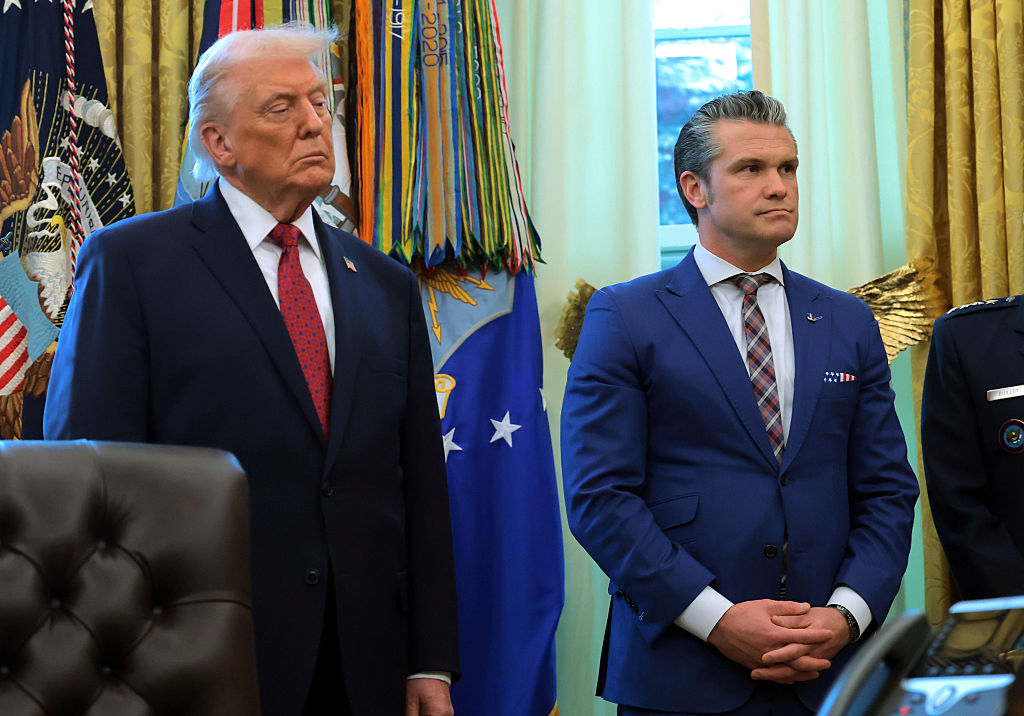
Donald Trump used to pose as an antiwar president. Yet as the United States asserts its control of its backyard, its government asserts an ever-more blatantly imperialist policy. (Anna Moneymaker / Getty Images)
In the depths of a winter night, US airborne forces scream over Caribbean waters. Jets rain fire on key infrastructure, while attack helicopters deliver raiding parties of special operatives to targets on the ground. Amid the spectacle of shock and awe, a president is kidnapped and indicted on drug-trafficking charges. It’s a key test case for how an ambitious Republican administration intends to handle an era of seismic change.
This was December 20, 1989; the operation in question was the ouster of strongman Panamanian leader and erstwhile CIA asset Manuel Noriega. But there’s an unmistakable parallel with Donald Trump’s kidnapping of Venezuelan president Nicolás Maduro and his wife. It illustrates everything that has changed, and stayed the same, in the three decades separating these two acts of aggression. The first occurred at the start of a new age of American hyperpower. The second is a symptom of that age’s chaotic and violent decline.
Two Abductions
George H. W. Bush’s deposition of Noriega signaled a new, post–Cold War age of American world-making. Within a few years, the United States let rip in the Persian Gulf (like Noriega, Iraq’s Saddam Hussein would quickly learn that serving US interests is no guarantee of protection), alongside new wars on three continents.
The collapse of the Soviet Union surely watered down the appeal of anti-communism as a rationale for constant warfare. But the War on Drugs had already been built up as a replacement justification for forever wars, devouring lives and resources on a global scale. Soviet retreat brought Latin America little peace from US militarism. If anything, the reverse was true, with Washington playing a key role in feeding Colombia’s civil war.
The region also provided a unique study in leftist resurgence during a period of neoliberal dominance. Venezuela’s barrios delivered Hugo Chávez to power in 1998 and a new, indigenous-led alliance brought Evo Morales and the Movement Toward Socialism (MAS) to power in Bolivia in 2005, in the continent’s so-called Pink Tide.
That project saw a revival at the start of the 2020s but has faced severe setbacks: the collapse of MAS rule in Bolivia; economic and political fragility in Venezuela producing one of the world’s largest displacement crises; and the victories of staunch Trump backers such as José Antonio Kast in Chile, Nayib Bukele in El Salvador, and Javier Milei in Argentina. US support is just one variable in these complex processes, but a significant one.
In this context, Trump’s attack on Venezuela looks like a fairly straightforward piece of imperial theater. The abduction of a president, smoke rising from ports, ships held in place, and the lack of likelihood of Venezuelan capability to retaliate even if its government holds firm, all bring succor to Washington’s reactionary friends and fear to its enemies.
This is part of what’s happening, but not all of it.
Circling the Wagons
In Colombian capital Bogotá two years ago, while researching US foreign policy in the region, I had a long conversation with a former immigration official.
While not necessarily an enthusiastic supporter of Gustavo Petro’s leftist administration, the official heralded a possible new era of strategic independence. The government had just refused a deportation flight returning Colombians accused of illegally entering the United States. While Bogotá was still cooperating with US attempts to prevent migration across the deadly Darien Gap at its Panama border, it was willing to show an independent streak.
When Trump took power, the limits of this approach were tested. Petro’s renewed attempt to refuse flights was quickly battered by punitive tariff threats. He appeared to have overplayed his hand, which undoubtedly informed the more cautious approach to handling Washington taken by Mexico’s president Claudia Sheinbaum.
This controversy reflects the extent to which immigration control has supplanted specters such as communism, drugs, and terror as the justification du jour for US warmongering. The Beltway foreign-policy industry’s lurid tales of a “narco-terrorism” spanning Hezbollah, drug gangs, and the Venezuelan state may have anchored Washington’s Caribbean buildup in recent months. But hawks’ attribution of blame to Caracas for irregular migrant flows has been central to selling war, both within the Trump administration and to the US public.
There is a strangely European air to all this. The claim that hostile actors are using migration as an undermining tactic has been central to developing a regime of militarized human rights abuses at the EU’s eastern borders. Meanwhile, impunity for lethal conduct at sea — as seen in US strikes on alleged drug boats — has echoes in European backing for militias that attack migrant boats and rescue ships, or attacks on vessels bringing aid to Palestine.
More directly, the United States is pursuing deportation deals with a variety of countries where European states have long been active, like Uganda, Kosovo, and Libya. But it’s now going further than Europe. After being forced to accept the return of a Salvadoran man illegally deported last spring, the United States has embarked on a spree of hyperactive deal-making with dozens of African countries, strong-arming some of the poorest places in the world into accepting ICE deportees.
This isn’t really about immigration numbers. None of these deals involve especially large numbers of deportees. Evidence suggests that Trump ignored warnings that US intervention in Venezuela is a driver of refugee arrivals at the southern border.
Nor is it solely about the appearance of being tough on migration, although this does play a role. Trump’s Africa strategy has been accompanied by broader weight-throwing in the region, from Christmas Day airstrikes in Nigeria to a fictive campaign against “white genocide” in South Africa. There is a strong correlation between countries where deportation arrangements (and presumably lucrative contracts for US carceral firms) have taken place, and where the United States has interests in critical minerals, as Washington overtakes Beijing in African investments. As Trump’s fixation with Venezuelan oil demonstrates, resource control remains fundamental.
The totemic focus on immigration reflects a more underlying evolution of US thinking. The vision of Washington as a guarantor of world order — so central to both liberal and conservative Cold War and War on Terror politics — no longer inspires at either the public or even the strategic level. It has been replaced with something far more parochial and defensive. External aggression is still painted as a threat, but it is sold primarily as a method of drawing higher walls around a fragile, threatened state.
This is not only about the border so much as a wider sense of strategic threat. Immigration control has become central because it is one of few points of foreign policy unity in a government that lacks a shared mental model for strategy and is lurching between different attempts to reconcile its fantastical ambitions and a striking reduction in its material capacities.
Strategic Ambiguity
Trump’s approach to international strategy seems to contain two key elements.
The first is an acceleration of a George W. Bush–era approach where small units of key personnel rush through legal, political, and military interventions while bypassing institutions. In the Venezuelan case, this has led to a series of extrajudicial executions on the high seas condemned as war crimes by a medley of officials.
The second is a dynamic redolent of kings who allowed courtiers to fight about strategy so that the best option could emerge through a form of Darwinian selection. In the Venezuelan case, this seems to have led to a confluence of interests emerging around a Caribbean center of gravity. Immigration hawks spied an opportunity to escalate mass deportations to a post-intervention Venezuela, oil watchers saw profit and energy security, and ideologues saw an opportunity to remove a long-standing thorn in their side. For Trump, it is a chance to do what Karl Rove might have called “making our own reality” — establishing circumstances where Washington does whatever, wherever, whenever it pleases.
A convenient concordance over Venezuela belies a deep disunity between camps. There remains a tendency that genuinely objects to “globalism” as a liberal conceit and shares some ground with the antiwar left in believing that putting “America First” means pulling back from “forever wars.” Other and larger camps are animated by a desire to focus on one particular area over another. The Latin America hawks, those staunchly obsessed with arming Israel and shredding Iran, and those who have clashed over Russia, policy are the most obvious examples. While his methods have frustrated administration insiders, Elbridge Colby has attempted to provide a bridging logic for internal compromises on Russia and the Middle East — a relentless focus on containing China.
Such zero-sum framing has intensified for a reason. In the waning days of Joe Biden’s administration, it became clear that simultaneous arming of Ukraine and Israel was stretching US military-industrial capacity to its limit, despite absurdly bloated military budgets. The rapid redeployment of the Gerald R. Ford, the world’s largest aircraft carrier, from the Middle East to the Caribbean last autumn underscores this impression of a flailing empire running from place to place putting out (or in reality, starting) fires.
So, too, does the United States’ willingness to tear up its traditional social-military contract with Europe, where it contributed disproportionately in return for European acceptance of its strategic priorities and dependence on its matériel.
This reckoning with shrinking power emerged during the Biden administration, in its attempt at a “foreign policy for the middle class” characterized by increased “friend-shoring” and industrial strategy (the inverse of Trump’s trade wars with allies) and in its chaotic Afghanistan drawdown.
A common critique of the attack on Venezuela is that the United States has given up on any pretense at maintaining the liberal world order. This is true but misses the point. That order, where the United States promises steadfast support for allies, economic aid when needed, and the maintenance of global financial and political architecture, in exchange for consent for its preeminence, is no longer structurally capable of existing.
The question is what comes next. The attack on Venezuela provides many of the answers.
When Empires End
While as a piece of operational art the attack superficially resembles the Panama invasion, its intellectual roots are closer to the unhinged Venezuela coup attempt undertaken by a collection of freelancers in 2020. It’s short-termist and haphazard. It doesn’t look especially “strategic” in the grand scheme of things — and that’s the point.
The Trump administration has found an answer to the problem of constraints on its global power, by “flooding the zone with sh-t”, as Steve Bannon called it. Like the prison guard in Michel Foucault’s Panopticon, Washington lacks the resources to lash out everywhere, but it might unpredictably lash out anywhere. Nigeria and Venezuela today; tomorrow, who knows? The message is: brace for more random kidnappings and bombings.
Much of US foreign policy can now be read as an attempt to manage decline through ambiguity and threats. Its unyielding fealty to Israel as that state trashes the foundations of international humanitarian law should be seen, at least partially, as a signal of commitment to clients elsewhere. Washington is intentionally flexing a lack of moral restraint. Its preoccupation with resources is nothing new, but in the context of climate stressors and new geoeconomic competitions, it is likely to take on more frenzied and existential dynamics. The beleaguered US economy’s Hail Mary on the AI revolution and the subordination of the state to millenarian tech oligarchs and the prison-military-border-industrial complex is almost certainly framing its carceral deportation deals in Africa, and probably much more.
Empires do not go gently into the good night. The European imperial age was cut decisively short by World War II–era destruction. Even then, its exit was decades-long, bloody, and in many places remains unresolved. It’s de rigueur among leftists to talk about the decline and fall of the US empire, but that decline is relative to others and descends from an age of historically unprecedented hyperpower. Even US strategic defeats such as Vietnam and Afghanistan shattered the countries they took place in.
Meanwhile, the United States does not exist in a vacuum. Clearly, Trump faces few internal constraints, and many of his opponents fall in line on foreign affairs. For all of Brussels’s carping, the EU cannot and will not exert a moderating influence. Among everyone else, this will inevitably strengthen the incentive for a cynical, Hobbesian view of international relations, where constant imitative displays of aggression and unpredictability are necessary for survival. Through the fires in Caracas, myriad bleak futures can be glimpsed.
Amid such bleakness, it’s worth mentioning something else that has happened in the United States in the last few days — new democratic-socialist local leaders like Zohran Mamdani and Katie Wilson taking office, based on stridently internationalist campaigns. In the United States and beyond, the forces of rampant militarism have attempted to insist that their destructive, nihilistic approach to the world is the only thing that can protect people at home in dangerous times. It will take locally rooted leadership with a firm grasp of the national and international dimensions to prove that the opposite is true, to provide better ways of navigating the world’s rapid and traumatic convulsions, and to imagine a different world order.