Turkey’s Brazil-Style Lawfare Means Harder Authoritarianism
In Brazil, the jailing of former president Luiz Inácio Lula da Silva served a far-right takeover. The Turkish government is following the same playbook as it stifles the opposition.
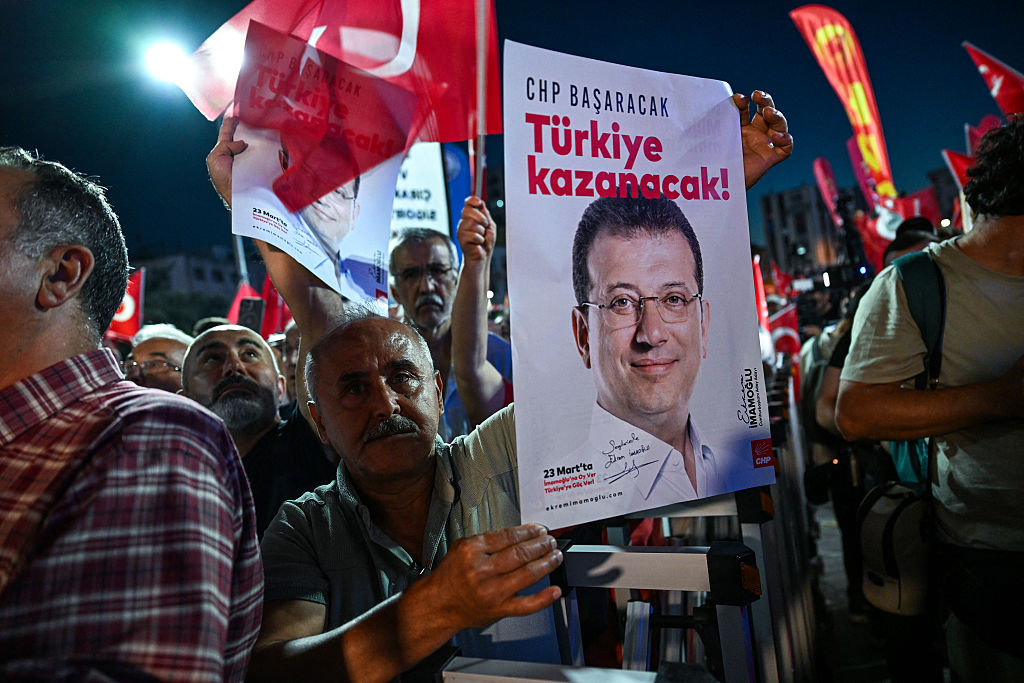
The Turkish government is making parallel use of repression and legal tactics to entrench its control. (Ozan Kose / AFP via Getty Images)
On December 17, a court struck down the protest bans imposed after the arrest of Istanbul mayor Ekrem İmamoğlu back in March. Weeks earlier, prosecutors had finalized an indictment meant to keep İmamoğlu, the leading opposition figure, jailed indefinitely. Together they show a system under strain, making parallel use of repression and legal tactics to entrench its control.
Turkey is now a frontline case of lawfare: the weaponized use of the judiciary to political ends. If the jailing of Brazil’s President Luiz Inácio Lula da Silva revealed the damage that lawfare can do to the democratic process, Turkey shows how far it can go in hardening authoritarian rule. Left unchecked, it will not remain an exception but set a precedent for attacks on democracy elsewhere.
The Lula blueprint is now being reproduced against İmamoğlu, the center-left challenger to President Recep Tayyip Erdoğan, in a harsher authoritarian setting. In today’s Turkey, lawfare has expanded beyond a way of managing the opposition into a means of recalibrating the state itself.
İmamoğlu is the presidential nominee for the Republican People’s Party (CHP), which after the 2024 local elections overtook Erdoğan’s Justice and Development Party (AKP) for the first time in decades. Throughout 2025, national polls placed İmamoğlu ahead of Erdoğan, making his party one of the largest center-left forces across Europe and the Middle East.
The severity of the shift from electoral competition to criminal prosecution is visible even outside the courtroom. Authorities have banned the display of İmamoğlu’s posters and the circulation of campaign materials, treating his visibility as a security risk.
Blueprint
Brazil’s Lava Jato investigation established the strategy for all this. Prosecutors placed Lula at the center of a schematic “criminal network,” and a coordinated media offensive branded him the “maximum leader” of a criminal organization, isolating him and barring his return to an election he was favored to win. Judge Sergio Moro led the charge against Lula — before himself joining Jair Bolsonaro’s far-right government.
Turkey has been replicating this almost line for line. On March 19, İmamoğlu was detained just after he became the CHP’s presidential nominee. One day earlier, his decades-old university diploma, constitutionally required for the presidency, was annulled, creating parallel disqualification channels through imprisonment and technical ineligibility. On March 23, a court ordered his pretrial detention, sending him to jail pending trial. In July, prosecutors escalated things further by opening a criminal case alleging his diploma was forged, turning a technical disqualification into a prosecutable offense.
As in Brazil, the target is both the candidate and the party. The ruling bloc is moving to judicially disable the CHP as it becomes capable of unseating a now twenty-two-year-old authoritarian government. This includes attempts to nullify the party congress that elected its new leader, Özgür Özel, who has openly called the crackdown a “coup.”
This mirrors Lava Jato’s effort to weaken the Workers’ Party’s organizational capacity ahead of elections. A parallel track weaponizes counterterrorism laws. Prosecutors accuse İmamoğlu and CHP officials of “aiding a terrorist organization” just because of their limited electoral coordination with the pro-Kurdish DEM Party in 2024. Even as the government advances a new “peace initiative,” it criminalizes the opposition for the same democratic contacts, seeking to sever potential Turkish-Kurdish opposition alliances and place the party under a permanent shadow of “terrorism.”
More than a dozen CHP mayors have been imprisoned, local governments placed under trusteeship, and the CHP’s Istanbul provincial headquarters has been besieged as court-appointed trustees moved in. In an offensive against opposition strongholds, coordinated operations against Istanbul Metropolitan Municipality and its subsidiaries have produced hundreds of detentions and arrests. As in Lava Jato, many cases rely on audited transactions, anonymous tips, “secret witnesses,” and pressured confessor testimony rather than material evidence, echoing Brazil’s “delação premiada” (plea bargain) system.
Indictment
The November 11 indictment runs to nearly 4,000 pages, names hundreds of defendants, and seeks up to 2,352 years in prison. Its sheer scale is itself a tool of political messaging, seeking to intimidate the opposition. The structure mirrors Lava Jato’s expansion strategy, widening the defendant network until the narrative of criminal collusion becomes unavoidable. It alleges a vast corruption scheme yet offers no clear financial trail or documented instructions tying İmamoğlu to specific acts. In the second half of 2025, prosecutors also layered on “political espionage” allegations, widening the case beyond corruption into a national security framing.
As in Brazil, the “etkin pişmanlık” (“effective remorse”) mechanism — a means of plea-based cooperation allowing suspects to reduce or avoid punishment in exchange for testimony — is used to generate witness evidence after the fact, shaping statements to fit a predesigned narrative. One emblematic figure in the broader file, businessman Aziz İhsan Aktaş, was first cast as central to an alleged criminal network — yet later flipped into a cooperating witness and released. It’s an echo of Lava Jato’s reliance on deal-driven testimony. According to a CHP report, municipal workers and private sector managers describe pressure to implicate senior officials in exchange for release, with claims often resting on hearsay.
Judicial consolidation in Turkey mirrors Brazil. Much as Lula’s cases were removed from their natural jurisdictions and concentrated in the city of Curitiba, İmamoğlu’s files have been centralized under the Istanbul Chief Public Prosecutor’s Office. The judicial leadership is likewise politically entangled, with chief prosecutor, Akın Gürlek, previously having served as deputy justice minister. His career has been built through high-profile political trials, including sentencing the imprisoned Kurdish leader Selahattin Demirtaş, targeting academics and journalists, and refusing to implement a Constitutional Court ruling. After the indictment, Gürlek launched a media campaign reminiscent of Lava Jato theatrics, portraying the alleged network as an “octopus,” highlighting an “informant breakthrough,” and framing the case as a historic anti-corruption effort. Pro-government media routinely shares selective leaks and schematic diagrams, presenting İmamoğlu as the head of a vast corruption network, reproducing the spectacle that defined Lava Jato.
There have been some expressions of international solidarity, with statements from the Socialist International, the European alliance of social democratic parties, and Spain’s ruling Socialist Party, alongside a growing “Free İmamoğlu” campaign. Governmental reactions, however, have been largely muted. The British government has remained silent, prompting CHP leader Özel to accuse Labour prime minister Keir Starmer of betraying the social democratic cause.
The European Union, which relies on Erdoğan for both security and controlling migration, has limited itself to cautious language. In the United States, official responses have tilted toward accommodation, with senior envoys’ remarks described by the CHP leader as tacit American approval. İmamoğlu’s X accounts have been suspended, illustrating how authoritarian repression also increasingly relies on cooperation from global tech companies. These treatments form part of the imperial ecosystem that normalizes lawfare, much as it did during Lava Jato.
Protests
Still, Turks have not remained silent. İmamoğlu’s arrest in March also triggered the largest demonstrations since the 2013 Gezi uprising. Protests spread across major cities, followed by mass repression, detentions, and blanket bans on assembly. Hundreds were pushed into fast-track mass trials for allegedly joining banned demonstrations, with cases stretching on for months. Turkish courts also issued sweeping orders to block hundreds of social media accounts. Yet months later, on December 17, an Istanbul court ruled those protest bans unlawful. This ruling certainly functioned as damage containment, managing the blowback of an expansive intervention.
However, this lawfare has also converged with an open debate in Erdoğan’s camp over constitutional overhaul and extending his rule beyond established term limits. Lawfare is no longer just aimed at neutralizing opponents but is extended to redesigning institutions, disciplining elite networks, and narrowing the field of permissible politics. It has all the trappings of a purge of the state. This logic has pushed legal pressure beyond the opposition into media, business networks, cultural sectors, professional sports, and security-related domains, spreading uncertainty inside the regime’s own ecosystem and generating friction between different power circles. Even its soft-power apparatus was reshuffled in 2025. Erdoğan replaced communications chief Fahrettin Altun, central to the government’s propaganda and “disinformation” drive, and later removed Ali Erbaş from Turkey’s Directorate of Religious Affairs, the state body that supervises religious life and reinforces social control.
These dynamics have also coincided with succession talks and related disputes within the ruling camp. In Ankara, there are tense discussions around both dynastic continuity — the prospect of Erdoğan being succeeded by his son Bilal — and the Kurdish peace process. Ironically, whereas President Erdoğan has made only calibrated openings on the Kurdish question, in order to ward off electoral risks, his nationalist partner Devlet Bahçeli seems more invested in pushing the process, in the interest of stabilizing the state.
Seen in this light, the December 17 ruling declaring the protest bans unlawful carries a second meaning, alongside simple damage control. It can be read as a symptom of internal conflict within a fragmented governing apparatus, where courts and prosecutors put constraints on rival power centers without breaking from the overall strategy.
It also serves a signaling function, as an indirect battlefield of power struggles within the regime. In this sense, judicial processes can become sites of a legal-institutional factional conflict, through which competing factions seek to discipline one another, undermine rival power centers, and push back against the expansion of coercive campaigns by other actors. They do not mitigate lawfare but help explain the form it can take as a tool of multiple political battles in an authoritarian setting.
What is unfolding around the CHP and İmamoğlu is not, therefore, simply a specific act of interference in the electoral process but a use of lawfare in the wider process of reordering the state. If Lula’s case revealed the early mechanics of autocratic legalism, Turkey shows how this model can now advance in a hypercentralized presidential system, with higher stakes, fewer constraints, and far less room for reversal. The İmamoğlu case is not just about blocking one candidate but about adapting lawfare to a higher-speed authoritarianism.
Turkey has long been a laboratory for the authoritarian right. With this country’s scale and geostrategic leverage, the precedent set here will travel far. For anyone serious about confronting the global authoritarian right, this is not a story to observe from afar but a fight that will shape the prospects for democratic and progressive forces worldwide, much like the Lula case did in Brazil. This is why the case demands sustained international attention.