Corporations Are Ready to Cash In on Venezuela

Before Donald Trump’s capture of Nicolás Maduro, corporations filed lawsuits against Venezuela seeking damages tied to state nationalization, international sanctions, and political instability. A Trump-installed government could tilt the courts in their favor.
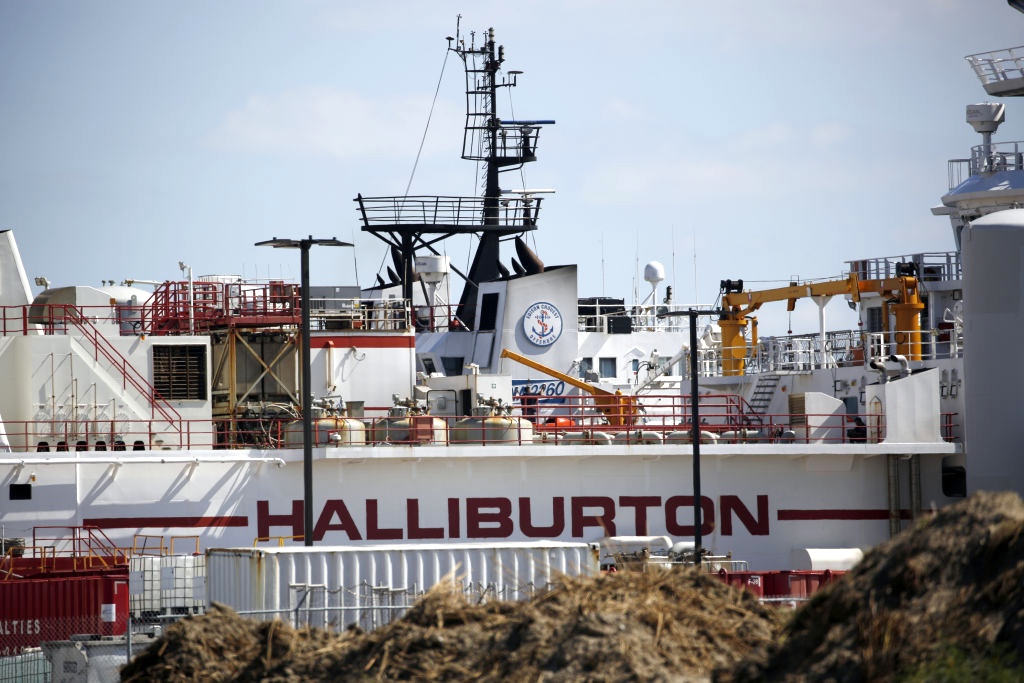
Companies with pending claims could be among the first in line to receive a windfall from a new Trump-installed Venezuelan government that is willing to funnel the South American country’s cash to corporate plaintiffs. (Luke Sharrett / Bloomberg via Getty Images)

Just weeks before the American military operation in Venezuela to capture President Nicolás Maduro, the US energy giant Halliburton filed an unusual lawsuit in international court claiming the Venezuelan government owed them damages for US sanctions against the country.

A separate case against Venezuela is also being pursued by another fossil fuel giant whose board includes an oil magnate whose family has delivered large financial contributions to Republicans and conservative causes. One family member poured tens of thousands of dollars into a political committee focused on reelecting President Donald Trump in 2024.

Such companies with pending claims could now be among the first in line to receive a massive windfall from a new Trump-installed Venezuelan government that is willing to funnel the South American country’s cash to corporate plaintiffs.

Shortly after the US military operation on January 3, Trump declared that the United States would “run” Venezuela, along with making investments in the country’s oil and gas infrastructure and selling state-run oil assets. Venezuela is home to the largest oil reserves in the world, representing about 17 percent of the world’s global supply, though much of the country’s reserves remain untapped.

In all, Venezuela is facing nine pending cases launched by investors and major corporations alleging financial damages related to the country’s nationalization of state industries, international sanctions, and political instability. The country has settled dozens more in recent decades.

These cases are arbitrated within the World Bank’s International Centre for Settlement of Investment Disputes, a governing body that has been widely criticized for prioritizing investors’ interests over those of sovereign states, and particularly those of developing nations. In 17 percent of such cases, the host country has been forced to settle.

A US-backed Venezuelan government could settle those cases or fail to adequately argue their side in court, using Venezuela’s resources to award companies with hundreds of millions in damages.

Halliburton’s case seeks damages for the roughly $200 million in losses it allegedly incurred between 2016 and 2020 as it began to cease operations in the country to comply with the US sanctions first imposed in 2005 and escalated in 2017 and 2020. But Halliburton is blaming Venezuela’s domestic instability for those losses and demanding the country now pay up.

Such a legal argument is reportedly rare in arbitration courts, and some financial analysts argued the move indicated that Halliburton potentially expected a military operation in Venezuela to install a more friendly government willing to cut a deal to make them whole. GOP allies have directly cited Halliburton as one of the energy companies that could invest in Venezuela to “rebuild their country” after regime change, as Trump’s former US secretary of state Mike Pompeo told Fox News in December.

In a separate case filed in the World Bank’s arbitration courts, natural gas conglomerate the Williams Companies is seeking damages over a disputed contract and Venezuela’s nationalization of fossil fuel infrastructure in the early 2000s.

Williams’s board includes Scott Sheffield, whose family has donated more than $6 million over the last fifteen years, mostly to conservative causes and Republican candidates. That includes $165,200 worth of donations in 2024 from Sheffield’s son Bryan to the Republican National Committee, according to Federal Election Commission data compiled by the watchdog group Public Citizen. Those donations were earmarked for the “Trump 47 Committee,” a joint fundraising committee to support Trump’s 2024 campaign.

Other companies with pending cases against Venezuela for nationalizing their assets and causing other business disruptions include the food giant Kellogg’s, the cement and construction firm Holcim Group, packaging conglomerate Smurfit, and Gold Reserve, a mining conglomerate whose largest investors include a trio of US investment firms.

The Irish company Smurfit, which is publicly traded on the New York Stock Exchange, won a $469 million arbitration case against Venezuela last year over the company’s 2018 seizure of its assets in the country and has since filed for additional damages.

For years, US and other Western firms have sued the Venezuelan government in international arbitration courts for expropriated property and unpaid debts.

In 2019, the US oil and gas giant ConocoPhillips won nearly $9 billion in the World Bank’s arbitration court after Venezuela’s former president, Hugo Chávez, nationalized the company’s oil assets nearly eighteen years earlier. And in 2021, Koch Industries won a $444 million case against the country for the expropriation of its fertilizer business by Chávez in 2010.

Halliburton’s arbitration case, however, involves a different argument. The company’s exit from the market was the direct result of US sanctions imposed on Venezuela in 2017 and 2020, not state nationalization. According to the Global Arbitration Review’s summary of the filing, Halliburton blames both US sanctions and Venezuelan policy failures for the financial losses it incurred but is suing only Venezuela for damages.

“Halliburton also notes that changes in the Venezuelan government’s exchange rate and U.S. sanctions further complicated the viability of its operations in the country,” reads the review of the legal brief. Although Venezuela withdrew from the international treaty that enforces the World Bank’s arbitration rules in 2012, the country has still been forced to participate in these cases and abide by the court’s rulings.

An energy service company, Halliburton operates oil drilling infrastructure around the world, including the Deepwater Horizon offshore drilling rig that led to the fatal and environmentally catastrophic 2010 Gulf of Mexico oil spill. Since the 1940s, the company has been involved in extracting Venezuela’s massive oil reserves.

Halliburton has previously benefited from US regime-change efforts. In 2003, Vice President Dick Cheney, the company’s former CEO, helped launch the Iraq War. After the country’s military-backed regime change, Cheney’s onetime employer secured lucrative contracts with the new US occupying force to administer the country’s energy production.